



 Chat with AI
Exam 15: Conjugated Systems, Orbital Symmetry, and Ultraviolet Spectroscopy

Exam 1: Introduction and Review127 Questions
Exam 2: Structure and Properties of Organic Molecules129 Questions
Exam 3: Structure and Stereochemistry of Alkanes129 Questions
Exam 4: The Study of Chemical Reactions128 Questions
Exam 5: Stereochemistry128 Questions
Exam 6: Alkyl Halides: Nucleophilic Substitution and Elimination132 Questions
Exam 7: Structure and Synthesis of Alkenes128 Questions
Exam 8: Reactions of Alkenes132 Questions
Exam 9: Alkynes124 Questions
Exam 10: Structure and Synthesis of Alcohols132 Questions
Exam 11: Reactions of Alcohols124 Questions
Exam 12: Infrared Spectroscopy and Mass Spectrometry120 Questions
Exam 13: Nuclear Magnetic Resonance Spectroscopy130 Questions
Exam 14: Ethers, Epoxides, and Thioethers127 Questions
Exam 15: Conjugated Systems, Orbital Symmetry, and Ultraviolet Spectroscopy130 Questions
Exam 16: Aromatic Compounds128 Questions
Exam 17: Reactions of Aromatic Compounds129 Questions
Exam 18: Ketones and Aldehydes132 Questions
Exam 19: Amines129 Questions
Exam 20: Carboxylic Acids125 Questions
Exam 21: Carboxylic Acid Derivatives128 Questions
Exam 22: Condensations and Alpha Substitutions of Carboxyl Compounds125 Questions
Exam 23: Carbohydrates and Nucleic Acids125 Questions
Exam 24: Amino Acids, Peptides, and Proteins127 Questions
Exam 25: Lipids127 Questions
Exam 26: Synthetic Polymers128 Questions
Select questions type


Including all possible stereoisomeric forms, how many distinct allylic bromides could be produced when 2-methylpent-1-ene is treated with NBS under irradiation by a sunlamp?
(Multiple Choice)
4.8/5  (60)
(60) Which of the following terms best describes a Diels-Alder reaction?
(Multiple Choice)
4.9/5 (91)
(91) Which has a lmax in its UV spectrum at a longer wavelength, 2,4-hexadiene, 1,4-hexadiene, or 1,5-hexadiene?
(Short Answer)
4.8/5 (74)
(74) 
Provide the structure of the major organic product in the following reaction. 
(Essay)
4.9/5 (75)
(75) Draw the structure of the major product which results when the diene shown is treated with HBr at -80°C. 
(Essay)
4.8/5 (86)
(86) Provide the structure of the major organic product in the following reaction. 
(Essay)
4.8/5 (73)
(73) Provide the structure of the major organic product in the following reaction. 
(Essay)
4.9/5 (82)
(82) Provide the structure of the major organic product in the following reaction. 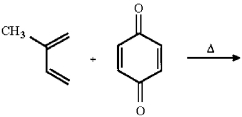
(Essay)
4.7/5 (68)
(68) When 1-methylcyclohex-2-en-1-ol is treated with HBr, two constitutionally isomeric bromides are produced. Provide a detailed, stepwise mechanism which explains this observation.
(Essay)
4.8/5 (85)
(85) Give a representation of the highest occupied π MO of 1,3-butadiene in its ground state.
(Essay)
4.9/5 (99)
(99) The following [3+2] cycloaddition was reported in Organic Letters, 2011, 402. Predict whether the reaction would be thermally or photochemically promoted. Justify your answer by showing overlap of the correct molecular orbitals. Assume the alkene is the electrophile. 
(Essay)
4.9/5 (82)
(82) What diene and dienophile are used in the Diels-Alder route to the compound shown? 
(Essay)
4.8/5 (85)
(85) When the relative energies of the s-cis and s-trans conformers of 1,3-butadiene are compared, one finds that:
(Multiple Choice)
4.8/5 (82)
(82) The Diels-Alder reaction is a concerted reaction; this means :
(Multiple Choice)
4.9/5 (95)
(95) In the UV-visible spectrum of (E)-1,3,5-hexatriene, the lowest energy absorption corresponds to a:
(Multiple Choice)
4.8/5 (74)
(74) Provide the structure of the major organic product in the following reaction. 
(Essay)
4.8/5 (94)
(94) Show how the carbon p orbitals overlap to form the LUMO of the allyl anion.
(Essay)
4.9/5 (67)
(67) 
Filters
- Essay(0)
- Multiple Choice(0)
- Short Answer(0)
- True False(0)
- Matching(0)