



 Chat with AI
Exam 15: Conjugated Systems, Orbital Symmetry, and Ultraviolet Spectroscopy

Exam 1: Introduction and Review127 Questions
Exam 2: Structure and Properties of Organic Molecules129 Questions
Exam 3: Structure and Stereochemistry of Alkanes129 Questions
Exam 4: The Study of Chemical Reactions128 Questions
Exam 5: Stereochemistry128 Questions
Exam 6: Alkyl Halides: Nucleophilic Substitution and Elimination132 Questions
Exam 7: Structure and Synthesis of Alkenes128 Questions
Exam 8: Reactions of Alkenes132 Questions
Exam 9: Alkynes124 Questions
Exam 10: Structure and Synthesis of Alcohols132 Questions
Exam 11: Reactions of Alcohols124 Questions
Exam 12: Infrared Spectroscopy and Mass Spectrometry120 Questions
Exam 13: Nuclear Magnetic Resonance Spectroscopy130 Questions
Exam 14: Ethers, Epoxides, and Thioethers127 Questions
Exam 15: Conjugated Systems, Orbital Symmetry, and Ultraviolet Spectroscopy130 Questions
Exam 16: Aromatic Compounds128 Questions
Exam 17: Reactions of Aromatic Compounds129 Questions
Exam 18: Ketones and Aldehydes132 Questions
Exam 19: Amines129 Questions
Exam 20: Carboxylic Acids125 Questions
Exam 21: Carboxylic Acid Derivatives128 Questions
Exam 22: Condensations and Alpha Substitutions of Carboxyl Compounds125 Questions
Exam 23: Carbohydrates and Nucleic Acids125 Questions
Exam 24: Amino Acids, Peptides, and Proteins127 Questions
Exam 25: Lipids127 Questions
Exam 26: Synthetic Polymers128 Questions
Select questions type


How many electrons are present in the nonbonding π molecular orbital of the allyl cation?
(Multiple Choice)
4.9/5  (78)
(78) Which sequence correctly ranks the following dienes in order of increasing reactivity in the Diels-Alder reaction? 
(Multiple Choice)
4.8/5 (79)
(79) What is the hybridization of the central carbon of allene (1,2-propadiene)?
(Multiple Choice)
4.9/5 (82)
(82) Is the thermal [4+2] cycloaddition between allyl anion and ethylene an allowed one? To answer, draw the HOMO of allyl anion and the LUMO of ethylene, and comment on the symmetry match of the two.
(Essay)
4.9/5 (65)
(65) According to the 1,3-butadiene structure below, which positions would be best to place methoxy groups to yield the most reactive dimethoxy-1,3-butadiene isomer in the Diels-Alder reaction? 
(Multiple Choice)
4.8/5 (72)
(72) 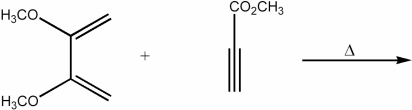
Provide the structure of the major organic product in the following reaction. 
(Essay)
4.8/5 (91)
(91) 
Provide the structure of the major organic product in the following reaction. 
(Essay)
4.8/5 (81)
(81) 
Consider the possible thermal [4+4] cycloaddition of two molecules of 1,3-butadiene to generate cycloocta-1,5-diene. Show the HOMO/LUMO interaction which would result, and use this interaction to predict whether the proposed cycloaddition could occur.
(Essay)
4.9/5 (64)
(64) Show how the carbon p orbitals overlap to form the lowest energy π molecular orbital of 1,3-butadiene.
(Essay)
4.9/5 (73)
(73) Provide the structure of the major product which results from 1,4-addition of Br2 to the diene shown below. 
(Essay)
4.7/5 (68)
(68) The following Diels-Alder reaction was featured in Tet. Lett. 2011, 960. Predict the structure of the starting materials. 
(Essay)
4.8/5 (85)
(85) Which sequence correctly ranks the following conjugated systems in order of increasing UV 8max absorption values? 
(Multiple Choice)
4.8/5 (78)
(78) 
Filters
- Essay(0)
- Multiple Choice(0)
- Short Answer(0)
- True False(0)
- Matching(0)