



 Chat with AI
Exam 15: Conjugated Systems, Orbital Symmetry, and Ultraviolet Spectroscopy

Exam 1: Introduction and Review127 Questions
Exam 2: Structure and Properties of Organic Molecules129 Questions
Exam 3: Structure and Stereochemistry of Alkanes129 Questions
Exam 4: The Study of Chemical Reactions128 Questions
Exam 5: Stereochemistry128 Questions
Exam 6: Alkyl Halides: Nucleophilic Substitution and Elimination132 Questions
Exam 7: Structure and Synthesis of Alkenes128 Questions
Exam 8: Reactions of Alkenes132 Questions
Exam 9: Alkynes124 Questions
Exam 10: Structure and Synthesis of Alcohols132 Questions
Exam 11: Reactions of Alcohols124 Questions
Exam 12: Infrared Spectroscopy and Mass Spectrometry120 Questions
Exam 13: Nuclear Magnetic Resonance Spectroscopy130 Questions
Exam 14: Ethers, Epoxides, and Thioethers127 Questions
Exam 15: Conjugated Systems, Orbital Symmetry, and Ultraviolet Spectroscopy130 Questions
Exam 16: Aromatic Compounds128 Questions
Exam 17: Reactions of Aromatic Compounds129 Questions
Exam 18: Ketones and Aldehydes132 Questions
Exam 19: Amines129 Questions
Exam 20: Carboxylic Acids125 Questions
Exam 21: Carboxylic Acid Derivatives128 Questions
Exam 22: Condensations and Alpha Substitutions of Carboxyl Compounds125 Questions
Exam 23: Carbohydrates and Nucleic Acids125 Questions
Exam 24: Amino Acids, Peptides, and Proteins127 Questions
Exam 25: Lipids127 Questions
Exam 26: Synthetic Polymers128 Questions
Select questions type


Draw the structure of the major product which results when the diene shown is treated with HBr at 40°C. 
(Essay)
4.8/5  (66)
(66) When 3-bromo-1-methylcyclohexene is heated in a good ionizing solvent, reactions occur through a carbocation intermediate. Draw all reasonable resonance contributors of this cation and indicate which is the major contributor.
(Essay)
4.8/5 (86)
(86) Which of the following compounds is the most reactive dienophile in a Diels-Alder reaction with 1,3-butadiene?
(Multiple Choice)
4.8/5 (65)
(65) Provide the structure of the major organic product in the following reaction. 
(Essay)
4.9/5 (77)
(77) How many nodes, other than the node coincident with the molecular plane, are present in the HOMO of 1,3,5-hexatriene?
(Multiple Choice)
4.9/5 (76)
(76) 
When (S)-3-bromopent-1-ene is heated in water, which of the following compounds is not produced?
(Multiple Choice)
4.9/5 (74)
(74) In the planar conformation of 1,3-butadiene, the electron density in the π-system is ________ over the entire molecule.
(Short Answer)
4.8/5 (83)
(83) Indicate whether the following cyclization, conducted under thermal conditions, is symmetry allowed. Justify your answer by showing whether the overlapping orbitals in the transition state generate a symmetry-allowed or symmetry-forbidden scenario. Treat ethylene as the nucleophile. 
(Essay)
4.9/5 (83)
(83) Provide the structure of the major product which results from 1,2-addition of HBr to the diene shown below. 
(Essay)
4.8/5 (89)
(89) When 1 mole of anhydrous HCl is reacted with excess 1,3-pentadiene, both the 1,2 and the 1,4-addition products are formed. Which of the following structures shown below is the least likely to be one of these products? (Note: When a chiral carbon is formed in this reaction a racemic mixture results, only one of the two possible enantiomers is shown.)
(Multiple Choice)
4.9/5 (73)
(73) Which diene reacts more rapidly in Diels-Alder reactions, cyclopentadiene or 1,3-butadiene? Briefly explain your choice.
(Essay)
4.8/5 (98)
(98) What name is given to the type of "control" which arises in a reaction which does not achieve equilibrium and in which the product distribution is determined by the relative activation energies of the pathways which produced them?
(Short Answer)
4.9/5 (86)
(86) Provide the structure of the major organic product in the following reaction. 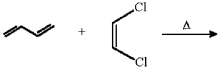
(Essay)
4.9/5 (72)
(72) In the addition of HBr to conjugated dienes, is the product which results from 1,2-addition or that which results from 1,4-addition typically the product of kinetic control?
(Essay)
4.9/5 (85)
(85) Which of the following alkyl halides yields the most stable carbocation intermediate during solvolysis in hot ethanol?
(Multiple Choice)
4.8/5 (87)
(87) 
Filters
- Essay(0)
- Multiple Choice(0)
- Short Answer(0)
- True False(0)
- Matching(0)