



 Chat with AI
Exam 6: Alkyl Halides: Nucleophilic Substitution and Elimination

Exam 1: Introduction and Review127 Questions
Exam 2: Structure and Properties of Organic Molecules129 Questions
Exam 3: Structure and Stereochemistry of Alkanes129 Questions
Exam 4: The Study of Chemical Reactions128 Questions
Exam 5: Stereochemistry128 Questions
Exam 6: Alkyl Halides: Nucleophilic Substitution and Elimination132 Questions
Exam 7: Structure and Synthesis of Alkenes128 Questions
Exam 8: Reactions of Alkenes132 Questions
Exam 9: Alkynes124 Questions
Exam 10: Structure and Synthesis of Alcohols132 Questions
Exam 11: Reactions of Alcohols124 Questions
Exam 12: Infrared Spectroscopy and Mass Spectrometry120 Questions
Exam 13: Nuclear Magnetic Resonance Spectroscopy130 Questions
Exam 14: Ethers, Epoxides, and Thioethers127 Questions
Exam 15: Conjugated Systems, Orbital Symmetry, and Ultraviolet Spectroscopy130 Questions
Exam 16: Aromatic Compounds128 Questions
Exam 17: Reactions of Aromatic Compounds129 Questions
Exam 18: Ketones and Aldehydes132 Questions
Exam 19: Amines129 Questions
Exam 20: Carboxylic Acids125 Questions
Exam 21: Carboxylic Acid Derivatives128 Questions
Exam 22: Condensations and Alpha Substitutions of Carboxyl Compounds125 Questions
Exam 23: Carbohydrates and Nucleic Acids125 Questions
Exam 24: Amino Acids, Peptides, and Proteins127 Questions
Exam 25: Lipids127 Questions
Exam 26: Synthetic Polymers128 Questions
Select questions type


Provide the structure of the major organic product which results in the following reaction. 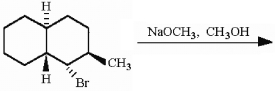
(Essay)
4.9/5  (72)
(72) Which of the following mechanisms (SN1, SN2, E1, E2) feature(s) a carbocation intermediate?
(Multiple Choice)
4.9/5 (79)
(79) Which of the following factors is favorable for nucleophilicity but not basicity?
(Multiple Choice)
4.7/5 (72)
(72) Provide circumstances under which solvolysis of a chiral alkyl halide would not result in the generation of a mixture of enantiomeric products.
(Essay)
4.9/5 (60)
(60) When (cis)-1-bromo-2 methylcyclohexane is treated with methanol and heat, four different products are formed - two by substitution and two by elimination. 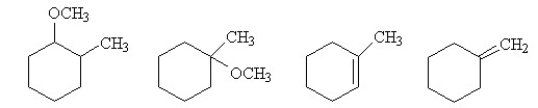 Which of the following conditions would change the outcome of this reaction by promoting the production of 3-methylhexene as the major product?
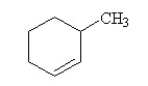
Which of the following conditions would change the outcome of this reaction by promoting the production of 3-methylhexene as the major product? (Multiple Choice)
4.8/5 (75)
(75) Which of the following alkyl halides reacts most rapidly via an SN2 reaction with NaCN?
(Multiple Choice)
4.7/5 (72)
(72) Which of the cations below would be subject to a structural rearrangement? 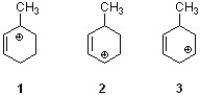
(Multiple Choice)
4.9/5 (83)
(83) A sample of 1-chloro-1-phenylethane with an [α]25D of -94.8∘ is reacted with NH3 in methanol/water solvent. The major substitution product of the reaction is 1-phenyl-1-ethylamine with an [α]25D of -8.6∘. Given that optically pure (R) 1-chloro-1-phenylethane has a specific rotation of -109.0∘ and that optically pure (R) 1-phenyl-1-ethylamine has a specific rotation of +39.3∘, which of the following statements best describes this reaction? 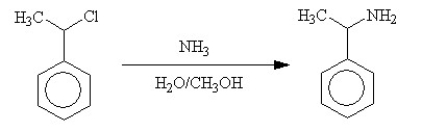
(Multiple Choice)
4.7/5 (87)
(87) Name one factor that is favorable for nucleophilicity but not for basicity.
(Short Answer)
4.8/5 (82)
(82) How many distinct alkene products are possible when the alkyl iodide below undergoes E2 elimination? 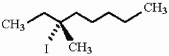
(Multiple Choice)
4.9/5 (92)
(92) Which of the following alkyl halides can produce only a single alkene product from when treated with sodium methoxide?
(Multiple Choice)
4.8/5 (74)
(74) Provide the structure of the major organic product in the following reaction. 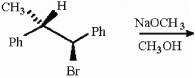
(Essay)
4.9/5 (86)
(86) When 3-iodo-3-ethylpentane is heated in methanol, the major organic product is an ________ that is generated through an ________ mechanism.
(Multiple Choice)
4.9/5 (74)
(74) 

When 1-iodo-1-methylcyclohexane is treated with NaOCH2CH3 the more highly substituted alkene product predominates. When KOC(CH3)3 is used instead, the less highly substituted alkene product predominates. Offer an explanation.
(Essay)
4.9/5 (66)
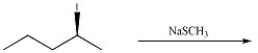
(66) 

Filters
- Essay(0)
- Multiple Choice(0)
- Short Answer(0)
- True False(0)
- Matching(0)