



 Chat with AI
Exam 6: Alkyl Halides: Nucleophilic Substitution and Elimination

Exam 1: Introduction and Review127 Questions
Exam 2: Structure and Properties of Organic Molecules129 Questions
Exam 3: Structure and Stereochemistry of Alkanes129 Questions
Exam 4: The Study of Chemical Reactions128 Questions
Exam 5: Stereochemistry128 Questions
Exam 6: Alkyl Halides: Nucleophilic Substitution and Elimination132 Questions
Exam 7: Structure and Synthesis of Alkenes128 Questions
Exam 8: Reactions of Alkenes132 Questions
Exam 9: Alkynes124 Questions
Exam 10: Structure and Synthesis of Alcohols132 Questions
Exam 11: Reactions of Alcohols124 Questions
Exam 12: Infrared Spectroscopy and Mass Spectrometry120 Questions
Exam 13: Nuclear Magnetic Resonance Spectroscopy130 Questions
Exam 14: Ethers, Epoxides, and Thioethers127 Questions
Exam 15: Conjugated Systems, Orbital Symmetry, and Ultraviolet Spectroscopy130 Questions
Exam 16: Aromatic Compounds128 Questions
Exam 17: Reactions of Aromatic Compounds129 Questions
Exam 18: Ketones and Aldehydes132 Questions
Exam 19: Amines129 Questions
Exam 20: Carboxylic Acids125 Questions
Exam 21: Carboxylic Acid Derivatives128 Questions
Exam 22: Condensations and Alpha Substitutions of Carboxyl Compounds125 Questions
Exam 23: Carbohydrates and Nucleic Acids125 Questions
Exam 24: Amino Acids, Peptides, and Proteins127 Questions
Exam 25: Lipids127 Questions
Exam 26: Synthetic Polymers128 Questions
Select questions type


Which of the following compounds will undergo an SN2 reaction most readily?
(Multiple Choice)
5.0/5  (70)
(70) Predict the two most likely mechanisms for the reaction of 2-iodohexane with sodium ethoxide.
(Multiple Choice)
4.8/5 (68)
(68) Provide the structure of the major alkene product of the reaction below. 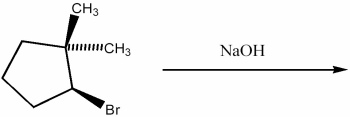
(Essay)
4.8/5 (85)
(85) List the following bromides in order of their increasing reactivity as substrates in SN1 reactions: 1-iodo-1-ethylcyclopentane, chlorocyclopentane, and iodocyclopentane.
(Essay)
4.9/5 (82)
(82) If the absolute configuration at an asymmetric carbon does not change during the course of a reaction, the reaction is said to occur with ________ of stereochemistry.
(Short Answer)
4.8/5 (88)
(88) When water is shaken with dichloromethane, a two-phase system results. Which compound forms the upper phase? Explain.
(Essay)
4.8/5 (78)
(78) When 1-bromo-2, 2-dimethylcyclopentane is heated in ethanol, one of the products which results is shown below. Provide a detailed, stepwise mechanism for the production of this compound, and give the name of the mechanism by which it is produced. 
(Essay)
4.9/5 (85)
(85) Which of the following best describes the carbon-chlorine bond of an alkyl chloride?
(Multiple Choice)
4.8/5 (81)
(81) Provide the major organic product of the reaction below and a detailed, stepwise mechanism which accounts for its formation. 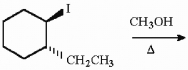
(Essay)
5.0/5 (92)
(92) Provide a structure for the major substitution and elimination product of the following reaction. 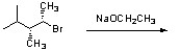
(Essay)
4.8/5 (84)
(84) Arrange the following alkyl halides in order of increasing boiling point:
CH3CH2Br, CH3CH2CH2Br, (CH3)2CHBr, CH3CH2F.
(Essay)
4.8/5 (85)
(85) When t-butyl chloride undergoes solvolysis in a solvent mixture composed of 70% water/30% acetone, the reaction rate is slower than when the same compound is solvolyzed in 80% water/20% acetone. Explain.
(Essay)
4.8/5 (86)
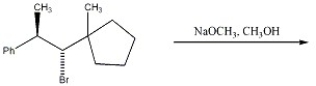
(86) 
List the following compounds in order of increasing reactivity in an SN1 reaction.
CH3Br, CH3CH2CH2I, (CH3)3CI, CH3CHBrCH3, CH3CHICH3
(Essay)
5.0/5 (82)
(82) 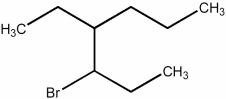
Provide a step-by-step mechanism for the reaction below. Include all intermediates, formal charges and correct arrow pushing of electrons. 
(Essay)
4.8/5 (81)
(81) Why does CH2=CHCHBrCH3 undergo solvolysis much more rapidly than 2-bromobutane?
(Essay)
4.8/5 (75)
(75) 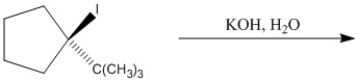
Which of the following statements correctly describe(s) E1 reactions of alkyl halides (RX)?
I. Rate = k[base]
II. Rate = k[base][RX]
III. Rate = k[RX]
IV. The reactions occur in two or more distinct steps.
V. Rearrangements are sometimes seen.
(Multiple Choice)
4.9/5 (73)
(73) 
Filters
- Essay(0)
- Multiple Choice(0)
- Short Answer(0)
- True False(0)
- Matching(0)