



 Chat with AI
Exam 6: Alkyl Halides: Nucleophilic Substitution and Elimination

Exam 1: Introduction and Review127 Questions
Exam 2: Structure and Properties of Organic Molecules129 Questions
Exam 3: Structure and Stereochemistry of Alkanes129 Questions
Exam 4: The Study of Chemical Reactions128 Questions
Exam 5: Stereochemistry128 Questions
Exam 6: Alkyl Halides: Nucleophilic Substitution and Elimination132 Questions
Exam 7: Structure and Synthesis of Alkenes128 Questions
Exam 8: Reactions of Alkenes132 Questions
Exam 9: Alkynes124 Questions
Exam 10: Structure and Synthesis of Alcohols132 Questions
Exam 11: Reactions of Alcohols124 Questions
Exam 12: Infrared Spectroscopy and Mass Spectrometry120 Questions
Exam 13: Nuclear Magnetic Resonance Spectroscopy130 Questions
Exam 14: Ethers, Epoxides, and Thioethers127 Questions
Exam 15: Conjugated Systems, Orbital Symmetry, and Ultraviolet Spectroscopy130 Questions
Exam 16: Aromatic Compounds128 Questions
Exam 17: Reactions of Aromatic Compounds129 Questions
Exam 18: Ketones and Aldehydes132 Questions
Exam 19: Amines129 Questions
Exam 20: Carboxylic Acids125 Questions
Exam 21: Carboxylic Acid Derivatives128 Questions
Exam 22: Condensations and Alpha Substitutions of Carboxyl Compounds125 Questions
Exam 23: Carbohydrates and Nucleic Acids125 Questions
Exam 24: Amino Acids, Peptides, and Proteins127 Questions
Exam 25: Lipids127 Questions
Exam 26: Synthetic Polymers128 Questions
Select questions type


Consider the reaction of (CH3)3CO- with iodomethane. Will the reaction rate increase, decrease, or remain the same if the concentration of iodomethane is increased? Explain.
(Essay)
4.7/5  (89)
(89) Among the following alkyl halides, choose the one with the lowest boiling point.
(Multiple Choice)
4.9/5 (83)
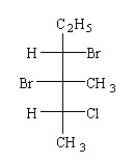
(83) 
Which of the following alkyl halides is most likely to undergo rearrangement in an SN1 reaction?
(Multiple Choice)
4.8/5 (83)
(83) Provide the structure of the major organic product in the following reaction. 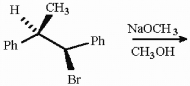
(Essay)
4.9/5 (75)
(75) Provide the structure of the major organic product in the following reaction. 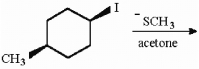
(Essay)
4.8/5 (76)
(76) When ionization occurs at the single stereocenter of a chiral compound, the resulting carbocation is:
(Multiple Choice)
4.8/5 (79)
(79) 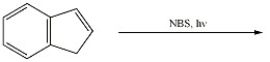

The flame retardant below has been found to be an androgen agonist and may have a contribution to an increasing rate of occurrence of prostate cancer (J. Med. Chem. 2006, 7366). What is the correct term that describes the relative position of the bromides in this structure? 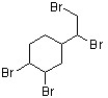
(Multiple Choice)
4.8/5 (84)
(84) Arrange the following species in order of increasing nucleophilicity:
CH3CH2S-, CH3CH2O-, (CH3)3CO-, (CH3)3COH.
(Essay)
5.0/5 (87)
(87) Predict the most likely mechanism for the reaction shown below. 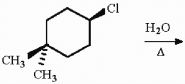
(Multiple Choice)
4.8/5 (78)
(78) List the following bromides in order of their increasing reactivity as substrates in SN1 reactions: 2-chlorobutane, 2-iodobutane, and 1-iodobutane.
(Essay)
4.8/5 (87)
(87) Rank the species below in order of increasing nucleophilicity in hydroxylic solvents:
CH3CO2-, CH3S-, HO-, H2O.
(Essay)
4.7/5 (76)
(76) Dehydration of 1-butanol with concentrated sulfuric acid at 140∘C results in the formation of mainly trans-2-butene. According to these results, which of the following conclusions might be valid?
(Multiple Choice)
4.9/5 (72)
(72) Which of the following alkyl bromides undergoes solvolysis in aqueous methanol most rapidly?
(Multiple Choice)
4.9/5 (80)
(80) Name the haloalkane shown. Be sure to include the appropriate R or S description if needed. 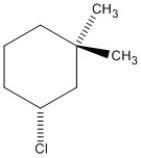
(Short Answer)
4.8/5 (90)
(90) 
How many distinct alkene products results when 1-bromo-1-ethylcyclopentane is treated with NaOCH3?
(Multiple Choice)
4.8/5 (83)
(83) 
Filters
- Essay(0)
- Multiple Choice(0)
- Short Answer(0)
- True False(0)
- Matching(0)