



 Chat with AI
Exam 19: Information for Decisions: Relevant Costs and Benefits

Exam 1: Management Accounting: Information for Creating Value and Managing Resources67 Questions
Exam 2: Management Accounting: Cost Terms and Concepts87 Questions
Exam 3: Cost Behaviour, Cost Drivers and Cost Estimation93 Questions
Exam 4: Product Costing Systems88 Questions
Exam 5: Process Costing and Operation Costing87 Questions
Exam 6: Service Costing91 Questions
Exam 7: A Closer Look at Overhead Costs99 Questions
Exam 8: Activity-Based Costing91 Questions
Exam 9: Budgeting Systems92 Questions
Exam 10: Standard Costs for Control: Direct Material and Direct Labour105 Questions
Exam 11: Standard Costs for Control: Flexible Budgets and Manufacturing Overhead109 Questions
Exam 12: Managing and Reporting Performance102 Questions
Exam 13: Financial Performance Measures and Incentive Schemes93 Questions
Exam 14: Strategic Performance Measurement Systems80 Questions
Exam 15: Managing Suppliers and Customers90 Questions
Exam 16: Managing Costs and Quality92 Questions
Exam 17: Sustainability and Management Accounting76 Questions
Exam 18: Cost Volume Profit Analysis111 Questions
Exam 19: Information for Decisions: Relevant Costs and Benefits116 Questions
Exam 20: Pricing and Product Mix Decisions113 Questions
Exam 21: Information for Capital Expenditure Decisions125 Questions
Select questions type


Which of the following is not a characteristic of a tactical decision?
(Multiple Choice)
4.8/5  (75)
(75) When a costing system has been designed explicitly to influence certain decisions, this will:
(Multiple Choice)
4.8/5 (70)
(70) When the objectives of the decision are in conflict, one objective may be specified as the decision criterion and the other objectives are established as:
(Multiple Choice)
4.9/5 (73)
(73) Which of the following statements is true of relevant costs?
(Multiple Choice)
4.9/5 (82)
(82) Rapid Growth Pty Ltd is presently operating at full capacity. They received a special order that, if accepted, would require refusing some sales to regular customers. Which of the following factors should management consider when making their decision?

(Multiple Choice)
5.0/5 (76)
(76) Which of the following statements about the decision-making process is/are true?
i. The first step in the decision-making process is to define or clarify a decision problem into clear terms that can be addressed.
ii. Before alternatives can be identified, the necessary data must first be collected.
iii. After the alternatives are identified, the criterion on which a decision will be made must be specified.
(Multiple Choice)
5.0/5 (97)
(97) In order to be relevant to a decision, cost or benefit information must involve ________, rather than ________.
(Multiple Choice)
4.9/5 (71)
(71) In the relative sales value method, joint costs are allocated between products:
(Multiple Choice)
5.0/5 (81)
(81) In a decision to keep or replace a piece of equipment, calculate the total yearly expense of keeping the old equipment using the following data. 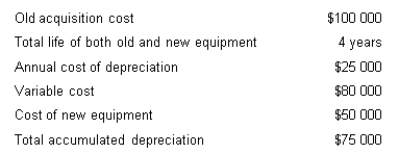
(Multiple Choice)
5.0/5 (81)
(81) An accounting information system should be designed to provide useful information. To be useful the information must be:
(Multiple Choice)
4.8/5 (82)
(82) Which of the following statements regarding short-term decisions is true?
(Multiple Choice)
4.8/5 (80)
(80) Which of the following steps in the decision making process would be primarily the responsibility of the management accountant?
(Multiple Choice)
4.9/5 (91)
(91) When excess capacity exists, the only relevant cost associated with a special order will usually be which cost?
(Multiple Choice)
4.8/5 (71)
(71) A firm has the following cost data per unit. 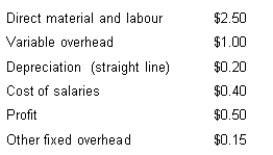 Calculate total cost per unit.
 (Multiple Choice)
4.9/5 (81)
(81) When considering the allocation of joint costs, which of the following statements (if any) is false?
(Multiple Choice)
5.0/5 (71)
(71) A firm incurs manufacturing costs totalling $240 000 in process 1 to produce the following three beverages emerging from that process at the split-off point.
Apple juice: sold immediately it emerges from Process 1 without further processing for $0.70 litre.
Apple cider: processed further in Process 2 at an additional cost of $0.66667 litre, then sold for $1.50 litre
Apple pulp: processed further in Process 3 at an additional cost of $1.50 litre, then sold for $3.50 litre.
The following data relates to the period in which the joint costs were incurred. 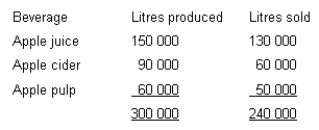 What is the amount of joint cost that would be allocated to apple juice if the net realisable value method had been used?
 (Multiple Choice)
4.8/5 (80)
(80) 
Filters
- Essay(0)
- Multiple Choice(0)
- Short Answer(0)
- True False(0)
- Matching(0)