



 Chat with AI
Exam 19: Information for Decisions: Relevant Costs and Benefits

Exam 1: Management Accounting: Information for Creating Value and Managing Resources67 Questions
Exam 2: Management Accounting: Cost Terms and Concepts87 Questions
Exam 3: Cost Behaviour, Cost Drivers and Cost Estimation93 Questions
Exam 4: Product Costing Systems88 Questions
Exam 5: Process Costing and Operation Costing87 Questions
Exam 6: Service Costing91 Questions
Exam 7: A Closer Look at Overhead Costs99 Questions
Exam 8: Activity-Based Costing91 Questions
Exam 9: Budgeting Systems92 Questions
Exam 10: Standard Costs for Control: Direct Material and Direct Labour105 Questions
Exam 11: Standard Costs for Control: Flexible Budgets and Manufacturing Overhead109 Questions
Exam 12: Managing and Reporting Performance102 Questions
Exam 13: Financial Performance Measures and Incentive Schemes93 Questions
Exam 14: Strategic Performance Measurement Systems80 Questions
Exam 15: Managing Suppliers and Customers90 Questions
Exam 16: Managing Costs and Quality92 Questions
Exam 17: Sustainability and Management Accounting76 Questions
Exam 18: Cost Volume Profit Analysis111 Questions
Exam 19: Information for Decisions: Relevant Costs and Benefits116 Questions
Exam 20: Pricing and Product Mix Decisions113 Questions
Exam 21: Information for Capital Expenditure Decisions125 Questions
Select questions type


Decision problems involving accounting data are specified in:
(Multiple Choice)
4.8/5  (72)
(72) Zoota Ltd makes four products: Alta, Bepha, Delma and Gamta. The selling price and per unit costs are show below. 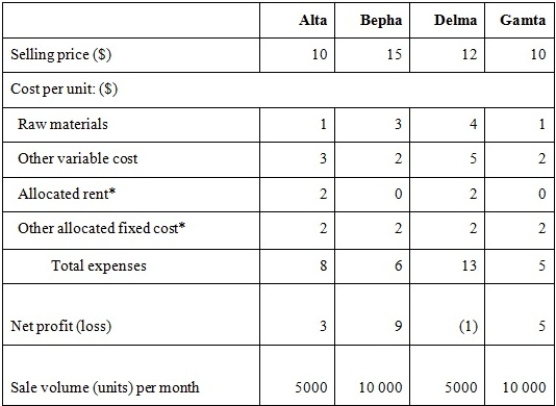 *Alta and Delma share the same factory; therefore, monthly rent is allocated equally between the two products. Other allocated monthly fixed costs include administrative costs, which are allocated based on a $2/unit charge.
What will be the company's total fixed cost (excluding rent) after Delma is dropped (assuming that sales volume = production volume)?
*Alta and Delma share the same factory; therefore, monthly rent is allocated equally between the two products. Other allocated monthly fixed costs include administrative costs, which are allocated based on a $2/unit charge.
What will be the company's total fixed cost (excluding rent) after Delma is dropped (assuming that sales volume = production volume)? (Multiple Choice)
4.7/5 (89)
(89) Consider the situation where an activity-based costing system is in use rather than a traditional volume-based costing system. Which of the following statements is/are true?
(Multiple Choice)
4.8/5 (76)
(76) A firm incurs manufacturing costs totalling $240 000 in process 1 to produce the following three beverages emerging from that process at the split-off point.
Apple juice: sold immediately it emerges from Process 1 without further processing for $0.70 litre.
Apple cider: processed further in Process 2 at an additional cost of $0.66667 litre, then sold for $1.50 litre.
Apple pulp: processed further in Process 3 at an additional cost of $1.50 litre, then sold for $3.50 litre.
The following data relates to the period in which the joint costs were incurred. 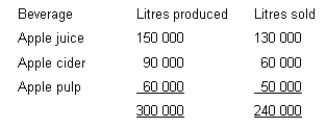 What is the amount of joint cost that would be allocated to apple juice if the relative sales value method had been used?
 (Multiple Choice)
4.8/5 (67)
(67) Xebex Pty Ltd is considering whether to make or buy a component used in the production of Faz Machines. The annual cost of producing the 100 000 components used by the company is as follows. 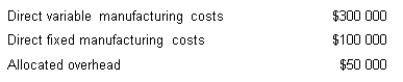 If Xebex were to discontinue production of the component, direct fixed manufacturing costs would be reduced by 80 per cent.
Xebex should buy the 100 000 components if the cost of purchasing per unit is less than what amount?
If Xebex were to discontinue production of the component, direct fixed manufacturing costs would be reduced by 80 per cent.
Xebex should buy the 100 000 components if the cost of purchasing per unit is less than what amount? (Multiple Choice)
4.7/5 (89)
(89) In order for information to be relevant, the decision to be made must have an effect on:
i. future cost or revenues.
ii. past cost or revenues.
iii. the timeliness of information.
(Multiple Choice)
4.8/5 (89)
(89) A firm incurs manufacturing costs totalling $240 000 in process 1 to produce the following three beverages emerging from that process at the split-off point.
Apple juice: sold immediately it emerges from Process 1 without further processing for $0.70 litre.
Apple cider: processed further in Process 2 with an additional cost of $0.66667 litre, then sold for $1.50 litre.
Apple pulp: processed further in Process 3 with an additional cost of $1.50 litre, then sold for $3.50 litre.
The following data relates to the period in which the joint costs were incurred. 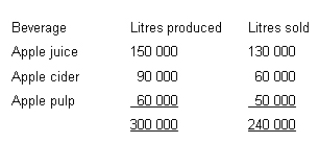 What is the amount of joint cost that would be allocated to apple juice if the physical measures method had been used?
 (Multiple Choice)
4.7/5 (80)
(80) Which of the following statements about relevant information is/are true?
i. An accountant can use past prices, previous market demand and previous cost data to predict future costs when repetitive decisions are made.
ii. No relevant information is available within an organisation's information system for unique decisions.
iii. It is important to segregate relevant data from irrelevant data because it is possible to overload management with information.
(Multiple Choice)
4.7/5 (87)
(87) Contribution margin per machine hour can be calculated by dividing:
(Multiple Choice)
4.9/5 (69)
(69) Consider a situation where an activity-based costing system is in use rather than a traditional volume-based costing system. Which of the following statements is/are true?
(Multiple Choice)
4.7/5 (83)
(83) Manufacturers sometimes sell products at less than full price for a special order. The analysis of such decisions focuses on:
(Multiple Choice)
4.9/5 (73)
(73) When a department or a product is showing a loss after all costs have been traced and allocated, a company has no option but to make the decision to either close the department or drop the product.
(True/False)
4.8/5 (82)
(82) Which of the following statements in relation to making tactical decisions is incorrect?
(Multiple Choice)
4.8/5 (80)
(80) Characteristics for information for decision making
i. One characteristic of information that is essential in order for the information to be useful for decision making is relevance. What are the other two characteristics?
ii. Frequently there is a conflict between the two characteristics requested in question (i), describe why this conflict exists.
iii. What distinguishes relevant information from irrelevant information?
(Essay)
4.8/5 (86)
(86) Which of the following costs would not be recorded in the cost accounting system?
(Multiple Choice)
4.8/5 (76)
(76) When cost allocations are used to encourage the sales managers to push the higher margin products this action will link:
(Multiple Choice)
4.9/5 (96)
(96) If a management accountant is trying to decide whether a cost is relevant to a decision, he or she should consider the cost relevant if:
(Multiple Choice)
4.7/5 (87)
(87) Relevance of joint costs for decision
The managers of firm LT are facing a decision to discontinue the production process. This process begins with a joint process that yields three products. Each of the three products is further processed after the split-off point. The costs of the entire production process are broken down into two major categories: costs of the joint process before split-off and after split-off. Discuss the relevance of each of these categories of costs to the decision to discontinue the entire production process.
(Essay)
4.9/5 (71)
(71) Generally, joint costs are not relevant in decision making after split-off because:
(Multiple Choice)
4.8/5 (98)
(98) 
Filters
- Essay(0)
- Multiple Choice(0)
- Short Answer(0)
- True False(0)
- Matching(0)