



 Chat with AI
Exam 16: Managing Costs and Quality


Three processes are involved in the manufacturing of Chemical Z. First, the raw mixture goes through the Mixing Process, then the Heating Process, and finally the Bottling Process. The hourly production capacity of the three processes is 400 units, 600 units and 400 units respectively. Assume that a recent process improvement has resulted in a 20 per cent increase in the capacity of the Bottling Process. This process improvement will:

 (67)
 Verified
D
Which of the following is not a characteristic of total quality management?
(80) VerifiedA
Business Process Re-engineering (BPR) focuses on the processes that are essential to achieving the company's business objectives and strategies. As each process is identified the four major steps used in BPR are applied. Describe these four major steps.
(85) VerifiedOnce a process has been identified for re-engineering, BPR involves four major steps:
1 Prepare a business process map. A flowchart of the activities that make up the business process, called a business process map, is prepared.
2 Establish goals. Clear goals for the re-engineered process are established, based on the sources of customer value. These may include quality and delivery performance, as well as cost. Depending on the strategies of the business, they may also include innovation, flexibility and so on.
3 Reorganise work flow. The flow of work is reorganised to enable the goals to be achieved. These changes can lead to spare capacity, which needs to be reduced in order to achieve cost reductions.
4 Implementation. The final step is implementation of the changed workflows. Business process re-engineering involves substantial change and, like any change, may meet resistance from employees. Such resistance may be managed through forming re-engineering project teams that involve employees from all functional areas affected by the proposed change. In such situations, employees may feel a stronger sense of ownership of the changes.
The following four tasks take place in the concept known as target costing.
i. Value engineering
ii. Establish a target price
iii. Establish a target cost
iv. Establish a target profit
Which of the following correctly depicts the sequence of these tasks?
(78) When a manufacturer incurs costs to determine whether defects exist in their products, these costs are known as:
(69) When we consider the life cycle sequence of a product, the majority of costs for a typical product have been committed by the end of:
(69) Which of the following statements is consistent with target costing?
(83) When throughput increases with no change in operating expenses or inventory levels, then:
(73) Consider a situation where an activity-based costing system is in use rather than a traditional volume-based costing system. Which of the following statements is/are true?
(73) From the following list of costs, determine the amount of non-value-added cost. 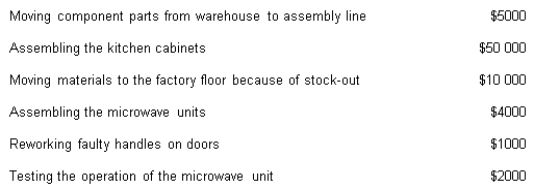
(95) The following are the expected quality costs for a firm for a selected period.
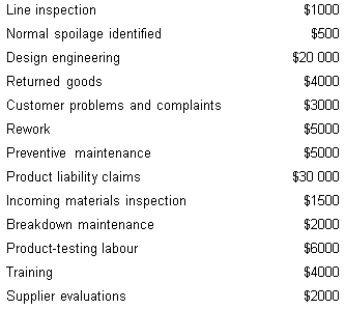
(71) When a company uses an activity-based management system to reduce costs, the first step in the process is to determine the real causes of the costs.
(73) Customer value is measured by the customer and the value the customer places on particular aspects of a product.
(79) Which of the following are key features of target costing?
i. Cross functionality
ii. Market price driven
iii. Focus on customer value
iv. Based on life cycle management
(85) Lazy Linda Kitchen Appliances manufactures small kitchen appliances such as toasters and blenders. Last month Lazy Linda recorded the following quality costs: 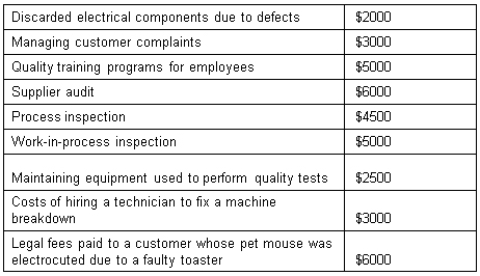 Lazy Linda's total external failure cost was:
 (88) If a firm needs to identify the root cause cost drivers of activities, the firm needs to undertake a thorough cost driver analysis.
(63) 
Filters
- Essay(0)
- Multiple Choice(0)
- Short Answer(0)
- True False(0)
- Matching(0)