



 Chat with AI
Exam 21: Information for Capital Expenditure Decisions

Exam 1: Management Accounting: Information for Creating Value and Managing Resources67 Questions
Exam 2: Management Accounting: Cost Terms and Concepts87 Questions
Exam 3: Cost Behaviour, Cost Drivers and Cost Estimation93 Questions
Exam 4: Product Costing Systems88 Questions
Exam 5: Process Costing and Operation Costing87 Questions
Exam 6: Service Costing91 Questions
Exam 7: A Closer Look at Overhead Costs99 Questions
Exam 8: Activity-Based Costing91 Questions
Exam 9: Budgeting Systems92 Questions
Exam 10: Standard Costs for Control: Direct Material and Direct Labour105 Questions
Exam 11: Standard Costs for Control: Flexible Budgets and Manufacturing Overhead109 Questions
Exam 12: Managing and Reporting Performance102 Questions
Exam 13: Financial Performance Measures and Incentive Schemes93 Questions
Exam 14: Strategic Performance Measurement Systems80 Questions
Exam 15: Managing Suppliers and Customers90 Questions
Exam 16: Managing Costs and Quality92 Questions
Exam 17: Sustainability and Management Accounting76 Questions
Exam 18: Cost Volume Profit Analysis111 Questions
Exam 19: Information for Decisions: Relevant Costs and Benefits116 Questions
Exam 20: Pricing and Product Mix Decisions113 Questions
Exam 21: Information for Capital Expenditure Decisions125 Questions
Select questions type


The ___________ the discount rate used in a net present value analysis, the ___________ the present value of all future cash flows.

Free
(Multiple Choice)
4.8/5  (86)
(86) Correct Answer: Verified
D
Both the net present value method and the internal rate of return method focus on:
Free
(Multiple Choice)
4.8/5 (84)
(84) Correct Answer:Verified
VerifiedB
When analysing capital expenditure proposals, if a firm is interested in cash inflows and cash outflows, depreciation resulting from the expenditure would always be treated as a cash outflow.
Free
(True/False)
4.9/5 (75)
(75) Correct Answer:Verified
VerifiedFalse
The mayor of Smalltown, Western Australia, is considering the purchase of a computer system to automate the city's rate collections. The system costs $75 000 and has an estimated life of five years. The mayor estimates the following savings will result if the system is purchased. 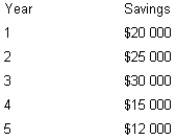 If Smalltown uses a 10 per cent discount rate for capital budgeting decisions, what can be said about the internal rate of return (IRR) if the net present value at 12 per cent is positive?
 (Multiple Choice)
4.8/5 (79)
(79) The internal rate of return for a proposed investment can be calculated:
(Multiple Choice)
4.8/5 (91)
(91) Which method of capital expenditure appraisal is used to rank projects of different initial outlays?
(Multiple Choice)
4.8/5 (72)
(72) When managers use a discounted cash flow analysis method for investment projects, which of the following factors are not considered when projecting cash flows?
(Multiple Choice)
4.9/5 (86)
(86) Which of the following is not an assumption of the models that analyse cash flows for capital investment decisions?
(Multiple Choice)
5.0/5 (77)
(77) Comparisons between net present value (NPV) and internal rate of return (IRR) methods
Both the NPV and IRR methods have a reinvestment assumption.
i. State the assumption for each method.
ii. One of the advantages of the NPV method over the IRR method is the ability to adjust for risk considerations. Explain how this can be done.
(Essay)
4.9/5 (62)
(62) A small business is likely to have capital expenditure processes that are likely to be:
(Multiple Choice)
4.7/5 (82)
(82) Consider the following statements. Since money has a time value:
i. businesses will take tax deductions as early as possible.
ii. businesses will take tax deductions as late as possible.
iii. businesses will obtain a greater tax benefit by using the diminishing value method of depreciation.
Which of the above statements is/are correct?
(Multiple Choice)
4.8/5 (80)
(80) 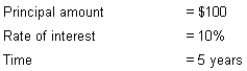
Suppose a firm has an asset that originally cost $5000 and currently has accumulated depreciation of $2000. The firm is subject to a 28 per cent income tax rate. Suppose the firm sells the asset for $2000. What was the book value before sale?
(Multiple Choice)
4.9/5 (83)
(83) Which of the following are limitations of traditional capital expenditure analysis?
i. Hurdle rates are too high.
ii. Rejection assumes the status quo will apply.
iii. There is often a high degree of uncertainty in cash flow forecasts.
(Multiple Choice)
5.0/5 (86)
(86) Which of the following reasons would explain the popularity of the payback technique?
(Multiple Choice)
4.9/5 (85)
(85) What will $5000 invested at 10 per cent today accumulate to at the end of five years?
(Multiple Choice)
4.8/5 (87)
(87) Which of the following statements regarding the assumptions underlying discounted cash flow analysis is/are true?
i. All cash flows are treated as though they occur at year-end.
ii. Cash flows associated with the investment project are treated as if they are known with certainty.
iii. The discount rate is always the same as the average cost of capital.
(Multiple Choice)
4.9/5 (80)
(80) The manager of Malan Pty Ltd wants to buy a new machine to replace the one currently being used. The new machine will cost $100 000 with no disposal value at the end of a five-year useful life. The manager estimates that the machine will reduce annual operating costs by $30 000. Depreciation will be $20 000 per year for five years. The tax rate for each year is expected to be 20 per cent and the company has an after-tax hurdle rate of 12 per cent. What is the after-tax payback period of the machine?
(Multiple Choice)
4.8/5 (83)
(83) The cost of capital is the maximum return needed to compensate suppliers of capital for committing resources to a project.
(True/False)
4.9/5 (80)
(80) 
Filters
- Essay(0)
- Multiple Choice(0)
- Short Answer(0)
- True False(0)
- Matching(0)