



 Chat with AI
Exam 19: Information for Decisions: Relevant Costs and Benefits

Exam 1: Management Accounting: Information for Creating Value and Managing Resources67 Questions
Exam 2: Management Accounting: Cost Terms and Concepts87 Questions
Exam 3: Cost Behaviour, Cost Drivers and Cost Estimation93 Questions
Exam 4: Product Costing Systems88 Questions
Exam 5: Process Costing and Operation Costing87 Questions
Exam 6: Service Costing91 Questions
Exam 7: A Closer Look at Overhead Costs99 Questions
Exam 8: Activity-Based Costing91 Questions
Exam 9: Budgeting Systems92 Questions
Exam 10: Standard Costs for Control: Direct Material and Direct Labour105 Questions
Exam 11: Standard Costs for Control: Flexible Budgets and Manufacturing Overhead109 Questions
Exam 12: Managing and Reporting Performance102 Questions
Exam 13: Financial Performance Measures and Incentive Schemes93 Questions
Exam 14: Strategic Performance Measurement Systems80 Questions
Exam 15: Managing Suppliers and Customers90 Questions
Exam 16: Managing Costs and Quality92 Questions
Exam 17: Sustainability and Management Accounting76 Questions
Exam 18: Cost Volume Profit Analysis111 Questions
Exam 19: Information for Decisions: Relevant Costs and Benefits116 Questions
Exam 20: Pricing and Product Mix Decisions113 Questions
Exam 21: Information for Capital Expenditure Decisions125 Questions
Select questions type


When deciding whether to accept a special order, spare or idle capacity is not a factor that needs to be taken into account.

Free
(True/False)
4.9/5  (88)
(88) Correct Answer: Verified
False
Which of the following statements is/are true?
i. Accurate but irrelevant information is still useful for decision making.
ii. Relevant, accurate, but not timely information is not useful in decision making.
iii. Relevant information that is known to have some weaknesses in accuracy still is useful in decision making.
Free
(Multiple Choice)
4.8/5 (84)
(84) Correct Answer:Verified
VerifiedD
C Limited produces two products (A and B) from a particular joint process. Each product may be sold at split-off or may be further processed. Joint production costs for the year amounted to $60 000. Sales values and costs are as follows. 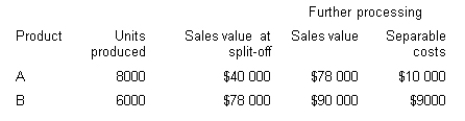 If the joint production costs were assigned using the net realisable value method, the joint costs allocated to B would be:
Free
(Multiple Choice)
4.9/5 (75)
(75) Correct Answer:Verified
VerifiedC
Efficient decision-making tends to consider relevant information only and this information focuses on incremental revenue and expenses.
(True/False)
4.8/5 (77)
(77) Holt Pty Ltd presently makes 20 000 units of a certain part to use in production. The cost to make the part is $20 per unit including $15 in variable costs and $5 in fixed overhead applied. If Holt buys the part from Bricker, the cost would be $18 per unit and the released facilities could not be used for any other activity. Eighty per cent of the fixed overhead would continue. Determine the relevant costs to make the part.
(Multiple Choice)
4.9/5 (75)
(75) While there is a decision-making model, in many instances managers frequently make decisions without necessarily following the set steps detailed in the model.
(True/False)
4.9/5 (69)
(69) C Limited produces two products (A and B) from a particular joint process. Each product may be sold at split-off or may be further processed. Joint production costs for the year amounted to $60 000. Sales values and costs are as follows. 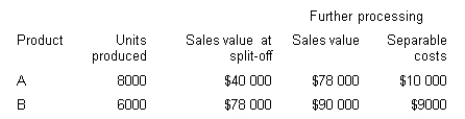 If the joint production costs were assigned using the relative sales value method the joint costs allocated to A would be:
 (Multiple Choice)
4.8/5 (86)
(86) Which of the following is a correct quantitative decision-rule with respect to whether to drop a product?
(Multiple Choice)
4.8/5 (77)
(77) A firm has the following cost data per unit. 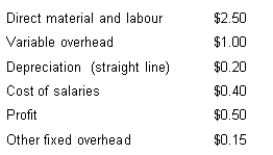 Calculate fixed costs per unit.
 (Multiple Choice)
4.8/5 (70)
(70) A chocolate company uses the weight of joint products as the allocation basis. This type of cost allocation is the:
(Multiple Choice)
4.9/5 (86)
(86) Which of these statements about joint cost allocation is false?
(Multiple Choice)
4.7/5 (89)
(89) Which of the following statements about variable and fixed expenses, as they relate to relevance, is/are true?
i. Variable expenses may or may not be relevant costs.
ii. Variable expenses are always relevant.
iii. Fixed expenses are never relevant.
(Multiple Choice)
4.9/5 (82)
(82) Which of the following statements about the management accountant's role in the decision-making process is/are true?
i. The management accountant is primarily responsible for selecting an alternative in the decision-making process.
ii. The management account is primarily responsible for collecting the data in the decision-making process.
iii. The management accountant is sometimes involved in developing a decision model in the decision-making process.
(Multiple Choice)
4.9/5 (86)
(86) Mod Clothiers makes women's clothes. It costs $28 000 to produce 5000 pairs of polka-dot polyester pants. They have been unable to sell the pants at their usual price of $50.00. The company is evaluating two alternatives. They could sell the pants 'as is' for a total $15 000 or they could modify the pants and sell them for a total of $20 000.
At what cost to modify each pair of pants, would Mod Clothiers be indifferent between the two alternatives?
(Multiple Choice)
4.8/5 (81)
(81) Lipex Pty Ltd produces two products (A and B) from a particular joint process. Each product may be sold at the split-off point or processed further. Additional processing requires no special facilities, and production costs of further processing are entirely variable and traceable to the products involved. Joint production costs for the year were $60 000. Sales values and costs are as follows.  Allocate the joint production costs based on the physical units method. What are the joint costs assigned to product B?
 (Multiple Choice)
4.9/5 (80)
(80) Lido Products produces two products (A and B) from a joint process. The joint cost of production is $80 000. Five thousand units of Product A can be sold at split-off for $20 per unit or processed further at an additional cost of $20 000 and sold for $25 per unit. Ten thousand units of Product B can be sold at split-off for $15 per unit or processed further at an additional cost of $20 000 and sold for $16 per unit.
What is the difference in profit if Lido decides to process further Product B, instead of selling it at split-off?
(Multiple Choice)
4.9/5 (77)
(77) Product costs incurred after the split-off point are called:
(Multiple Choice)
4.9/5 (73)
(73) Jaspar Ltd has 1000 units in inventory that cost $2.00 per unit to produce. Due to changing technology, the sales department is having difficulty selling the product. It will cost $500 to scrap the units. The company should consider any price over:
(Multiple Choice)
4.9/5 (87)
(87) Steps in the decision-making process
i. Two of the steps in the decision-making process are to 'specify the criterion' and to 'develop a decision model'. List the remaining four steps in the decision-making process.
ii. Explain the difference between the two steps listed above, specifying the criterion and developing a decision model.
(Essay)
4.8/5 (77)
(77) 
Filters
- Essay(0)
- Multiple Choice(0)
- Short Answer(0)
- True False(0)
- Matching(0)