



 Chat with AI
Exam 19: Information for Decisions: Relevant Costs and Benefits

Exam 1: Management Accounting: Information for Creating Value and Managing Resources67 Questions
Exam 2: Management Accounting: Cost Terms and Concepts87 Questions
Exam 3: Cost Behaviour, Cost Drivers and Cost Estimation93 Questions
Exam 4: Product Costing Systems88 Questions
Exam 5: Process Costing and Operation Costing87 Questions
Exam 6: Service Costing91 Questions
Exam 7: A Closer Look at Overhead Costs99 Questions
Exam 8: Activity-Based Costing91 Questions
Exam 9: Budgeting Systems92 Questions
Exam 10: Standard Costs for Control: Direct Material and Direct Labour105 Questions
Exam 11: Standard Costs for Control: Flexible Budgets and Manufacturing Overhead109 Questions
Exam 12: Managing and Reporting Performance102 Questions
Exam 13: Financial Performance Measures and Incentive Schemes93 Questions
Exam 14: Strategic Performance Measurement Systems80 Questions
Exam 15: Managing Suppliers and Customers90 Questions
Exam 16: Managing Costs and Quality92 Questions
Exam 17: Sustainability and Management Accounting76 Questions
Exam 18: Cost Volume Profit Analysis111 Questions
Exam 19: Information for Decisions: Relevant Costs and Benefits116 Questions
Exam 20: Pricing and Product Mix Decisions113 Questions
Exam 21: Information for Capital Expenditure Decisions125 Questions
Select questions type


The term given to the practice of having a process undertaken by an external firm rather than a company doing it itself, is outsourcing.
(True/False)
4.8/5  (83)
(83) Distinctions between sunk costs and opportunity costs
i. Define sunk costs and opportunity costs.
ii. 'Information about sunk costs generally can be found in the accounting system; however, information about opportunity costs rarely is found in the accounting records.' Do you agree with that statement? Explain why or why not.
(Essay)
4.9/5 (83)
(83) A firm incurs manufacturing costs totalling $240 000 in process 1 to produce the following three beverages emerging from that process at the split-off point:
Apple juice: sold immediately it emerges from Process 1 without further processing for $0.70 litre.
Apple cider: processed further in Process 2 at an additional cost of $0.66667 litre, then sold for $1.50 litre.
Apple pulp: processed further in Process 3 at an additional cost of $1.50 litre, then sold for $3.50 litre.
The following data relates to the period in which the joint costs were incurred. 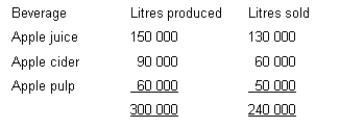 What is the amount of joint cost that would be allocated to apple juice if the constant gross margin method had been used?
 (Multiple Choice)
4.9/5 (84)
(84) Which of the following is a correct statement regarding the link between decision making and performance evaluation?
(Multiple Choice)
4.7/5 (93)
(93) What term is used to describe factors in a decision problem that cannot be expressed effectively in numerical terms?
(Multiple Choice)
4.8/5 (88)
(88) The joint cost allocation method that ensures that the gross margin for each product is identical is the:
(Multiple Choice)
4.9/5 (82)
(82) Zoota Ltd makes four products: Alta, Bepha, Delma and Gamta. The selling price and per unit costs are show below. 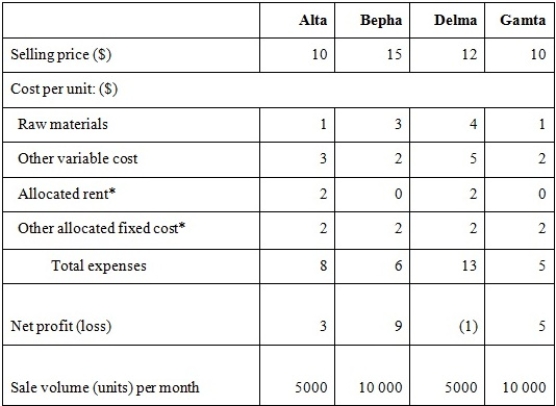 *Alta and Delma share the same factory; therefore, monthly rent is allocated equally between the two products. Other allocated monthly fixed costs include administrative costs, which are allocated based on a $2/unit charge.
Zoota Ltd decides to drop Delma because it is unprofitable. Christina Bobo, the management accountant of Zoota Ltd, suggests that by dropping Delma the company can save $1 x 5000 = $5000 a month. Your assessment of Christina's suggestion is:
*Alta and Delma share the same factory; therefore, monthly rent is allocated equally between the two products. Other allocated monthly fixed costs include administrative costs, which are allocated based on a $2/unit charge.
Zoota Ltd decides to drop Delma because it is unprofitable. Christina Bobo, the management accountant of Zoota Ltd, suggests that by dropping Delma the company can save $1 x 5000 = $5000 a month. Your assessment of Christina's suggestion is: (Multiple Choice)
4.8/5 (76)
(76) Pitfalls in using unit fixed costs
Fixed costs can be expressed as total fixed costs or can be divided by the expected level of activity to obtain fixed costs per unit. Which of these is likely to be more useful in decision making? Explain.
(Essay)
4.8/5 (68)
(68) The joint cost allocation method that is not based on the economic characteristics of the joint products is the:
(Multiple Choice)
4.7/5 (97)
(97) The most common trade-off in a decision situation is between information:
(Multiple Choice)
4.9/5 (80)
(80) The split-off point is that stage in the manufacturing process where the products being manufactured can finally be identified as separate products.
(True/False)
4.9/5 (84)
(84) Zoota Ltd makes four products: Alta, Bepha, Delma and Gamta. The selling price and per unit costs are show below. 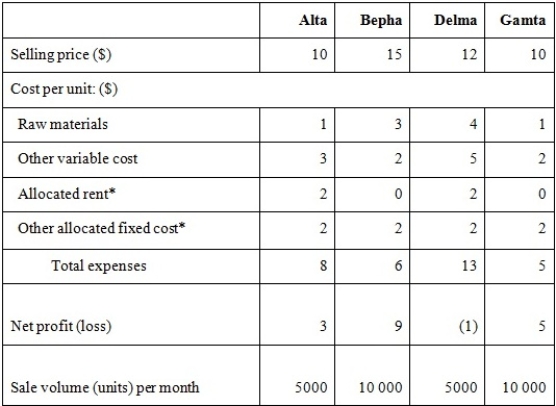 *Alta and Delma share the same factory; therefore, monthly rent is allocated equally between the two products. Other allocated monthly fixed costs include administrative costs, which are allocated based on a $2/unit charge.
Zoota Ltd is planning to downsize by focusing on the two most profitable products, Bepha and Gamta, while discontinuing Alta and Delma. Which of the following are the correct assessments of the relevance of the items listed?
*Alta and Delma share the same factory; therefore, monthly rent is allocated equally between the two products. Other allocated monthly fixed costs include administrative costs, which are allocated based on a $2/unit charge.
Zoota Ltd is planning to downsize by focusing on the two most profitable products, Bepha and Gamta, while discontinuing Alta and Delma. Which of the following are the correct assessments of the relevance of the items listed? (Multiple Choice)
5.0/5 (76)
(76) Qualitative and quantitative characteristics
i. Distinguish between qualitative and quantitative characteristics.
ii. At what point in the six-step decision-making process do the qualitative characteristics have an impact?
(Essay)
4.8/5 (84)
(84) Relevance of joint costs for decision
The managers of firm ST are facing a decision to further process product J2 before sale. J2 is one of three joint products provided by a manufacturing process. Product J2 presently is sold immediately after split-off. However, product J2 can be processed further and sold for a higher price. The overall volume of activity is not expected to change. Are the joint costs allocated to product J2 relevant for this decision? Explain your answer.
(Essay)
4.9/5 (85)
(85) Criteria measured utilising quantitative terms include objectives such as:
(Multiple Choice)
4.8/5 (78)
(78) Which of the following statements about relevant information is/are true?
i. For information to be relevant, it must relate to the future.
ii. For information to be relevant, it must differ between the alternatives.
iii. For information to be relevant, it must be completely accurate.
(Multiple Choice)
4.8/5 (83)
(83) Sunk costs, unitising costs, how costs are allocated, and leaving out opportunity costs are all factors where errors are often made, and will ultimately affect the outcome of the decision.
(True/False)
4.8/5 (87)
(87) Mod Clothiers makes women's clothes. It costs $28 000 to produce 5000 pairs of polka-dot polyester pants. They have been unable to sell the pants at their usual price of $50.00. The company is evaluating two alternatives. They could sell the pants 'as is' for a total of $15 000 or they could modify the pants at a cost of $3000 and sell them for a total of $20 000.
What would be the effect on profit of modifying the pants and selling them as opposed to selling 'as is'?
(Multiple Choice)
4.8/5 (79)
(79) 
Filters
- Essay(0)
- Multiple Choice(0)
- Short Answer(0)
- True False(0)
- Matching(0)