



 Chat with AI
Exam 16: Managing Costs and Quality

Exam 1: Management Accounting: Information for Creating Value and Managing Resources67 Questions
Exam 2: Management Accounting: Cost Terms and Concepts87 Questions
Exam 3: Cost Behaviour, Cost Drivers and Cost Estimation93 Questions
Exam 4: Product Costing Systems88 Questions
Exam 5: Process Costing and Operation Costing87 Questions
Exam 6: Service Costing91 Questions
Exam 7: A Closer Look at Overhead Costs99 Questions
Exam 8: Activity-Based Costing91 Questions
Exam 9: Budgeting Systems92 Questions
Exam 10: Standard Costs for Control: Direct Material and Direct Labour105 Questions
Exam 11: Standard Costs for Control: Flexible Budgets and Manufacturing Overhead109 Questions
Exam 12: Managing and Reporting Performance102 Questions
Exam 13: Financial Performance Measures and Incentive Schemes93 Questions
Exam 14: Strategic Performance Measurement Systems80 Questions
Exam 15: Managing Suppliers and Customers90 Questions
Exam 16: Managing Costs and Quality92 Questions
Exam 17: Sustainability and Management Accounting76 Questions
Exam 18: Cost Volume Profit Analysis111 Questions
Exam 19: Information for Decisions: Relevant Costs and Benefits116 Questions
Exam 20: Pricing and Product Mix Decisions113 Questions
Exam 21: Information for Capital Expenditure Decisions125 Questions
Select questions type


If a company has quality accreditation , the company is then known to practice total quality management.
(True/False)
4.9/5  (80)
(80) One approach to cost reduction is to undertake value engineering where an analysis of design and production takes place with an aim to identify and eliminate non-value-adding activities.
(True/False)
4.7/5 (84)
(84) The underlying factors that trigger costs to be incurred when an activity is performed are known as:
(Multiple Choice)
4.8/5 (75)
(75) A series of pictures that shows the flow of activities that make up a process is called:
(Multiple Choice)
4.9/5 (77)
(77) The modern management tool that focuses on restrictions that limit a firm's ability to maximise long-run profit is commonly known as:
(Multiple Choice)
4.9/5 (93)
(93) The following are the expected quality costs for a firm for a selected period.
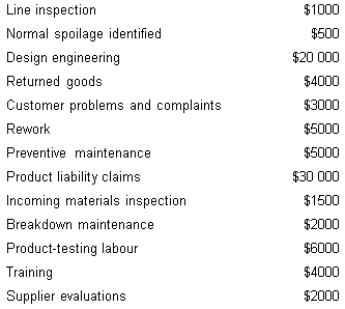
(Multiple Choice)
5.0/5 (76)
(76) Which of the following stages are considered in a product's life cycle?
i. Preliminary design
ii. Product pricing
iii. Product decline
(Multiple Choice)
4.9/5 (75)
(75) Orwell is about to introduce a new product and has established a target cost of $144 and a target margin on sales of 40 per cent. What is the target price?
(Multiple Choice)
4.9/5 (74)
(74) Which of the following statements about re-engineering is/are true?
i. Re-engineering is the complete redesign of a process in an attempt to find new creative ways to accomplish objectivity.
ii. Re-engineering involves more of a 'giant leap' than the concept of activity-based management.
iii. Re-engineering may entail high risks.
(Multiple Choice)
4.8/5 (87)
(87) Which of the following time drivers contribute to non-value-added activities?
i. Poor quality
ii. Efficient inventory management
iii. Bottlenecks in production
iv. Poorly structured delivery processes
(Multiple Choice)
5.0/5 (80)
(80) A target selling price can be calculated by deducting the target margin from the target cost.
(True/False)
4.9/5 (68)
(68) The following are the expected quality costs for a firm for a selected period.
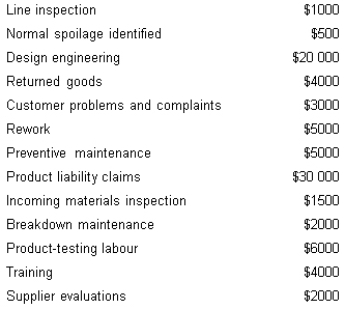
(Multiple Choice)
4.7/5 (81)
(81) Which of the following are considerations in determining a target selling price?
i. Customer expectations
ii. Competitors' actions
iii. Product cost
iv. Strategic objectives
(Multiple Choice)
4.8/5 (75)
(75) In the process of target costing, where is the concentration of effort required to have the greatest impact on cost savings?
i. Product design
ii. Process design
iii. Production costs
iv. After sales costs
(Multiple Choice)
4.8/5 (81)
(81) Which of the following are possible root-cause cost drivers?
i. Complexity
ii. Defects produced
iii. Plant layout
iv. Inadequate employee training
(Multiple Choice)
4.9/5 (84)
(84) When monitored, activity-based performance measures can provide managers with feedback on their:
(Multiple Choice)
5.0/5 (80)
(80) Define the term 'bottleneck' and describe how the application of the 'theory of constraints' can assist management in production.
(Essay)
4.8/5 (84)
(84) 
Filters
- Essay(0)
- Multiple Choice(0)
- Short Answer(0)
- True False(0)
- Matching(0)