



 Chat with AI
Exam 16: Managing Costs and Quality

Exam 1: Management Accounting: Information for Creating Value and Managing Resources67 Questions
Exam 2: Management Accounting: Cost Terms and Concepts87 Questions
Exam 3: Cost Behaviour, Cost Drivers and Cost Estimation93 Questions
Exam 4: Product Costing Systems88 Questions
Exam 5: Process Costing and Operation Costing87 Questions
Exam 6: Service Costing91 Questions
Exam 7: A Closer Look at Overhead Costs99 Questions
Exam 8: Activity-Based Costing91 Questions
Exam 9: Budgeting Systems92 Questions
Exam 10: Standard Costs for Control: Direct Material and Direct Labour105 Questions
Exam 11: Standard Costs for Control: Flexible Budgets and Manufacturing Overhead109 Questions
Exam 12: Managing and Reporting Performance102 Questions
Exam 13: Financial Performance Measures and Incentive Schemes93 Questions
Exam 14: Strategic Performance Measurement Systems80 Questions
Exam 15: Managing Suppliers and Customers90 Questions
Exam 16: Managing Costs and Quality92 Questions
Exam 17: Sustainability and Management Accounting76 Questions
Exam 18: Cost Volume Profit Analysis111 Questions
Exam 19: Information for Decisions: Relevant Costs and Benefits116 Questions
Exam 20: Pricing and Product Mix Decisions113 Questions
Exam 21: Information for Capital Expenditure Decisions125 Questions
Select questions type


Lazy Linda Kitchen Appliances manufactures small kitchen appliances such as toasters and blenders. Last month Lazy Linda recorded the following quality costs: 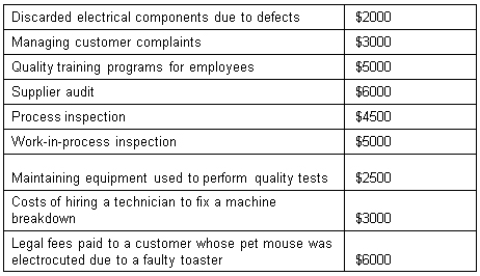 Lazy Linda's total prevention cost was:
 (Multiple Choice)
4.8/5  (74)
(74) If the target selling price is $120 and the target profit margin is a 40 per cent mark-up on cost, what is the target cost?
(Multiple Choice)
4.9/5 (69)
(69) Carwell has introduced a new product with a target price of $150 and a target cost of $90. What is the target percentage margin on sales?
(Multiple Choice)
5.0/5 (84)
(84) Lazy Linda Ltd manufactures small kitchen appliances. One of the non-value added activities identified by the production manager is 'reworking the electrical component in a toaster'. Which of the following is a likely root cause cost driver?
(Multiple Choice)
4.8/5 (86)
(86) Which of the following statements is/are true in relation to activity-based management (ABM)?
i. ABM is primarily concerned with customer value.
ii. Activity-based costing is the primary source of data for ABM.
iii. ABM is primarily concerned with the control of inputs.
(Multiple Choice)
4.9/5 (75)
(75) When management uses financial measures to determine the effect of bottlenecks and operational decisions, they are likely to be using:
(Multiple Choice)
4.9/5 (80)
(80) The removal of bottlenecks has which of the following benefits?
i. Increased customer value
ii. Reduced costs
iii. Improved quality
iv. Increased profitability
(Multiple Choice)
5.0/5 (88)
(88) What management approaches might be used to overcome the problem of poorly structured production processes?
i. Value analysis to identify and remove non-value-added activities.
ii. Implement continuous improvement processes.
iii. Process re-engineering.
(Multiple Choice)
4.9/5 (82)
(82) Which of the following statements is not specifically related to product life cycle costing?
(Multiple Choice)
4.9/5 (72)
(72) Cost drivers and a process perspective, are two of the main differences between modern and traditional approaches to cost management.
(True/False)
4.8/5 (66)
(66) One way to manage throughput efficiently is to use a theory of constraints approach in an attempt to identify and remove bottlenecks in the system of production.
(True/False)
4.9/5 (72)
(72) Which of the following is a possible cause of a firm's reluctance to implement activity-based management (ABM)?
I Employee resistance to change.
Ii) Lack of understanding of the benefits of ABM.
Iii) Significant resources required.
Iv) Focus is on value-added activities.
(Multiple Choice)
4.8/5 (80)
(80) 
Filters
- Essay(0)
- Multiple Choice(0)
- Short Answer(0)
- True False(0)
- Matching(0)