



 Chat with AI
Exam 2: Atoms

Exam 1: Matter, Energy, and Measurement143 Questions
Exam 2: Atoms133 Questions
Exam 3: Chemical Bonds140 Questions
Exam 4: Chemical Reactions140 Questions
Exam 5: Gases, Liquids, and Solids132 Questions
Exam 6: Solutions and Colloids153 Questions
Exam 7: Reaction Rates and Chemical Equilibrium103 Questions
Exam 8: Acids and Bases197 Questions
Exam 9: Nuclear Chemistry155 Questions
Exam 10: Organic Chemistry70 Questions
Exam 11: Alkanes142 Questions
Exam 12: Alkenes and Alkynes123 Questions
Exam 13: Benzene and Its Derivatives60 Questions
Exam 14: Alcohols, Ethers, and Thiols122 Questions
Exam 15: Chirality: the Handedness of Molecules92 Questions
Exam 16: Amines89 Questions
Exam 17: Aldehydes and Ketones101 Questions
Exam 18: Carboxylic Acids115 Questions
Exam 19: Carboxylic Anhydrides, Esters, and Amides117 Questions
Exam 20: Carbohydrates103 Questions
Exam 21: Lipids132 Questions
Exam 22: Proteins128 Questions
Exam 23: Enzymes62 Questions
Exam 24: Chemical Communications: Neurotransmitters and Hormones89 Questions
Exam 25: Nucleotides, Nucleic Acids, and Heredity121 Questions
Exam 26: Gene Expression and Protein Synthesis129 Questions
Exam 27: Bioenergetics: How the Body Converts Food to Energy140 Questions
Exam 28: Specific Catabolic Pathways: Carbohydrate, Lipid, and Protein Metabolism104 Questions
Exam 29: Biosynthetic Pathways67 Questions
Exam 30: Nutrition73 Questions
Exam 31: Immunochemistry142 Questions
Exam 32: Body Fluids72 Questions
Select questions type


Which of the following is the correct order of filling orbitals?
(Multiple Choice)
4.9/5  (76)
(76) Ammonium nitrate is a component of both fertilizers and explosives. Ammonium nitrate has nitrogen, hydrogen and oxygen atoms in the ratio 2:4:3. What is the correct formula for ammonium nitrate?
(Multiple Choice)
5.0/5 (81)
(81) When filling a set of orbitals of equal energy which of the following is true?
(Multiple Choice)
4.8/5 (75)
(75) Zinc can be uniformly mixed in differing amounts with copper to form an alloy called brass. Brass is an examples of which of the following?
(Multiple Choice)
4.9/5 (68)
(68) Which of the following give(s) the correct order of ionization energies?
(Multiple Choice)
4.8/5 (75)
(75) Which of the following give(s) the correct order of ionization energies?
(Multiple Choice)
5.0/5 (84)
(84) The ionization energy of an atom is which of the following?
(Multiple Choice)
4.8/5 (81)
(81) Electrons can sometimes fill orbitals in a manner other than according to the rules we have specified. If they do so we say the atom is in an excited state. Which of the following represent(s) the excited state of an atom?
(Multiple Choice)
4.7/5 (80)
(80) Which of the following is true of ionization energies as one moves left to right across a period of the periodic table?
(Multiple Choice)
4.8/5 (81)
(81) It is commonly assumed that the isotopic abundances of a particular element are independent of the source of the element. If isotopic abundance does vary with location what is the consequence of that observation?
(Multiple Choice)
4.8/5 (77)
(77) Which of the following best compares Democritus' view of matter and our current view?
(Multiple Choice)
4.8/5 (81)
(81) What is the mass number of an atom which is made up of 38 protons, 52 neutrons and 38 electrons?
(Multiple Choice)
4.8/5 (76)
(76) Consider the image given below. 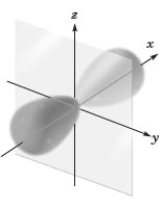 Which of the following is the correct designation for this orbital?
 (Multiple Choice)
4.8/5 (79)
(79) 
Filters
- Essay(0)
- Multiple Choice(0)
- Short Answer(0)
- True False(0)
- Matching(0)