



 Chat with AI
Exam 7: Reaction Rates and Chemical Equilibrium

Exam 1: Matter, Energy, and Measurement143 Questions
Exam 2: Atoms133 Questions
Exam 3: Chemical Bonds140 Questions
Exam 4: Chemical Reactions140 Questions
Exam 5: Gases, Liquids, and Solids132 Questions
Exam 6: Solutions and Colloids153 Questions
Exam 7: Reaction Rates and Chemical Equilibrium103 Questions
Exam 8: Acids and Bases197 Questions
Exam 9: Nuclear Chemistry155 Questions
Exam 10: Organic Chemistry70 Questions
Exam 11: Alkanes142 Questions
Exam 12: Alkenes and Alkynes123 Questions
Exam 13: Benzene and Its Derivatives60 Questions
Exam 14: Alcohols, Ethers, and Thiols122 Questions
Exam 15: Chirality: the Handedness of Molecules92 Questions
Exam 16: Amines89 Questions
Exam 17: Aldehydes and Ketones101 Questions
Exam 18: Carboxylic Acids115 Questions
Exam 19: Carboxylic Anhydrides, Esters, and Amides117 Questions
Exam 20: Carbohydrates103 Questions
Exam 21: Lipids132 Questions
Exam 22: Proteins128 Questions
Exam 23: Enzymes62 Questions
Exam 24: Chemical Communications: Neurotransmitters and Hormones89 Questions
Exam 25: Nucleotides, Nucleic Acids, and Heredity121 Questions
Exam 26: Gene Expression and Protein Synthesis129 Questions
Exam 27: Bioenergetics: How the Body Converts Food to Energy140 Questions
Exam 28: Specific Catabolic Pathways: Carbohydrate, Lipid, and Protein Metabolism104 Questions
Exam 29: Biosynthetic Pathways67 Questions
Exam 30: Nutrition73 Questions
Exam 31: Immunochemistry142 Questions
Exam 32: Body Fluids72 Questions
Select questions type


Suppose that the equilibrium constant for the chemical reaction 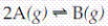 has an equilibrium constant of 2.3 × 10⁷. What is the equilibrium constant for the following reaction?
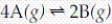
has an equilibrium constant of 2.3 × 10⁷. What is the equilibrium constant for the following reaction? (Multiple Choice)
5.0/5  (87)
(87) For the exothermic reaction  which of the following changes could be carried out in such a way as to not cause the reaction to shift either to the left or to the right?
 (Multiple Choice)
4.9/5 (81)
(81) For the reaction 2C → A + B, 0.01 mol of A is formed during the first 15 seconds of the reaction. Assuming that the rate of reaction remains constant for two minutes, which of the following statements is true?
(Multiple Choice)
4.8/5 (84)
(84) If the exothermic reaction  has reached equilibrium, what is the effect of raising the temperature of the reaction vessel?
 (Multiple Choice)
4.8/5 (72)
(72) For the reaction  which of the following is the equilibrium constant expression?
 (Multiple Choice)
4.8/5 (80)
(80) Which of the following an example of an equilibrium situation?
(Multiple Choice)
4.9/5 (59)
(59) For the reaction A + B → 2 C, which of the following statements is true?
(Multiple Choice)
4.9/5 (73)
(73) Which of the following must we know in order to write the equilibrium constant for a chemical reaction?
(Multiple Choice)
4.8/5 (88)
(88) Why will increasing the temperature of a reaction speed up the reaction?
(Multiple Choice)
4.9/5 (78)
(78) Which of the following describes the effect of raising the temperature of an endothermic reaction which has not yet reached equilibrium?
(Multiple Choice)
5.0/5 (77)
(77) Which of the following symbols is used to denote a reversible reaction?
(Multiple Choice)
4.9/5 (79)
(79) In an energy diagram for an exothermic chemical reaction which of the following is true?
(Multiple Choice)
4.9/5 (73)
(73) Consider the following graph.  The graph is based on data collected for the following reaction.
CH3COOH(g) + C2H5OH(g)
 CH3COOC2H5(g) + H2O(g)
-If the line B presently represents CH3COOH, how would the graph change if this line represented C2H5OH?
The graph is based on data collected for the following reaction.
CH3COOH(g) + C2H5OH(g) CH3COOC2H5(g) + H2O(g)
-If the line B presently represents CH3COOH, how would the graph change if this line represented C2H5OH? (Multiple Choice)
4.7/5 (83)
(83) When the concentration of a reactant is increased which of the following is true?
(Multiple Choice)
4.9/5 (74)
(74) Suppose that the equilibrium constant for the chemical reaction 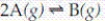 has an equilibrium constant of 2.3 x 10⁷. What is the equilibrium constant for the following reaction?
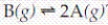
has an equilibrium constant of 2.3 x 10⁷. What is the equilibrium constant for the following reaction? (Multiple Choice)
4.8/5 (74)
(74) A particular reaction has an equilibrium constant of 1 x 10-15. Which of the following best describes the relationship between the equilibrium constant and the reaction rate?
(Multiple Choice)
4.9/5 (82)
(82) Consider the following graph. The graph is based on data collected for the following reaction.
CH3COOH(g) + C2H5OH(g) CH3COOC2H5(g) + H2O(g)
-At what point on the graph does the rate of the forward reaction equal the rate of the reverse reaction?
The graph is based on data collected for the following reaction.
CH3COOH(g) + C2H5OH(g) CH3COOC2H5(g) + H2O(g)
-At what point on the graph does the rate of the forward reaction equal the rate of the reverse reaction? (Multiple Choice)
4.8/5 (83)
(83) What is the effect of adding C2H5OH(l) to a container in which the reaction has reached equilibrium? 


(Multiple Choice)
4.8/5 (83)
(83) Sodium chloride and silver nitrate react to produce silver chloride and sodium nitrate? Which of the following will result in the fastest reaction between sodium chloride and silver nitrate?
(Multiple Choice)
4.8/5 (69)
(69) 
Filters
- Essay(0)
- Multiple Choice(0)
- Short Answer(0)
- True False(0)
- Matching(0)