



 Chat with AI
Exam 32: Body Fluids

Exam 1: Matter, Energy, and Measurement143 Questions
Exam 2: Atoms133 Questions
Exam 3: Chemical Bonds140 Questions
Exam 4: Chemical Reactions140 Questions
Exam 5: Gases, Liquids, and Solids132 Questions
Exam 6: Solutions and Colloids153 Questions
Exam 7: Reaction Rates and Chemical Equilibrium103 Questions
Exam 8: Acids and Bases197 Questions
Exam 9: Nuclear Chemistry155 Questions
Exam 10: Organic Chemistry70 Questions
Exam 11: Alkanes142 Questions
Exam 12: Alkenes and Alkynes123 Questions
Exam 13: Benzene and Its Derivatives60 Questions
Exam 14: Alcohols, Ethers, and Thiols122 Questions
Exam 15: Chirality: the Handedness of Molecules92 Questions
Exam 16: Amines89 Questions
Exam 17: Aldehydes and Ketones101 Questions
Exam 18: Carboxylic Acids115 Questions
Exam 19: Carboxylic Anhydrides, Esters, and Amides117 Questions
Exam 20: Carbohydrates103 Questions
Exam 21: Lipids132 Questions
Exam 22: Proteins128 Questions
Exam 23: Enzymes62 Questions
Exam 24: Chemical Communications: Neurotransmitters and Hormones89 Questions
Exam 25: Nucleotides, Nucleic Acids, and Heredity121 Questions
Exam 26: Gene Expression and Protein Synthesis129 Questions
Exam 27: Bioenergetics: How the Body Converts Food to Energy140 Questions
Exam 28: Specific Catabolic Pathways: Carbohydrate, Lipid, and Protein Metabolism104 Questions
Exam 29: Biosynthetic Pathways67 Questions
Exam 30: Nutrition73 Questions
Exam 31: Immunochemistry142 Questions
Exam 32: Body Fluids72 Questions
Select questions type


The secretion of renin by the kidneys results in which of the following?
(Multiple Choice)
4.7/5  (75)
(75) Serum is obtained by removing which of the following from plasma?
(Multiple Choice)
4.9/5 (83)
(83) Which of the following gives the correct order of pressures?
(Multiple Choice)
4.9/5 (91)
(91) Which of the following is associated with a low leukocyte count?
(Multiple Choice)
4.8/5 (76)
(76) Which group of materials accounts for most of the dissolved solids in the plasma?
(Multiple Choice)
4.9/5 (69)
(69) Examine the following diagram of a kidney nephron and the surrounding circulatory system. 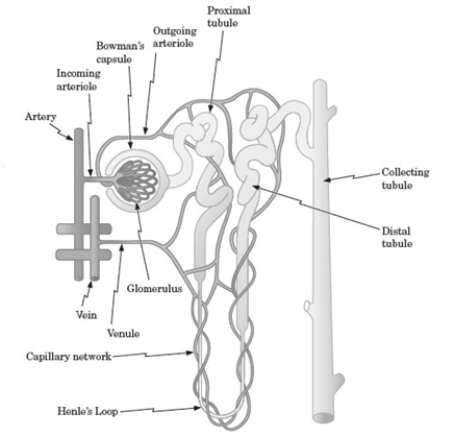 -Blood enters the capsule and glomerulus. Which of the following components of the blood will eventually pass to the collecting tubule?
 (Multiple Choice)
4.8/5 (74)
(74) Which of the following is the most abundant protein in blood plasma?
(Multiple Choice)
4.8/5 (68)
(68) Under normal conditions which of the following is involved in the reabsorption of water?
(Multiple Choice)
4.9/5 (79)
(79) Which of the following is associated with a high leukocyte count?
(Multiple Choice)
4.8/5 (76)
(76) Which of the following results from the fact that the osmotic pressure of blood is lower than the pressure at the arterial capillaries?
(Multiple Choice)
4.8/5 (77)
(77) How many heme units are present in a molecule of hemoglobin?
(Multiple Choice)
4.8/5 (81)
(81) A 150 lb man has approximately what volume of whole blood in his body?
(Multiple Choice)
4.8/5 (78)
(78) The following images shows some representations of some of the common components of blood. 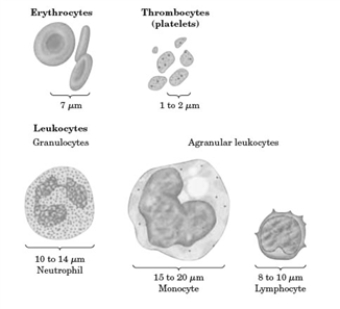 -Which type of cell is the most prevalent one found in the blood?
 (Multiple Choice)
4.8/5 (78)
(78) Which of the following enzymes is(are) involved in the transport of CO2 by blood?
(Multiple Choice)
4.8/5 (74)
(74) 
Filters
- Essay(0)
- Multiple Choice(0)
- Short Answer(0)
- True False(0)
- Matching(0)