



 Chat with AI
Exam 13: Regulation of Commercial Banks

Exam 1: Introduction50 Questions
Exam 2: Determinants of Interest Rates62 Questions
Exam 3: Interest Rates and Security Valuation72 Questions
Exam 4: The Federal Reserve System, monetary Policy, and Interest Rates60 Questions
Exam 5: Money Markets61 Questions
Exam 6: Bond Markets61 Questions
Exam 7: Mortgage Markets60 Questions
Exam 8: Stock Markets67 Questions
Exam 9: Foreign Exchange Markets60 Questions
Exam 10: Derivative Securities Markets61 Questions
Exam 11: Commercial Banks: Industry Overview48 Questions
Exam 12: Commercial Banks Financial Statements and Analysis59 Questions
Exam 13: Regulation of Commercial Banks60 Questions
Exam 14: Other Lending Institutions: Savings Institutions, credit Unions, and Finance Companies62 Questions
Exam 15: Insurance Companies62 Questions
Exam 16: Securities Firms and Investment Banks57 Questions
Exam 17: Investment Companies64 Questions
Exam 18: Pension Funds60 Questions
Exam 19: Types of Risks Incurred by Financial Institutions55 Questions
Exam 20: Managing Credit Risk on the Balance Sheet63 Questions
Exam 21: Managing Liquidity Risk on the Balance Sheet60 Questions
Exam 22: Managing Interest Rate Risk and Insolvency Risk on the Balance Sheet58 Questions
Exam 23: Managing Risk Off the Balance Sheet With Derivative Securities63 Questions
Exam 24: Managing Risk Off the Balance Sheet With Loan Sales and Securitization60 Questions
Select questions type


Unit banking states are states that do not allow interstate branch banking but allow the creation of intrastate branch banks.
(True/False)
4.7/5  (87)
(87) The 1993 Basel Agreement explicitly incorporated the different credit risks of assets into capital adequacy measures.
(True/False)
4.9/5 (90)
(90) What changes to foreign bank operations in the United States have been brought about by the Foreign Bank Supervision and Enhancement Act of 1991?
(Essay)
4.8/5 (95)
(95) (a)What are the mandatory Prompt Corrective Action (PCA)Provisions for an undercapitalized bank? Explain why these provisions are required.
(b)Why does one of the mandatory PCA Provisions for a critically undercapitalized bank include appointing a receiver/conservator within 90 days?
(Essay)
4.7/5 (84)
(84) A financial intermediary that can engage in a broad range of financial service activities is termed a universal FI.
(True/False)
4.7/5 (86)
(86) The FDIC is required to establish a plan to restore the DIF if the reserve ratio falls below ________ of insured deposits.
(Multiple Choice)
4.8/5 (82)
(82) Tier II (supplementary)capital includes which of the following?
I. Allowance for loan and lease losses,up to 1.25 percent of risk-weighted assets
II. Subordinated debt with original maturity of at least 5 years
III. Common stock and retained earnings
IV. Nontransaction deposits
(Multiple Choice)
4.9/5 (83)
(83) Which act allowed the establishment of full-service financial institutions in the United States?
(Multiple Choice)
4.8/5 (81)
(81) Major provisions of the Financial Services Modernization Act of 1999 include all of the following except
(Multiple Choice)
4.8/5 (86)
(86) Banks are generally prohibited from making loans exceeding more than 15 percent of their own equity capital to any one company or borrower.
(True/False)
4.9/5 (86)
(86) The average daily net transaction accounts of a local bank during the most recent reserve computation period is $589 million. The amount of average daily reserves at the Fed during the reserve maintenance period is $73.31 million,and the average daily vault cash corresponding to the maintenance period is $8.36 million. What is the average daily reserve balance required to be held by the bank during the maintenance period and is this bank in compliance with reserve requirements?
(Multiple Choice)
4.8/5 (73)
(73) The average daily net transaction accounts of a local bank during the most recent reserve computation period is $687 million. The amount of average daily reserves at the Fed during the reserve maintenance period is $35.23 million,and the average daily vault cash corresponding to the maintenance period is $12.74 million. Is this bank in compliance with reserve requirements?
(Multiple Choice)
4.9/5 (63)
(63) FBSEA Act of 1991 extended federal regulatory authority over foreign banking organizations in the United States.
(True/False)
4.7/5 (74)
(74) (a)A bank has risk-weighted assets of $175 and equity of $12.5. If regulators require a minimum risk-weighted capital ratio of 5 percent given the current level of equity,how many new assets with a 100 percent risk weight can the bank add? How many with a 50 percent risk weight?
(b)If the bank had 20 percent more equity,how many new assets with a 100 percent risk weight could the bank add? How many with a 50 percent risk weight? How does having more equity affect a bank's ability to grow? How is this growth affected by the riskiness of the bank's assets?
(Essay)
4.9/5 (83)
(83) How do risk-based deposit insurance premiums and risk-based capital requirements help reduce the moral hazard problem of deposit insurance? (Hint: Moral hazard means that because of deposit insurance,banks may take on excessive amounts of risk.)
(Essay)
4.8/5 (95)
(95) A Bank has the following balance sheet (in millions),with the risk weights in parentheses.
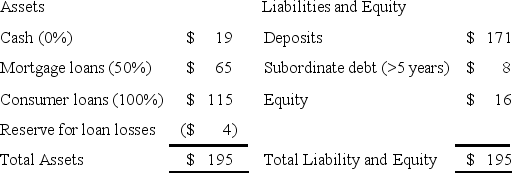 In addition,the bank has $30 million in commercial direct-credit substitute standby letters of credit to a public corporation and $30 million in 10-year FX forward contracts that are in the money by $2 million.
A) What are the risk-adjusted on-balance-sheet assets of the bank as defined under the Basel III?
B) What are the common equity Tier I (CET1)risk-based capital ratio,Tier I risk-based capital ratio,and the total risk-based capital ratio?
C) Disregarding the capital conservation buffer,does the bank have sufficient capital to meet the Basel requirements?
In addition,the bank has $30 million in commercial direct-credit substitute standby letters of credit to a public corporation and $30 million in 10-year FX forward contracts that are in the money by $2 million.
A) What are the risk-adjusted on-balance-sheet assets of the bank as defined under the Basel III?
B) What are the common equity Tier I (CET1)risk-based capital ratio,Tier I risk-based capital ratio,and the total risk-based capital ratio?
C) Disregarding the capital conservation buffer,does the bank have sufficient capital to meet the Basel requirements?
(Essay)
4.8/5 (90)
(90) Among other things,the Financial Institutions Reform,Recovery,and Enforcement Act stipulated the creation of the
(Multiple Choice)
4.8/5 (76)
(76) To be classified as an adequately capitalized bank,the bank must have a leverage ratio of at least ________ percent,Tier I capital to credit risk-adjusted asset ratio of at least ________ percent and a total capital to credit risk-adjusted assets ratio of at least ________ percent,and does not meet the definition of a well-capitalized bank.
(Multiple Choice)
5.0/5 (90)
(90) 
Filters
- Essay(0)
- Multiple Choice(0)
- Short Answer(0)
- True False(0)
- Matching(0)