



 Chat with AI
Exam 12: Commercial Banks Financial Statements and Analysis

Exam 1: Introduction50 Questions
Exam 2: Determinants of Interest Rates62 Questions
Exam 3: Interest Rates and Security Valuation72 Questions
Exam 4: The Federal Reserve System, monetary Policy, and Interest Rates60 Questions
Exam 5: Money Markets61 Questions
Exam 6: Bond Markets61 Questions
Exam 7: Mortgage Markets60 Questions
Exam 8: Stock Markets67 Questions
Exam 9: Foreign Exchange Markets60 Questions
Exam 10: Derivative Securities Markets61 Questions
Exam 11: Commercial Banks: Industry Overview48 Questions
Exam 12: Commercial Banks Financial Statements and Analysis59 Questions
Exam 13: Regulation of Commercial Banks60 Questions
Exam 14: Other Lending Institutions: Savings Institutions, credit Unions, and Finance Companies62 Questions
Exam 15: Insurance Companies62 Questions
Exam 16: Securities Firms and Investment Banks57 Questions
Exam 17: Investment Companies64 Questions
Exam 18: Pension Funds60 Questions
Exam 19: Types of Risks Incurred by Financial Institutions55 Questions
Exam 20: Managing Credit Risk on the Balance Sheet63 Questions
Exam 21: Managing Liquidity Risk on the Balance Sheet60 Questions
Exam 22: Managing Interest Rate Risk and Insolvency Risk on the Balance Sheet58 Questions
Exam 23: Managing Risk Off the Balance Sheet With Derivative Securities63 Questions
Exam 24: Managing Risk Off the Balance Sheet With Loan Sales and Securitization60 Questions
Select questions type


Both retail and wholesale CDs are negotiable instruments despite their different denominations.

Free
(True/False)
4.8/5  (87)
(87) Correct Answer: Verified
False
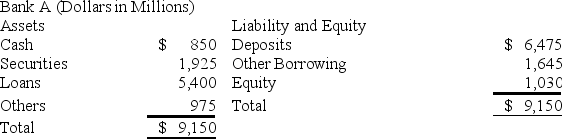
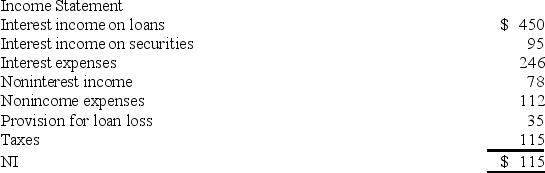 The bank's asset utilization ratio is
Free
(Multiple Choice)
4.8/5 (82)
(82) Correct Answer:Verified
VerifiedE
Interest-bearing retail accounts with limited checking features designed to compete with money market mutual fund investments are called ________.
Free
(Multiple Choice)
4.9/5 (88)
(88) Correct Answer:Verified
VerifiedC
Loans to consumers and to individuals are jointly termed C&I loans on a bank's balance sheet.
(True/False)
4.9/5 (87)
(87) Uniform principles,standards,and report forms for depository institutions are prescribed by the
(Multiple Choice)
4.8/5 (80)
(80) 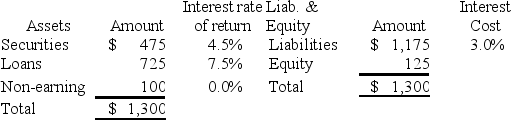
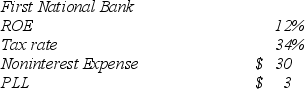
 If the net noninterest income were to increase to −$16,what would the average loan rate (ALR)have to be to generate a 12 percent ROE? Compared to the industry,does this ALR appear feasible? If not,what options does FNB have?
(Essay)
4.8/5 (88)
(88) Which of the following is not an off-balance sheet activity?
(Multiple Choice)
4.9/5 (82)
(82) At almost all banks noninterest expense is greater than noninterest income; hence,the overhead efficiency ratio is usually greater than 100 percent.
(True/False)
4.9/5 (79)
(79) Net loans and leases plus ________ plus ________ equals gross loans and leases.
(Multiple Choice)
4.9/5 (69)
(69) Bank A has a higher ROA than Bank B. Both banks have similar interest income to asset ratios and noninterest income to asset ratios. We know that
I. Bank A has a higher profit margin than Bank B.
II. Bank A has a higher AU ratio than Bank B.
III. Bank A must have a higher PLL/OI ratio.
(Multiple Choice)
4.7/5 (81)
(81) At the start of the quarter a bank has $55 million (gross)in its loan portfolio,and has $1 million in its allowance for loan loss account. During the quarter,loan audits indicate that an additional $300,000 of loans will not be paid as promised. These loans have not yet been written off as uncollectible,however. What are the starting and ending gross and net loan amounts and the provision for loan loss account,and what is the effect on the bank's quarterly earnings?

(Essay)
4.9/5 (86)
(86) 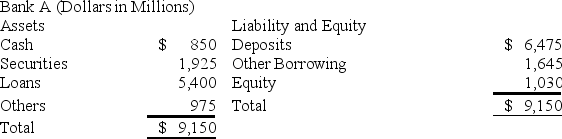
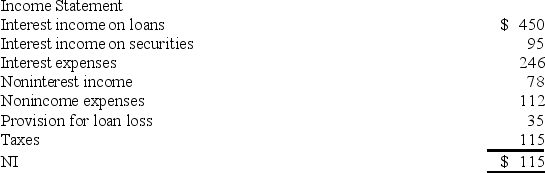 The bank's ROE is
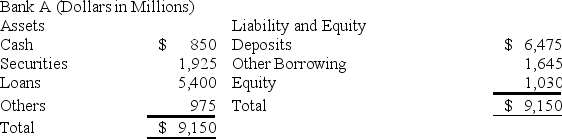
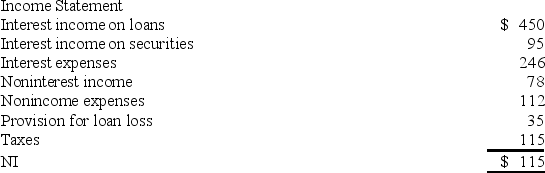 The bank's profit margin is
What is the difference between a loan commitment and a letter of credit?
(Essay)
4.7/5 (81)
(81) Which of the following assets are used to increase a bank's liquidity position?
(Multiple Choice)
4.9/5 (80)
(80) Rate-sensitive funding sources at a bank are termed core deposits.
(True/False)
4.8/5 (82)
(82) 
Filters
- Essay(0)
- Multiple Choice(0)
- Short Answer(0)
- True False(0)
- Matching(0)