



 Chat with AI
Exam 20: Managing Credit Risk on the Balance Sheet

Exam 1: Introduction50 Questions
Exam 2: Determinants of Interest Rates62 Questions
Exam 3: Interest Rates and Security Valuation72 Questions
Exam 4: The Federal Reserve System, monetary Policy, and Interest Rates60 Questions
Exam 5: Money Markets61 Questions
Exam 6: Bond Markets61 Questions
Exam 7: Mortgage Markets60 Questions
Exam 8: Stock Markets67 Questions
Exam 9: Foreign Exchange Markets60 Questions
Exam 10: Derivative Securities Markets61 Questions
Exam 11: Commercial Banks: Industry Overview48 Questions
Exam 12: Commercial Banks Financial Statements and Analysis59 Questions
Exam 13: Regulation of Commercial Banks60 Questions
Exam 14: Other Lending Institutions: Savings Institutions, credit Unions, and Finance Companies62 Questions
Exam 15: Insurance Companies62 Questions
Exam 16: Securities Firms and Investment Banks57 Questions
Exam 17: Investment Companies64 Questions
Exam 18: Pension Funds60 Questions
Exam 19: Types of Risks Incurred by Financial Institutions55 Questions
Exam 20: Managing Credit Risk on the Balance Sheet63 Questions
Exam 21: Managing Liquidity Risk on the Balance Sheet60 Questions
Exam 22: Managing Interest Rate Risk and Insolvency Risk on the Balance Sheet58 Questions
Exam 23: Managing Risk Off the Balance Sheet With Derivative Securities63 Questions
Exam 24: Managing Risk Off the Balance Sheet With Loan Sales and Securitization60 Questions
Select questions type


A rising sales to working capital ratio may indicate a potential borrower is using its net current assets more efficiently.

Free
(True/False)
4.8/5  (73)
(73) Correct Answer: Verified
True
The base loan rate accounts for
I. the FI's weighted average cost of capital.
II. the FI's marginal cost of funds.
III. the credit risk of the loan.
Free
(Multiple Choice)
4.9/5 (87)
(87) Correct Answer:Verified
VerifiedB
 GDS cutoff: 30 percent
TDS cutoff: 35 percent
Using only the GDS criteria,which one of the following statements is true?
GDS cutoff: 30 percent
TDS cutoff: 35 percent
Using only the GDS criteria,which one of the following statements is true?Free
(Multiple Choice)
4.8/5 (86)
(86) Correct Answer:Verified
VerifiedC
A $40,000 one-year loan with a 1 percent origination fee and a 7.50 percent interest rate is funded with money on which the bank owes 3 percent. What is the expected pretax dollar spread on the loan? If the bank needs to net at least 3.5 percent on the funds lent to make its ROE,how many dollars can the bank spend on credit investigation,loan servicing,and so forth? Would the bank be able to spend more if the loan amount was greater? What does this example suggest about credit analysis?
(Essay)
4.9/5 (93)
(93) Analysis of the statement of cash flows involves assessment of operating,financing and investing cash flows and analysis of the resulting net income.
(True/False)
4.8/5 (82)
(82) A corporate customer obtains a $1.5 million loan from a bank. The customer agrees to pay a 6.25 percent interest rate and agrees to make compensating balances of 4 percent of the loan amount. These will be held in noninterest-bearing transactions deposits at the bank for one year. The bank charges a 1 percent loan origination fee on the amount borrowed. Reserve requirements are 10 percent. What is the expected rate of return to the bank (k)(to the nearest basis point)?
(Multiple Choice)
4.9/5 (77)
(77) Explain how the Moody's Analytics Model predicts bankruptcy probability.
(Essay)
4.9/5 (83)
(83) Individuals with higher levels of income must have higher GDS and TDS ratios to qualify for a loan.
(True/False)
5.0/5 (72)
(72) The ratio that measures the firm's efficiency in utilizing its assets to generate revenue is:
(Multiple Choice)
4.7/5 (80)
(80) 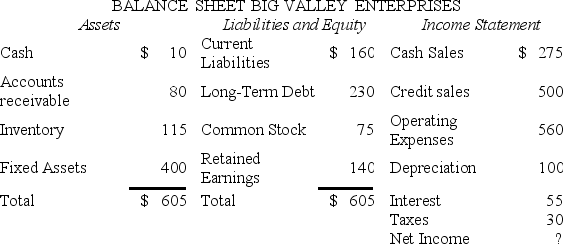 Interest is Big Valley's only fixed cash charge.
Big Valley's market value of equity to book value of debt ratio = 1.5.
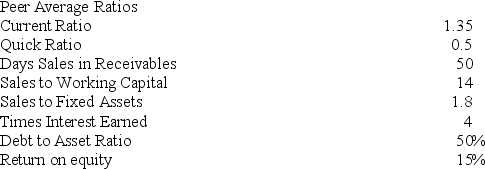 Big Valley's current ratio indicates that Big Valley is ________ liquid than the typical firm in the industry,and Big Valley's quick ratio indicates that Big Valley is ________ liquid than the typical firm.
Interest is Big Valley's only fixed cash charge.
Big Valley's market value of equity to book value of debt ratio = 1.5.
Big Valley's current ratio indicates that Big Valley is ________ liquid than the typical firm in the industry,and Big Valley's quick ratio indicates that Big Valley is ________ liquid than the typical firm. (Multiple Choice)
4.9/5 (81)
(81) Nonperforming loans are loans that are past due ________ that are not accruing interest.
(Multiple Choice)
4.8/5 (77)
(77) Which one of the following five Cs of credit is NOT correctly defined?
(Multiple Choice)
4.8/5 (79)
(79) Before allowing the borrower to actually acquire the funds for a mid-market collateralized loan,what must the lender ensure? What type of monitoring occurs by the lender after the loan is granted?
(Essay)
4.8/5 (80)
(80) A bank is using the RAROC to evaluate large business loans. The benchmark rate of return is 7.55 percent. The one-year loan interest rate is 8.00 percent and the bank must pay 7.40 percent to raise the funds. The cost to service the loan is 0.3 percent. If the loan defaults,92 percent of the money lent will be lost. Based on historical default rates,the extreme worst-case loss scenario is about 5 percent. Should the bank make the loan? Why or why not?
(Multiple Choice)
4.8/5 (69)
(69) If you are a lender evaluating a loan application and you calculate the following ratio: (EBIT + Lease Payments)/[Interest + Lease Payments + (Sinking Fund/(1 − T))],then you are calculating a debt service ratio and it should be less than one in order to approve the loan.
(True/False)
4.9/5 (74)
(74) In concept,the RAROC measure indicates a loan is acceptable if the RAROC is greater than the
(Multiple Choice)
4.9/5 (84)
(84) 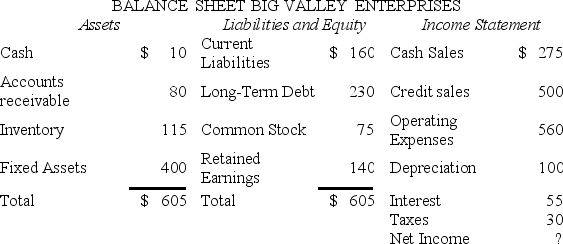 Interest is Big Valley's only fixed cash charge.
Big Valley's market value of equity to book value of debt ratio = 1.5.
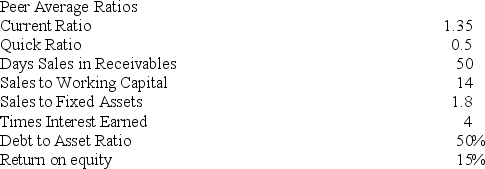 Big Valley's return on equity indicates that the firm generates a ________ return to their shareholders than their peers.
Interest is Big Valley's only fixed cash charge.
Big Valley's market value of equity to book value of debt ratio = 1.5.
Big Valley's return on equity indicates that the firm generates a ________ return to their shareholders than their peers. (Multiple Choice)
4.9/5 (76)
(76) 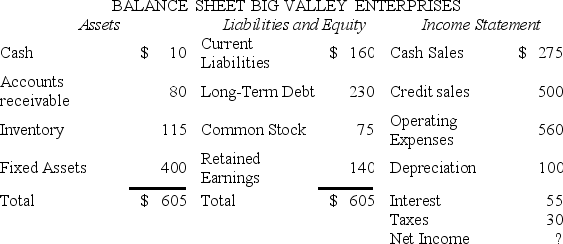 Interest is Big Valley's only fixed cash charge.
Big Valley's market value of equity to book value of debt ratio = 1.5.
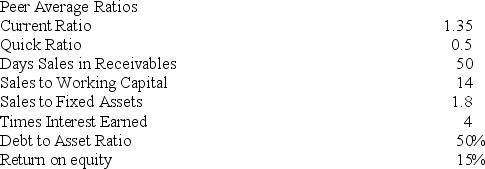 Big Valley is collecting their receivables about ________ than the typical firm.
Interest is Big Valley's only fixed cash charge.
Big Valley's market value of equity to book value of debt ratio = 1.5.
Big Valley is collecting their receivables about ________ than the typical firm. (Multiple Choice)
4.9/5 (74)
(74) As long as overall cash flow growth is positive,a bank loan officer would not be concerned if cash flow from operations was projected to be negative over the term of the loan.
(True/False)
4.8/5 (72)
(72) 
Filters
- Essay(0)
- Multiple Choice(0)
- Short Answer(0)
- True False(0)
- Matching(0)