



 Chat with AI
Exam 20: Managing Credit Risk on the Balance Sheet

Exam 1: Introduction50 Questions
Exam 2: Determinants of Interest Rates62 Questions
Exam 3: Interest Rates and Security Valuation72 Questions
Exam 4: The Federal Reserve System, monetary Policy, and Interest Rates60 Questions
Exam 5: Money Markets61 Questions
Exam 6: Bond Markets61 Questions
Exam 7: Mortgage Markets60 Questions
Exam 8: Stock Markets67 Questions
Exam 9: Foreign Exchange Markets60 Questions
Exam 10: Derivative Securities Markets61 Questions
Exam 11: Commercial Banks: Industry Overview48 Questions
Exam 12: Commercial Banks Financial Statements and Analysis59 Questions
Exam 13: Regulation of Commercial Banks60 Questions
Exam 14: Other Lending Institutions: Savings Institutions, credit Unions, and Finance Companies62 Questions
Exam 15: Insurance Companies62 Questions
Exam 16: Securities Firms and Investment Banks57 Questions
Exam 17: Investment Companies64 Questions
Exam 18: Pension Funds60 Questions
Exam 19: Types of Risks Incurred by Financial Institutions55 Questions
Exam 20: Managing Credit Risk on the Balance Sheet63 Questions
Exam 21: Managing Liquidity Risk on the Balance Sheet60 Questions
Exam 22: Managing Interest Rate Risk and Insolvency Risk on the Balance Sheet58 Questions
Exam 23: Managing Risk Off the Balance Sheet With Derivative Securities63 Questions
Exam 24: Managing Risk Off the Balance Sheet With Loan Sales and Securitization60 Questions
Select questions type


Explain the purpose/benefits in adding a credit-scoring model to evaluate a loan application.
(Essay)
4.9/5  (87)
(87) Describe the credit analysis process for a mid-market corporate loan applicant.
(Essay)
5.0/5 (84)
(84) Issuance of short-term debt would result in an increase in cash flow from operations on the statement of cash flows.
(True/False)
4.8/5 (78)
(78) For most business loans,growing earnings are not a sufficient reason to grant a loan. Why?
(Essay)
4.7/5 (83)
(83) A bank can charge a corporate borrower 6.25 percent on a loan. The borrower is asking for a $600,000 loan. The extreme loss rate on this loan type is 4.0 percent and,when default occurs,about 15 percent of the loan amount is recovered. The interest and noninterest cost of the loan is 5.85 percent. What is the RAROC of the loan? Under what circumstances should the bank make the loan?
(Essay)
4.8/5 (85)
(85) Asset management ratios are used in credit analysis to help understand the borrower's ability to generate sales from the amount invested in some asset category.
(True/False)
4.8/5 (79)
(79) The risk-adjusted return on capital (RAROC)model calculates the actual or promised annual cash flow on a loan as a percentage of the amount lent.
(True/False)
5.0/5 (84)
(84) Junk bonds usually yield lower returns than investment-grade bonds due to their speculative feature.
(True/False)
4.9/5 (79)
(79) A bank has a base loan rate of 4.75 percent and for the loan under consideration it would apply a 2 percent risk premium. The bank also requires compensating balances (noninterest-bearing)equal to 5 percent of the loan amount. The bank's reserve requirements are 10 percent. The bank charges 1 percent of the loan amount as an origination fee. The borrower is asking for a $500,000 loan. Calculate the ROA on the loan.
(Essay)
4.8/5 (81)
(81) Residential mortgage loan applications have the most diverse application processes that differ from one institution to the other.
(True/False)
4.9/5 (84)
(84) A bank charges a commercial borrower a 6.55 percent interest rate on a one-year loan. The bank also charges a 0.5 percent origination fee and requires compensating balances of 7 percent in the form of demand deposits. Reserve requirements are 10 percent. What is the promised gross rate of return on the loan?
(Multiple Choice)
5.0/5 (76)
(76) Individual credit-scoring models typically include all of the following information except
(Multiple Choice)
4.9/5 (86)
(86) A corporate loan applicant has cash of $40,receivables of $50,and inventory of $20. The applicant also has current debts of $65. If the bank's policy requires a current ratio of 1.75 or better and an acid test ratio of 1.25 or better,would the applicant receive the loan?
(Multiple Choice)
4.9/5 (87)
(87) 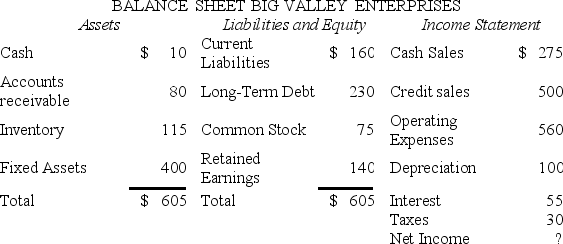 Interest is Big Valley's only fixed cash charge.
Big Valley's market value of equity to book value of debt ratio = 1.5.
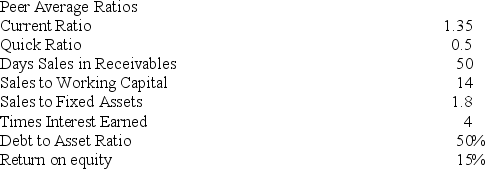 Big Valley's fixed asset efficiency score is ________ which is ________that of the typical firm in the industry.
Interest is Big Valley's only fixed cash charge.
Big Valley's market value of equity to book value of debt ratio = 1.5.
Big Valley's fixed asset efficiency score is ________ which is ________that of the typical firm in the industry. (Multiple Choice)
4.7/5 (65)
(65)  GDS cutoff: 30 percent
TDS cutoff: 35 percent
Using only the TDS criteria,which one of the following statements is true?
GDS cutoff: 30 percent
TDS cutoff: 35 percent
Using only the TDS criteria,which one of the following statements is true? (Multiple Choice)
4.9/5 (81)
(81) Which ratio measures the firm's ability to pay current interest and lease payments?
(Multiple Choice)
4.7/5 (84)
(84) If you were a loan officer evaluating a small business credit application for a loan and you wanted to ensure that the applicant had more than sufficient cash flow to pay off its existing debt,the applicant's cash-flow-to-debt ratio would have to be greater than
(Multiple Choice)
5.0/5 (85)
(85) As a business lender,you would prefer that the borrower have stable or growing cash flows resulting from which part of the statement of cash flows?
(Multiple Choice)
4.8/5 (70)
(70) 
Filters
- Essay(0)
- Multiple Choice(0)
- Short Answer(0)
- True False(0)
- Matching(0)