



 Chat with AI
Exam 12: Commercial Banks Financial Statements and Analysis

Exam 1: Introduction50 Questions
Exam 2: Determinants of Interest Rates62 Questions
Exam 3: Interest Rates and Security Valuation72 Questions
Exam 4: The Federal Reserve System, monetary Policy, and Interest Rates60 Questions
Exam 5: Money Markets61 Questions
Exam 6: Bond Markets61 Questions
Exam 7: Mortgage Markets60 Questions
Exam 8: Stock Markets67 Questions
Exam 9: Foreign Exchange Markets60 Questions
Exam 10: Derivative Securities Markets61 Questions
Exam 11: Commercial Banks: Industry Overview48 Questions
Exam 12: Commercial Banks Financial Statements and Analysis59 Questions
Exam 13: Regulation of Commercial Banks60 Questions
Exam 14: Other Lending Institutions: Savings Institutions, credit Unions, and Finance Companies62 Questions
Exam 15: Insurance Companies62 Questions
Exam 16: Securities Firms and Investment Banks57 Questions
Exam 17: Investment Companies64 Questions
Exam 18: Pension Funds60 Questions
Exam 19: Types of Risks Incurred by Financial Institutions55 Questions
Exam 20: Managing Credit Risk on the Balance Sheet63 Questions
Exam 21: Managing Liquidity Risk on the Balance Sheet60 Questions
Exam 22: Managing Interest Rate Risk and Insolvency Risk on the Balance Sheet58 Questions
Exam 23: Managing Risk Off the Balance Sheet With Derivative Securities63 Questions
Exam 24: Managing Risk Off the Balance Sheet With Loan Sales and Securitization60 Questions
Select questions type


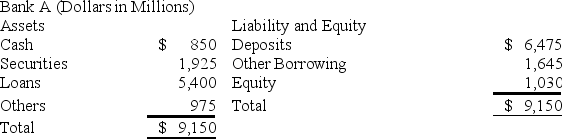
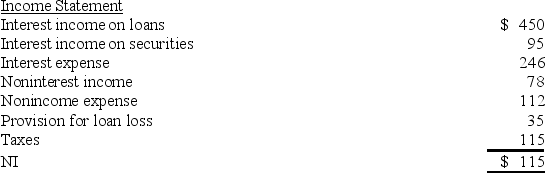 The bank's ROA is

A municipal bond is paying a 6 percent annual yield. An equivalent risk corporate bond is paying 7 percent. Investors with a tax rate of ________ or higher would prefer the municipal bond.
(Multiple Choice)
4.7/5  (73)
(73) MMDAs are a type of savings account that has some limited checking features. These accounts were designed to help banks compete with MMMFs.
(True/False)
4.8/5 (84)
(84) 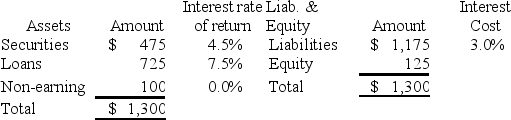
 What is the bank's NIM? Is the bank performing better or worse than average? In what area is the bank performing better or worse than average? How could the bank improve if necessary?
NIM = (Interest revenue − Interest expense)/(Securities + Loans)
[(475 × .045)+ (725 × .075)− (1,175 × .03)]/(475 + 725)= 3.383%
What is the bank's NIM? Is the bank performing better or worse than average? In what area is the bank performing better or worse than average? How could the bank improve if necessary?
NIM = (Interest revenue − Interest expense)/(Securities + Loans)
[(475 × .045)+ (725 × .075)− (1,175 × .03)]/(475 + 725)= 3.383%
(Essay)
4.8/5 (78)
(78) Investment securities plus ________ is equal to a bank's earning assets.
(Multiple Choice)
4.9/5 (81)
(81) What are the major sources of purchased funds? Can using purchased funds change a bank's profitability? Its risk level? Explain.
(Essay)
4.9/5 (83)
(83) Oceanside Bank converts a dollar of equity into 10 cents of net income and has $9.50 in assets per dollar of equity capital. Oceanside also has a profit margin of 15 percent. What is Oceanside's AU ratio?
(Multiple Choice)
4.9/5 (83)
(83) The largest market available for purchased funds is the ________.
(Multiple Choice)
4.8/5 (80)
(80) What is the difference between net charge-offs (NCOs,sometimes called write-offs)and the provision for loan loss (PLL)? What is the purpose of the PLL account?
(Essay)
4.9/5 (87)
(87) The provision for loan loss account is actual loan losses less loan recoveries in a given time period.
(True/False)
4.7/5 (78)
(78) A bank has interest income to total assets ratio of 5.45 percent and has noninterest income of $45 million and total assets of $700 million. What is the bank's asset utilization ratio?
(Multiple Choice)
4.9/5 (89)
(89) A wholesale bank is one that focuses its business activities on commercial banking relationships.
(True/False)
4.8/5 (71)
(71) Plains National Bank has interest income of $250 million and interest expense of $110 million,noninterest income of $40 million and noninterest expense of $65 million on earning assets of $3,900 million. What is Plains' overhead efficiency ratio?
(Multiple Choice)
4.8/5 (83)
(83) Wholesale CDs obtained from an investment house rather than directly from a customer are referred to as brokered deposits.
(True/False)
4.8/5 (83)
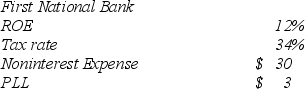
(83) 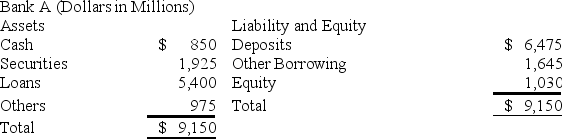
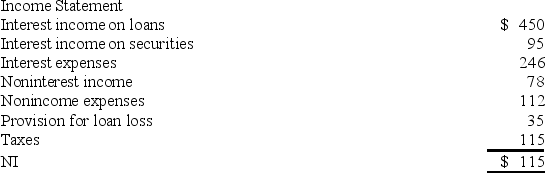 If the typical bank of this type has an overhead efficiency ratio of 0.65,then this particular bank ________ than the typical bank,ceteris paribus.
 (Multiple Choice)
4.8/5 (93)
(93) The allowance for loan and lease losses is bank management's estimate of the amount of gross loans and leases that will not be repaid to the bank.
(True/False)
4.9/5 (86)
(86) Core deposits typically include all except which one of the following?
(Multiple Choice)
4.9/5 (86)
(86) 
Filters
- Essay(0)
- Multiple Choice(0)
- Short Answer(0)
- True False(0)
- Matching(0)