



 Chat with AI
Exam 3: Interdependence and the Gains From Trade

Exam 1: Ten Principles of Economics439 Questions
Exam 2: Thinking Like an Economist617 Questions
Exam 3: Interdependence and the Gains From Trade527 Questions
Exam 4: The Market Forces of Supply and Demand697 Questions
Exam 5: Elasticity and Its Application594 Questions
Exam 6: Supply, Demand, and Government Policies645 Questions
Exam 7: Consumers, Producers, and the Efficiency of Markets549 Questions
Exam 8: Application: the Costs of Taxation513 Questions
Exam 9: Application: International Trade492 Questions
Exam 10: Externalities524 Questions
Exam 11: Public Goods and Common Resources433 Questions
Exam 12: The Design of the Tax System549 Questions
Exam 13: The Costs of Production420 Questions
Exam 14: Firms in Competitive Markets543 Questions
Exam 15: Monopoly637 Questions
Exam 16: Monopolistic Competition580 Questions
Exam 17: Oligopoly488 Questions
Exam 18: The Markets for the Factors of Production564 Questions
Exam 19: Earnings and Discrimination490 Questions
Exam 20: Income Inequality and Poverty455 Questions
Exam 21: The Theory of Consumer Choice431 Questions
Exam 22: Frontiers of Microeconomics440 Questions
Exam 23: Measuring a Nations Income520 Questions
Exam 24: Measuring the Cost of Living529 Questions
Exam 25: Production and Growth505 Questions
Exam 26: Saving, Investment, and the Financial System564 Questions
Exam 27: The Basic Tools of Finance500 Questions
Exam 28: Unemployment678 Questions
Exam 29: The Monetary System515 Questions
Exam 30: Money Growth and Inflation481 Questions
Exam 31: Open-Economy Macroeconomics: Basic Concepts522 Questions
Exam 32: A Macroeconomic Theory of the Open Economy475 Questions
Exam 33: Aggregate Demand and Aggregate Supply562 Questions
Exam 34: The Influence of Monetary and Fiscal Policy on Aggregate Demand508 Questions
Exam 35: The Short-Run Trade-Off Between Inflation and Unemployment491 Questions
Exam 36: Six Debates Over Macroeconomic Policy372 Questions
Select questions type


Figure 3-16
Hosne's Production Possibilities Frontier Merve's Production Possibilities Frontier  -Refer to Figure 3-16. Hosne has a comparative advantage in the production of
 (Multiple Choice)
4.7/5  (78)
(78) Table 3-7
Assume that the farmer and the rancher can switch between producing meat and producing potatoes at a constant rate.  -Refer to Table 3-7. Which of the following combinations of meat and potatoes could the rancher not produce in 24 hours?
 (Multiple Choice)
4.7/5 (61)
(61) Figure 3-11
The graph below represents the various combinations of ham and cheese (in pounds) that the nation of Bonovia could produce in a given month. 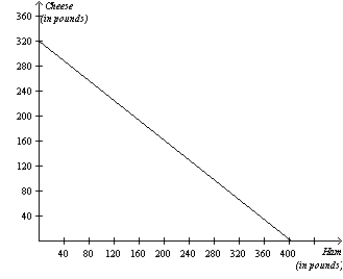 -Refer to Figure 3-11. If the production possibilities frontier shown is for 240 hours of production, then which of the following combinations of ham and cheese could Bonovia not produce in 240 hours?
 (Multiple Choice)
4.7/5 (89)
(89) When two countries trade with one another, it is most likely because
(Multiple Choice)
5.0/5 (83)
(83) Scenario 3-1
The production possibilities frontiers below show how much Greg and Catherine can each produce in 8 hours of time.
Greg's Production Possibilities Catherine's Production Possibilities 
 -Refer to Scenario 3-1. What is Greg's opportunity cost of producing ice cream? Explain how you derived your answer.
 (Essay)
4.9/5 (78)
(78) If a country has the comparative advantage in producing a product, then that country must also have the absolute advantage in producing that product.
(True/False)
4.8/5 (88)
(88) Table 3-27
Assume that Huang and Min can switch between producing parasols and producing porcelain plates at a constant rate.  -Refer to Table 3-27. The opportunity cost of 1 parasol for Min is
 (Multiple Choice)
4.9/5 (79)
(79) Figure 3-20
Canada's Production Possibilities Frontier Mexico's Production Possibilities Frontier  -Refer to Figure 3-20. Canada has an absolute advantage in the production of
 (Multiple Choice)
4.7/5 (77)
(77) When describing the opportunity cost of two producers, economists use the term
(Multiple Choice)
4.9/5 (66)
(66) Table 3-26
Assume that Japan and Korea can switch between producing cars and producing airplanes at a constant rate.  -Refer to Table 3-26. Assume that Japan and Korea each has 2400 hours available. Originally, each country divided its time equally between the production of cars and airplanes. Now, each country spends all its time producing the good in which it has a comparative advantage. As a result, the total output of cars increased by
 (Multiple Choice)
4.9/5 (81)
(81) Table 3-20
Assume that Brad and Theresa can switch between producing wheat and producing beef at a constant rate.  -Refer to Table 3-20. What is Brad's opportunity cost of producing one pound of beef?
 (Multiple Choice)
4.9/5 (84)
(84) Figure 3-14
Arturo's Production Possibilities Frontier Dina's Production Possibilities Frontier  -Refer to Figure 3-14. Arturo has an absolute advantage in the production of
 (Multiple Choice)
4.8/5 (73)
(73) Some countries win in international trade, while other countries lose.
(True/False)
4.8/5 (81)
(81) Table 3-41  -Refer to Table 3-41. What is England's opportunity cost of one radio?
 (Short Answer)
4.8/5 (87)
(87) Table 3-41
-Refer to Table 3-41. Which country has a comparative advantage in producing compasses?
-Refer to Table 3-41. Which country has a comparative advantage in producing compasses? (Short Answer)
4.9/5 (62)
(62) Table 3-34
Assume that Indonesia and India can switch between producing rice and bananas at a constant rate.  -Refer to Table 3-34. For which good(s) does Indonesia have a comparative advantage
 (Multiple Choice)
4.9/5 (75)
(75) Alexis is a lawyer. She bills her clients $100 an hour for her services. She can also mow her lawn in 30 minutes. She can hire someone to mow her lawn who takes an hour. Of the following prices, which is the highest Alexis would pay someone to mow her lawn?
(Multiple Choice)
4.9/5 (80)
(80) Table 3-27
Assume that Huang and Min can switch between producing parasols and producing porcelain plates at a constant rate.
-Refer to Table 3-27. The opportunity cost of 1 plate for Huang is
-Refer to Table 3-27. The opportunity cost of 1 plate for Huang is (Multiple Choice)
4.8/5 (81)
(81) Figure 3-20
Canada's Production Possibilities Frontier Mexico's Production Possibilities Frontier
-Refer to Figure 3-20. Mexico would incur an opportunity cost of 8 units of Good X if it increased its production of Good Y by
-Refer to Figure 3-20. Mexico would incur an opportunity cost of 8 units of Good X if it increased its production of Good Y by (Multiple Choice)
4.7/5 (70)
(70) Figure 3-23
The graph below represents the various combinations of ham and cheese (in pounds) that the nation of Bonovia could produce in a given month.  -Refer to Figure 3-23. For Bonovia, what is the opportunity cost of a pound of cheese?
 (Multiple Choice)
4.9/5 (86)
(86) 
Filters
- Essay(0)
- Multiple Choice(0)
- Short Answer(0)
- True False(0)
- Matching(0)