



 Chat with AI
Exam 3: Interdependence and the Gains From Trade

Exam 1: Ten Principles of Economics439 Questions
Exam 2: Thinking Like an Economist617 Questions
Exam 3: Interdependence and the Gains From Trade527 Questions
Exam 4: The Market Forces of Supply and Demand697 Questions
Exam 5: Elasticity and Its Application594 Questions
Exam 6: Supply, Demand, and Government Policies645 Questions
Exam 7: Consumers, Producers, and the Efficiency of Markets549 Questions
Exam 8: Application: the Costs of Taxation513 Questions
Exam 9: Application: International Trade492 Questions
Exam 10: Externalities524 Questions
Exam 11: Public Goods and Common Resources433 Questions
Exam 12: The Design of the Tax System549 Questions
Exam 13: The Costs of Production420 Questions
Exam 14: Firms in Competitive Markets543 Questions
Exam 15: Monopoly637 Questions
Exam 16: Monopolistic Competition580 Questions
Exam 17: Oligopoly488 Questions
Exam 18: The Markets for the Factors of Production564 Questions
Exam 19: Earnings and Discrimination490 Questions
Exam 20: Income Inequality and Poverty455 Questions
Exam 21: The Theory of Consumer Choice431 Questions
Exam 22: Frontiers of Microeconomics440 Questions
Exam 23: Measuring a Nations Income520 Questions
Exam 24: Measuring the Cost of Living529 Questions
Exam 25: Production and Growth505 Questions
Exam 26: Saving, Investment, and the Financial System564 Questions
Exam 27: The Basic Tools of Finance500 Questions
Exam 28: Unemployment678 Questions
Exam 29: The Monetary System515 Questions
Exam 30: Money Growth and Inflation481 Questions
Exam 31: Open-Economy Macroeconomics: Basic Concepts522 Questions
Exam 32: A Macroeconomic Theory of the Open Economy475 Questions
Exam 33: Aggregate Demand and Aggregate Supply562 Questions
Exam 34: The Influence of Monetary and Fiscal Policy on Aggregate Demand508 Questions
Exam 35: The Short-Run Trade-Off Between Inflation and Unemployment491 Questions
Exam 36: Six Debates Over Macroeconomic Policy372 Questions
Select questions type


Figure 3-3
Arturo's Production Possibilities Frontier Dina's Production Possibilities Frontier 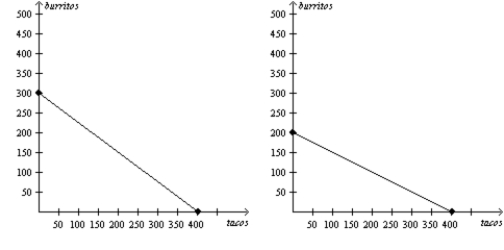 -Refer to Figure 3-3. If the production possibilities frontiers shown are each for one day of production, then which of the following combinations of tacos and burritos could Arturo and Dina together not produce in a given day?
 (Multiple Choice)
4.9/5  (76)
(76) Jennifer takes 2 hours to make a loaf of bread and 1 hour to make a dozen cookies. Janet takes 3 hours to make a loaf of bread and 3/4 hours to make a dozen cookies. Who, if either, has an absolute advantage baking bread? Who, if either, has an absolute advantage making cookies?
(Essay)
4.9/5 (75)
(75) If one producer has the absolute advantage in the production of all goods, then that same producer will have the comparative advantage in the production of all goods as well.
(True/False)
4.8/5 (73)
(73) The most obvious benefit of specialization and trade is that they allow us to
(Multiple Choice)
4.7/5 (70)
(70) Table 3-26
Assume that Japan and Korea can switch between producing cars and producing airplanes at a constant rate.  -Refer to Table 3-26. Japan's opportunity cost of one car is
 (Multiple Choice)
4.8/5 (78)
(78) Figure 3-2
Brazil's Production Possibilities Frontier 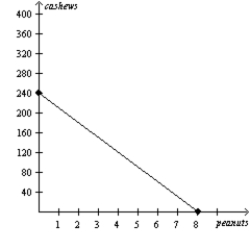 -Refer to Figure 3-2. If the production possibilities frontier shown is for two months of production, then which of the following combinations of peanuts and cashews could Brazil not produce in two months?
 (Multiple Choice)
5.0/5 (79)
(79) Figure 3-18
Bintu's Production Possibilities Frontier Juba's Production Possibilities Frontier  -Refer to Figure 3-18. Suppose Juba is willing to trade one bowl to Bintu for every two cups that Bintu makes and sends to Juba. Which of the following combinations of bowls and cups could Bintu then consume, assuming Bintu specializes in making cups and Juba specializes in making bowls?
 (Multiple Choice)
4.8/5 (75)
(75) Economists use the term to refer to the ability to produce a good using fewer inputs than another producer.
(Short Answer)
4.7/5 (79)
(79) Table 3-9
Assume that Maya and Miguel can switch between producing mixers and producing toasters at a constant rate.  -Refer to Table 3-9. We could use the information in the table to draw a production possibilities frontier for Maya and a second production possibilities frontier for Miguel. If we were to do this, measuring mixers along the horizontal axis, then
 (Multiple Choice)
4.9/5 (81)
(81) If Shawn can produce donuts at a lower opportunity cost than Sue, then
(Multiple Choice)
4.9/5 (80)
(80) Table 3-12
Barb and Jim run a business that sets up and tests computers. Assume that Barb and Jim can switch between setting up and testing computers at a constant rate. The following table applies. 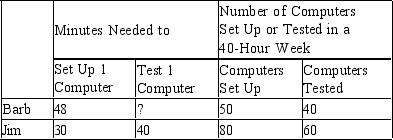 -Refer to Table 3-12. Which of the following points would not be on Barb's production possibilities frontier, based on a 40-hour week?
 (Multiple Choice)
4.9/5 (66)
(66) Timmy can edit 2 pages in one minute and he can type 80 words in one minute. Olivia can edit 1 page in one minute and she can type 100 words in one minute. Timmy has an absolute advantage and a comparative advantage in editing, while Olivia has an absolute advantage and a comparative advantage in typing.
(True/False)
4.7/5 (82)
(82) Gary and Diane must prepare a presentation for their marketing class. As part of their presentation, they must do a series of calculations and prepare 50 PowerPoint slides. It would take Gary 10 hours to do the required calculation and 10 hours to prepare the slides. It would take Diane 12 hours to do the calculations and 20 hours to prepare the slides.
a. How much time would it take the two to complete the project if they divide the calculations equally and the slides equally?
b. How much time would it take the two to complete the project if they use comparative advantage and specialize in calculating or preparing slides?
c. If Diane and Gary have the same opportunity cost of $5 per hour, is there a better solution than for each to specialize in calculating or preparing slides?
(Essay)
4.8/5 (72)
(72) Assume for Brazil that the opportunity cost of each cashew is 100 peanuts. Which of these pairs of points could be on Brazil's production possibilities frontier?
(Multiple Choice)
4.8/5 (76)
(76) Scenario 3-2
In country A a worker who works 40 hours can produce 200 pounds of rice or 100 pounds of broccoli. In country B a worker who works 40 hours can produce 160 pounds of rice or 120 pounds of broccoli.
-Refer to Scenario 3-2. Which country, if either, has an absolute advantage producing rice? Defend your answer.
(Essay)
4.8/5 (99)
(99) Table 3-31  -Refer to Table 3-31. For the farmer, 12.8 pounds of
 (Multiple Choice)
4.8/5 (79)
(79) Figure 3-16
Hosne's Production Possibilities Frontier Merve's Production Possibilities Frontier  -Refer to Figure 3-16. Hosne's opportunity cost of one purse is
 (Multiple Choice)
4.9/5 (78)
(78) Table 3-25
Assume that Maya and Miguel can switch between producing mixers and producing toasters at a constant rate.  -Refer to Table 3-25. The opportunity cost of 1 toaster for Miguel is
 (Multiple Choice)
4.8/5 (72)
(72) Table 3-3
Production Opportunities  -Refer to Table 3-3. We could use the information in the table to draw a production possibilities frontier for England and a second production possibilities frontier for France. If we were to do this, measuring wine along the horizontal axis, then
 (Multiple Choice)
4.9/5 (65)
(65) 
Filters
- Essay(0)
- Multiple Choice(0)
- Short Answer(0)
- True False(0)
- Matching(0)