



 Chat with AI
Exam 3: Interdependence and the Gains From Trade

Exam 1: Ten Principles of Economics439 Questions
Exam 2: Thinking Like an Economist617 Questions
Exam 3: Interdependence and the Gains From Trade527 Questions
Exam 4: The Market Forces of Supply and Demand697 Questions
Exam 5: Elasticity and Its Application594 Questions
Exam 6: Supply, Demand, and Government Policies645 Questions
Exam 7: Consumers, Producers, and the Efficiency of Markets549 Questions
Exam 8: Application: the Costs of Taxation513 Questions
Exam 9: Application: International Trade492 Questions
Exam 10: Externalities524 Questions
Exam 11: Public Goods and Common Resources433 Questions
Exam 12: The Design of the Tax System549 Questions
Exam 13: The Costs of Production420 Questions
Exam 14: Firms in Competitive Markets543 Questions
Exam 15: Monopoly637 Questions
Exam 16: Monopolistic Competition580 Questions
Exam 17: Oligopoly488 Questions
Exam 18: The Markets for the Factors of Production564 Questions
Exam 19: Earnings and Discrimination490 Questions
Exam 20: Income Inequality and Poverty455 Questions
Exam 21: The Theory of Consumer Choice431 Questions
Exam 22: Frontiers of Microeconomics440 Questions
Exam 23: Measuring a Nations Income520 Questions
Exam 24: Measuring the Cost of Living529 Questions
Exam 25: Production and Growth505 Questions
Exam 26: Saving, Investment, and the Financial System564 Questions
Exam 27: The Basic Tools of Finance500 Questions
Exam 28: Unemployment678 Questions
Exam 29: The Monetary System515 Questions
Exam 30: Money Growth and Inflation481 Questions
Exam 31: Open-Economy Macroeconomics: Basic Concepts522 Questions
Exam 32: A Macroeconomic Theory of the Open Economy475 Questions
Exam 33: Aggregate Demand and Aggregate Supply562 Questions
Exam 34: The Influence of Monetary and Fiscal Policy on Aggregate Demand508 Questions
Exam 35: The Short-Run Trade-Off Between Inflation and Unemployment491 Questions
Exam 36: Six Debates Over Macroeconomic Policy372 Questions
Select questions type


Figure 3-19
Chile's Production Possibilities Frontier Colombia's Production Possibilities Frontier  -Refer to Figure 3-19. Chile and Colombia would not be able to gain from trade if Colombia's opportunity cost of one pound of soybeans changed to
 (Multiple Choice)
5.0/5  (70)
(70) Figure 3-21
Uzbekistan's Production Possibilities Frontier Azerbaijan's Production Possibilities Frontier  -Refer to Figure 3-21. Suppose Azerbaijan decides to increase its production of nails by 20. What is the opportunity cost of this decision?
 (Multiple Choice)
4.9/5 (82)
(82) Figure 3-21
Uzbekistan's Production Possibilities Frontier Azerbaijan's Production Possibilities Frontier
-Refer to Figure 3-21. Azerbaijan has an absolute advantage in the production of
-Refer to Figure 3-21. Azerbaijan has an absolute advantage in the production of (Multiple Choice)
4.8/5 (73)
(73) Table 3-5
Assume that Aruba and Iceland can switch between producing coolers and producing radios at a constant rate.  -Refer to Table 3-5. Which of the following combinations of coolers and radios could Aruba produce in one 40- hour week?
 (Multiple Choice)
4.9/5 (81)
(81) The producer that requires a smaller quantity of inputs to produce a certain amount of a good, relative to the quantities of inputs required by other producers to produce the same amount of that good,
(Multiple Choice)
4.8/5 (75)
(75) Table 3-22
Assume that Zimbabwe and Portugal can switch between producing toothbrushes and producing hairbrushes at a constant rate.  -Refer to Table 3-22. Portugal has an absolute advantage in the production of
 (Multiple Choice)
4.9/5 (79)
(79) The principle of comparative advantage states that, regardless of the price at which trade takes place, everyone will benefit from trade if they specialize in the production of the good for which they have a comparative advantage.
(True/False)
4.8/5 (75)
(75) If Shawn can produce more donuts in one day than Sue can produce in one day, then
(Multiple Choice)
4.9/5 (89)
(89) Figure 3-10
Alice and Betty's Production Possibilities in one 8hour day.
Alice's Production Possibilities Frontier Betty's Production Possibilities Frontier  -Refer to Figure 3-10. Both Alice and Betty
 (Multiple Choice)
5.0/5 (87)
(87) Table 3-18
The following table contains some production possibilities for an economy for a given month.  -Refer to Table 3-18. If the production possibilities frontier is a straight line, then "?" must be
 (Multiple Choice)
4.9/5 (67)
(67) Figure 3-22
Alice and Betty's Production Possibilities in one 8hour day.
Alice's Production Possibilities Frontier Betty's Production Possibilities Frontier  -Refer to Figure 3-22. Which of the following statements is correct regarding comparative advantage?
 (Multiple Choice)
4.9/5 (79)
(79) Figure 3-21
Uzbekistan's Production Possibilities Frontier Azerbaijan's Production Possibilities Frontier
-Refer to Figure 3-21. Without trade, Uzbekistan produced and consumed 12 bolts and 36 nails and Azerbaijan produced and consumed 14 bolts and 24 nails. Then, each country agreed to specialize in the production of the good in which it has a comparative advantage and trade 16 bolts for 38 nails. As a result, Uzbekistan gained
-Refer to Figure 3-21. Without trade, Uzbekistan produced and consumed 12 bolts and 36 nails and Azerbaijan produced and consumed 14 bolts and 24 nails. Then, each country agreed to specialize in the production of the good in which it has a comparative advantage and trade 16 bolts for 38 nails. As a result, Uzbekistan gained (Multiple Choice)
4.9/5 (88)
(88) Figure 3-24
The production possibilities frontiers below show how much Bob and Betty can each produce in 8 hours of time.
Bob's Production Possibilities Frontier Betty's Production Possibilities Frontier 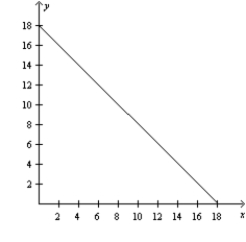
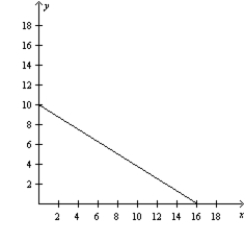 -Refer to Figure 3-24. Betty has
 (Multiple Choice)
4.9/5 (81)
(81) Figure 3-23
The graph below represents the various combinations of ham and cheese (in pounds) that the nation of Bonovia could produce in a given month.  -Refer to Figure 3-23. In the nation of Cropitia, the opportunity cost of a pound of cheese is 1.5 pounds of ham. Bonovia and Cropitia both can gain from trading with one another if one pound of cheese trades for
 (Multiple Choice)
4.8/5 (90)
(90) Table 3-3
Production Opportunities  -Refer to Table 3-3. We could use the information in the table to draw a production possibilities frontier for England and a second production possibilities frontier for France. If we were to do this, measuring cheese along the horizontal axis, then
 (Multiple Choice)
4.8/5 (74)
(74) Suppose a gardener produces both tomatoes and squash in his garden. If the opportunity cost of one bushel of squash is 2/5 bushel of tomatoes, then the opportunity cost of 1 bushel of tomatoes is
(Multiple Choice)
4.8/5 (77)
(77) Suppose that the country of Xenophobia chose to isolate itself from the rest of the world. Its ruler proclaimed that Xenophobia should become self-sufficient, so it would not engage in foreign trade. From an economic perspective, this idea would
(Multiple Choice)
4.9/5 (85)
(85) When each person specializes in producing the good in which he or she has a comparative advantage, total production in the economy
(Multiple Choice)
4.7/5 (70)
(70) Table 3-32
US and French Production Opportunities  -Refer to Table 3-32 The US has a comparative advantage in the production of
 (Multiple Choice)
4.9/5 (63)
(63) 
Filters
- Essay(0)
- Multiple Choice(0)
- Short Answer(0)
- True False(0)
- Matching(0)