



 Chat with AI
Exam 3: Interdependence and the Gains From Trade

Exam 1: Ten Principles of Economics439 Questions
Exam 2: Thinking Like an Economist617 Questions
Exam 3: Interdependence and the Gains From Trade527 Questions
Exam 4: The Market Forces of Supply and Demand697 Questions
Exam 5: Elasticity and Its Application594 Questions
Exam 6: Supply, Demand, and Government Policies645 Questions
Exam 7: Consumers, Producers, and the Efficiency of Markets549 Questions
Exam 8: Application: the Costs of Taxation513 Questions
Exam 9: Application: International Trade492 Questions
Exam 10: Externalities524 Questions
Exam 11: Public Goods and Common Resources433 Questions
Exam 12: The Design of the Tax System549 Questions
Exam 13: The Costs of Production420 Questions
Exam 14: Firms in Competitive Markets543 Questions
Exam 15: Monopoly637 Questions
Exam 16: Monopolistic Competition580 Questions
Exam 17: Oligopoly488 Questions
Exam 18: The Markets for the Factors of Production564 Questions
Exam 19: Earnings and Discrimination490 Questions
Exam 20: Income Inequality and Poverty455 Questions
Exam 21: The Theory of Consumer Choice431 Questions
Exam 22: Frontiers of Microeconomics440 Questions
Exam 23: Measuring a Nations Income520 Questions
Exam 24: Measuring the Cost of Living529 Questions
Exam 25: Production and Growth505 Questions
Exam 26: Saving, Investment, and the Financial System564 Questions
Exam 27: The Basic Tools of Finance500 Questions
Exam 28: Unemployment678 Questions
Exam 29: The Monetary System515 Questions
Exam 30: Money Growth and Inflation481 Questions
Exam 31: Open-Economy Macroeconomics: Basic Concepts522 Questions
Exam 32: A Macroeconomic Theory of the Open Economy475 Questions
Exam 33: Aggregate Demand and Aggregate Supply562 Questions
Exam 34: The Influence of Monetary and Fiscal Policy on Aggregate Demand508 Questions
Exam 35: The Short-Run Trade-Off Between Inflation and Unemployment491 Questions
Exam 36: Six Debates Over Macroeconomic Policy372 Questions
Select questions type


Figure 3-25
Chile's Production Possibilities Frontier Colombia's Production Possibilities Frontier 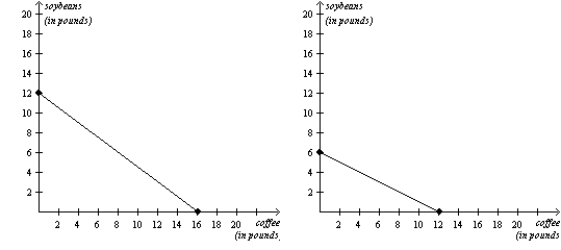 -Refer to Figure 3-25. Colombia should specialize in the production of
 (Multiple Choice)
4.8/5  (91)
(91) For two individuals who engage in the same two productive activities, it is impossible for one of the two individuals to
(Multiple Choice)
4.8/5 (72)
(72) Table 3-37
Assume that Aruba and Iceland can switch between producing coolers and producing radios at a constant rate. 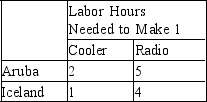 -Refer to Table 3-37. Iceland should export
 (Multiple Choice)
4.8/5 (86)
(86) Figure 3-19
Chile's Production Possibilities Frontier Colombia's Production Possibilities Frontier  -Refer to Figure 3-19. Chile has an absolute advantage in the production of
 (Multiple Choice)
4.8/5 (82)
(82) Adam Smith wrote that a person should never attempt to make at home what it will cost him more to make than to buy.
(True/False)
4.9/5 (84)
(84) Table 3-21
Assume that Jamaica and Norway can switch between producing coolers and producing radios at a constant rate. The following table shows the number of coolers or number of radios each country can produce in one day.  -Refer to Table 3-21. Jamaica should specialize in the production of
 (Multiple Choice)
5.0/5 (90)
(90) Table 3-9
Assume that Maya and Miguel can switch between producing mixers and producing toasters at a constant rate.  -Refer to Table 3-9. Which of the following combinations of mixers and toasters could Miguel not produce in 80 hours?
 (Multiple Choice)
4.9/5 (88)
(88) Table 3-37
Assume that Aruba and Iceland can switch between producing coolers and producing radios at a constant rate.
-Refer to Table 3-37. Aruba should export
-Refer to Table 3-37. Aruba should export (Multiple Choice)
4.9/5 (78)
(78) Figure 3-3
Arturo's Production Possibilities Frontier Dina's Production Possibilities Frontier  -Refer to Figure 3-3. If Dina must work 0.25 hour to produce each taco, then her production possibilities frontier is based on how many hours of work?
 (Multiple Choice)
4.9/5 (77)
(77) Table 3-28
Barb and Jim run a business that sets up and tests computers. Assume that Barb and Jim can switch between setting up and testing computers at a constant rate. The following table applies.  -Refer to Table 3-28. Barb's opportunity cost of testing one computer is setting up
 (Multiple Choice)
4.8/5 (71)
(71) Figure 3-24
The production possibilities frontiers below show how much Bob and Betty can each produce in 8 hours of time.
Bob's Production Possibilities Frontier Betty's Production Possibilities Frontier 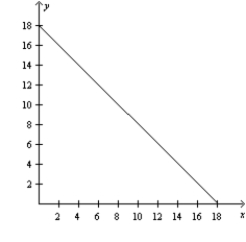
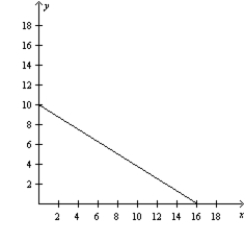 -Refer to Figure 3-24. Bob has
 (Multiple Choice)
4.9/5 (75)
(75) Figure 3-17
Maxine's Production Possibilities Frontier Daisy's Production Possibilities Frontier  -Refer to Figure 3-17. Suppose Daisy decides to increase her production of pies by 6. What is the opportunity cost of this decision?
 (Multiple Choice)
4.7/5 (87)
(87) Figure 3-7
Bintu's Production Possibilities Frontier Juba's Production Possibilities Frontier  -Refer to Figure 3-7. If the production possibilities frontier shown for Juba is for 2 hours of work, then how long does it take Juba to make one bowl?
 (Multiple Choice)
4.8/5 (74)
(74) Table 3-21
Assume that Jamaica and Norway can switch between producing coolers and producing radios at a constant rate. The following table shows the number of coolers or number of radios each country can produce in one day.
-Refer to Table 3-21. Jamaica has a comparative advantage in the production of
-Refer to Table 3-21. Jamaica has a comparative advantage in the production of (Multiple Choice)
4.9/5 (65)
(65) Table 3-12
Barb and Jim run a business that sets up and tests computers. Assume that Barb and Jim can switch between setting up and testing computers at a constant rate. The following table applies.  -Refer to Table 3-12. Which of the following points would not be on Jim's production possibilities frontier, based on a 40-hour week?
 (Multiple Choice)
4.9/5 (86)
(86) Table 3-41  -Refer to Table 3-41. Which country has a comparative advantage in producing radios?
 (Short Answer)
4.8/5 (88)
(88) Scenario 3-1
The production possibilities frontiers below show how much Greg and Catherine can each produce in 8 hours of time.
Greg's Production Possibilities Catherine's Production Possibilities 
 -Refer to Scenario 3-1. Which if any good(s) does Greg have an absolute advantage producing?
 (Essay)
4.7/5 (91)
(91) Table 3-22
Assume that Zimbabwe and Portugal can switch between producing toothbrushes and producing hairbrushes at a constant rate.  -Refer to Table 3-22. Zimbabwe has an absolute advantage in the production of
 (Multiple Choice)
4.9/5 (88)
(88) Table 3-13
Juanita and Shantala run a business that programs and tests cellular phones. Assume that Juanita and Shantala can switch between programming and testing cellular phones at a constant rate. The following table applies.  -Refer to Table 3-13. Which of the following points would be on Shantala's production possibilities frontier, based on a 40-hour week?
 (Multiple Choice)
4.9/5 (82)
(82) Which of the following would not result from all countries specializing according to the principle of comparative advantage?
(Multiple Choice)
4.8/5 (79)
(79) 
Filters
- Essay(0)
- Multiple Choice(0)
- Short Answer(0)
- True False(0)
- Matching(0)