



 Chat with AI
Exam 15: Biomolecules: Amino Acids, Peptides, and Proteins

Exam 1: Structure and Bonding:acids and Bases40 Questions
Exam 2: Alkanes: The Nature of Organic Compounds47 Questions
Exam 3: Alkenes and Alkynes: the Nature of Organic Reactions37 Questions
Exam 4: Reactions of Alkenes and Alkynes44 Questions
Exam 5: Aromatic Compounds51 Questions
Exam 6: Sterechemistry at Tetrahedral Centers35 Questions
Exam 7: Organohalides: Nucleophilic Substitutions and Eliminations49 Questions
Exam 8: Alcohols, Phenols, Ethers, and Their Sulfur Analogs39 Questions
Exam 9: Aldehydes and Ketones: Nucleophilic Addition Reactions32 Questions
Exam 10: Carboxylic Acids and Derivatives: Nucleophilic Acyl Substitution Reactions66 Questions
Exam 11: Carbonyl Alpha-Substitution Reactions and Condensation Reactions37 Questions
Exam 12: Amines31 Questions
Exam 13: Structure Determination64 Questions
Exam 14: Biomolecules: Carbohydrates41 Questions
Exam 15: Biomolecules: Amino Acids, Peptides, and Proteins43 Questions
Exam 16: Biomolecules: Lipids and Nucleic Acids37 Questions
Exam 17: The Organic Chemistry of Metabolic Pathways35 Questions
Select questions type


Instructions: Consider the following structure. Based on this structure answer the following question(s). 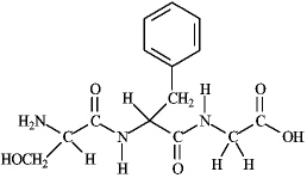 Refer to instructions. How many other peptides could be formed from this same combination of amino acids?
Free
(Multiple Choice)
4.7/5  (83)
(83) Correct Answer: Verified
B
Which of the following amino acids migrates to the negative electrode on paper electrophoresis at a pH of 7.0?
Free
(Multiple Choice)
4.7/5 (76)
(76) Correct Answer:Verified
VerifiedA
Instructions: Refer to the data below to answer the following question(s).
Porcine dynorphin is a neuropeptide having 17 amino acid residues. Its structure is shown below.
Tyr-Gly-Gly-Phe-Leu-Arg-Arg-Ile-Arg-Pro-Lys-Leu-Lys-Trp-Asp-Asn-Gln
Refer to instructions. What fragments would result if dynorphin were cleaved by trypsin?
Free
(Essay)
4.9/5 (76)
(76) Correct Answer:Verified
Verified Trypsin catalyzes the hydrolysis of peptides as the carboxyl side of arginine and lysine. Consequently, the fragments resulting from trypsin hydrolysis of dynorphin are:
What are the R/S designations of the two stereocenters of L-threonine? 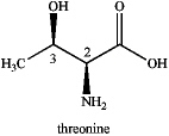
(Multiple Choice)
4.8/5 (82)
(82) 
Instructions: Refer to the data below to answer the following question.
Aregrine 10.76
Glutamic Acid 3.22
Tryptophan 5.89 Refer to instructions. The most basic amino acid is __________.
(Short Answer)
4.8/5 (85)
(85) Which of the following amino acids migrates to the positive electrode on paper electrophoresis at a pH of 7.0?
(Multiple Choice)
4.7/5 (90)
(90) Instructions: Refer to the data below to answer the following question(s).
Leucine is an essential amino acid with the systematic name 2-amino-3-methylpentanoic acid. It has pKa1 = 2.36 and pKa2 = 9.60.
Refer to instructions. Draw the condensed structure for leucine, and label all chirality centers with an asterisk and identify the amine as primary, secondary or tertiary. 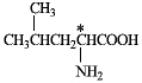
(Short Answer)
4.8/5 (75)
(75) To what structural feature does the term "tertiary structure" refer?
(Multiple Choice)
4.8/5 (69)
(69) Which of the following amino acids would contain the highest concentration of zwitterions at pH 5.90?
(Multiple Choice)
4.8/5 (86)
(86) Instructions: Refer to the data below to answer the following question.
Aregrine 10.76
Glutamic Acid 3.22
Tryptophan 5.89 Refer to inatructions. The most acidic amino acid is ____.
(Short Answer)
4.9/5 (77)
(77) An enzyme classified as a ligase would be associated with a reaction than involves the:
(Multiple Choice)
4.9/5 (86)
(86) Refer to the data below to answer the following questions:
The octapeptide saralasin is a specific antagonist of angiotensin II. A derivative of saralasin is used therapeutically as an antihypertensive. Amino acid analysis of saralasin show the presence of the following amino acids:
Ala, Arg, His, Pro, Sar, Tyr, Val2
Refer to instructions. Partial hydrolysis of saralasin with dilute hydrochloric acid yields the following fragments:
Tyr-Val-His
Sar-Arg-Val
His-Pro-Ala
Val-Tyr-Val
Arg-Val-Tyr
What is the structure of saralasin?
Sar-Arg-Val \nobreakspace\nobreakspace\nobreakspace\nobreakspace Arg-Val-Tyr \nobreakspace\nobreakspace\nobreakspace\nobreakspace\nobreakspace\nobreakspace\nobreakspace\nobreakspace\nobreakspace\nobreakspace Val-Tyr-Val \nobreakspace\nobreakspace\nobreakspace\nobreakspace\nobreakspace\nobreakspace\nobreakspace\nobreakspace\nobreakspace\nobreakspace\nobreakspace\nobreakspace\nobreakspace\nobreakspace Tyr-Val-His \nobreakspace\nobreakspace\nobreakspace\nobreakspace\nobreakspace\nobreakspace\nobreakspace\nobreakspace\nobreakspace\nobreakspace\nobreakspace\nobreakspace\nobreakspace\nobreakspace\nobreakspace\nobreakspace\nobreakspace\nobreakspace\nobreakspace\nobreakspace\nobreakspace\nobreakspace\nobreakspace\nobreakspace\nobreakspace\nobreakspace\nobreakspace\nobreakspace His-Pro-Ala
(Essay)
4.8/5 (70)
(70) To what structural feature does the term "secondary structure" refer?
(Multiple Choice)
4.8/5 (60)
(60) Instructions: Refer to the data below to answer the following question.
Aregrine 10.76
Glutamic Acid 3.22
Tryptophan 5.89 Refer to instructions. At what pH would you carry out an electrophoresis experiment if you wanted to separate a mixture of lysine, aspartic acid and phenylalanine? Explain.
(Essay)
4.9/5 (67)
(67) Instructions: Refer to the data below to answer the following question(s).
Leucine is an essential amino acid with the systematic name 2-amino-3-methylpentanoic acid. It has pKa1 = 2.36 and pKa2 = 9.60.
Refer to instructions. Draw the structure of the predominant form of leucine at pH = 1.50.
(Essay)
4.8/5 (67)
(67) Instructions: Consider the following structure. Based on this structure answer the following question(s). 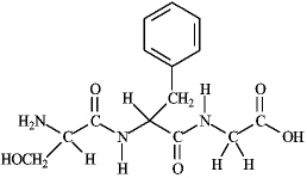 Refer to instructions. Identify the C-terminal amino acid and the N-terminal amino acid.
 (Essay)
4.8/5 (75)
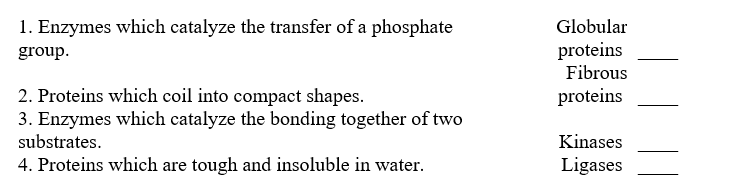
(75) Instructions: Match a term from the list below to each definition
Correct Answer:Verified
VerifiedPremises:
Responses:
(Matching)
4.9/5 (72)
(72) To what structural feature does the term "quaternary structure" refer?
(Multiple Choice)
4.9/5 (84)
(84) Which of the following amino acids has an aromatic side chain?
(Multiple Choice)
4.8/5 (75)
(75) 
Filters
- Essay(0)
- Multiple Choice(0)
- Short Answer(0)
- True False(0)
- Matching(0)