



 Chat with AI
Exam 12: Amines

Exam 1: Structure and Bonding:acids and Bases40 Questions
Exam 2: Alkanes: The Nature of Organic Compounds47 Questions
Exam 3: Alkenes and Alkynes: the Nature of Organic Reactions37 Questions
Exam 4: Reactions of Alkenes and Alkynes44 Questions
Exam 5: Aromatic Compounds51 Questions
Exam 6: Sterechemistry at Tetrahedral Centers35 Questions
Exam 7: Organohalides: Nucleophilic Substitutions and Eliminations49 Questions
Exam 8: Alcohols, Phenols, Ethers, and Their Sulfur Analogs39 Questions
Exam 9: Aldehydes and Ketones: Nucleophilic Addition Reactions32 Questions
Exam 10: Carboxylic Acids and Derivatives: Nucleophilic Acyl Substitution Reactions66 Questions
Exam 11: Carbonyl Alpha-Substitution Reactions and Condensation Reactions37 Questions
Exam 12: Amines31 Questions
Exam 13: Structure Determination64 Questions
Exam 14: Biomolecules: Carbohydrates41 Questions
Exam 15: Biomolecules: Amino Acids, Peptides, and Proteins43 Questions
Exam 16: Biomolecules: Lipids and Nucleic Acids37 Questions
Exam 17: The Organic Chemistry of Metabolic Pathways35 Questions
Select questions type


Instructions: Give the major organic product(s) of each of the following reaction or sequence of reactions. Show all relevant stereochemistry.
Give major product(s): 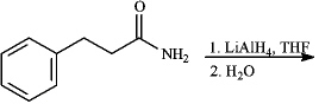

Free
(Essay)
4.9/5  (95)
(95) Correct Answer: Verified
Show how each of the following transformations might be best accomplished. More than one step may be required. Show all reagents and all intermediate structures.
Refer to instructions. 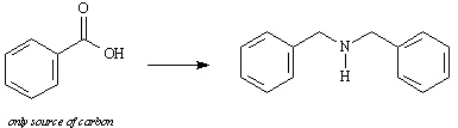
Free
(Essay)
4.9/5 (77)
(77) Correct Answer:Verified
Verified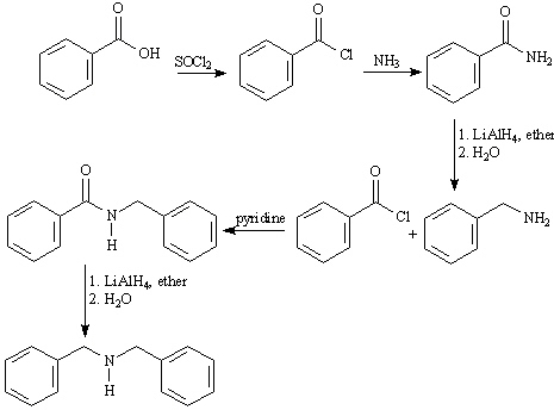
Instructions: Classify each of the nitrogen atoms in the compound shown below as primary, secondary, tertiary, or quaternary.
Classify: 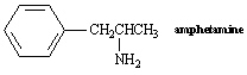
Free
(Essay)
4.7/5 (85)
(85) Correct Answer:Verified
VerifiedThe nitrogen atom in amphetamine is primary.
Instructions: Draw structures corresponding to each of the IUPAC names given in the following question(s).
Draw:
hexane-1,6-diamine
(Essay)
4.9/5 (74)
(74) What is the major organic product obtained from the following reaction? 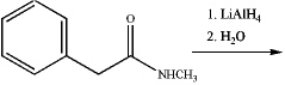
(Multiple Choice)
4.7/5 (77)
(77) Instructions: Draw structures corresponding to each of the IUPAC names given in the following question(s).
Draw:
(Essay)
4.8/5 (75)
(75) In the following series of compounds, which is the most basic and the least basic? Explain your choices. 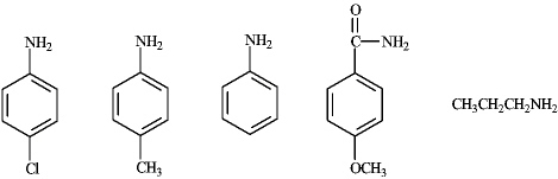
(Essay)
4.8/5 (79)
(79) Instructions: Give the major organic product(s) of each of the following reaction or sequence of reactions. Show all relevant stereochemistry.
Give major product(s): 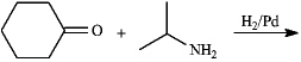
(Essay)
4.9/5 (99)
(99) 
Instructions: Give the major organic product(s) of each of the following reaction or sequence of reactions. Show all relevant stereochemistry.
Give the major product(s). 
(Essay)
4.9/5 (80)
(80) Instructions: Consider the reaction below to answer the following question(s).
Methamphetamine can be synthesized by reacting phenyl-2-propanone with methylamine in the presence of H2/Ni.  Refer to instructions. The synthesis of methamphetamine by reaction of 2-phenyl-2 propanone with methylamine in the presence of H2/Ni is referred to as:
a. reductive nitrogenation
b. reactive nitrogenation
c. reductive amination
d. reactive amination
Refer to instructions. The synthesis of methamphetamine by reaction of 2-phenyl-2 propanone with methylamine in the presence of H2/Ni is referred to as:
a. reductive nitrogenation
b. reactive nitrogenation
c. reductive amination
d. reactive amination
(Short Answer)
4.7/5 (82)
(82) Show how each of the following transformations might be best accomplished. More than one step may be required. Show all reagents and all intermediate structures.
Refer to instructions. 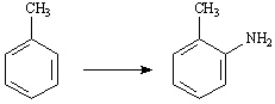
(Essay)
4.8/5 (60)
(60) Instructions: Give the major organic product(s) of each of the following reaction or sequence of reactions. Show all relevant stereochemistry.
Give major product(s): 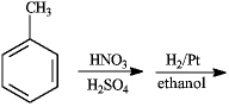
(Essay)
4.8/5 (85)
(85) Show how each of the following transformations might be best accomplished. More than one step may be required. Show all reagents and all intermediate structures.
Refer to instructions. 
(Essay)
4.8/5 (79)
(79) Predict the major organic product obtained from the following sequence of reactions. 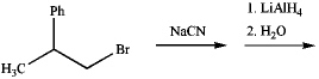
(Essay)
4.9/5 (83)
(83) Instructions: Based on the following structures, name the compound.
Name: 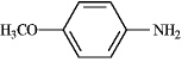
(Essay)
5.0/5 (75)
(75) Instructions: Give the major organic product(s) of each of the following reaction or sequence of reactions. Show all relevant stereochemistry.
Give major product(s): 
(Essay)
4.7/5 (74)
(74) Instructions: Classify each of the nitrogen atoms in the compound shown below as primary, secondary, tertiary, or quaternary.
Classify: 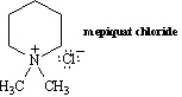
(Essay)
4.8/5 (81)
(81) Circle any of the following that would be classified as a heterocyclic amine. 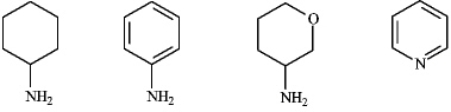
(Essay)
5.0/5 (78)
(78) Instructions: Consider the reaction below to answer the following question(s). Methamphetamine can be synthesized by reacting phenyl-2-propanone with methylamine in the presence of H2/Ni.  Refer to instructions. Intermediate A is an example of:
 (Multiple Choice)
4.8/5 (71)
(71) 
Filters
- Essay(0)
- Multiple Choice(0)
- Short Answer(0)
- True False(0)
- Matching(0)