



 Chat with AI
Exam 4: Reactions of Alkenes and Alkynes

Exam 1: Structure and Bonding:acids and Bases40 Questions
Exam 2: Alkanes: The Nature of Organic Compounds47 Questions
Exam 3: Alkenes and Alkynes: the Nature of Organic Reactions37 Questions
Exam 4: Reactions of Alkenes and Alkynes44 Questions
Exam 5: Aromatic Compounds51 Questions
Exam 6: Sterechemistry at Tetrahedral Centers35 Questions
Exam 7: Organohalides: Nucleophilic Substitutions and Eliminations49 Questions
Exam 8: Alcohols, Phenols, Ethers, and Their Sulfur Analogs39 Questions
Exam 9: Aldehydes and Ketones: Nucleophilic Addition Reactions32 Questions
Exam 10: Carboxylic Acids and Derivatives: Nucleophilic Acyl Substitution Reactions66 Questions
Exam 11: Carbonyl Alpha-Substitution Reactions and Condensation Reactions37 Questions
Exam 12: Amines31 Questions
Exam 13: Structure Determination64 Questions
Exam 14: Biomolecules: Carbohydrates41 Questions
Exam 15: Biomolecules: Amino Acids, Peptides, and Proteins43 Questions
Exam 16: Biomolecules: Lipids and Nucleic Acids37 Questions
Exam 17: The Organic Chemistry of Metabolic Pathways35 Questions
Select questions type


Circle whichever of the following would be classified as a conjugated diene. == == == ==

Free
(Essay)
4.8/5  (87)
(87) Correct Answer: Verified
Instructions: Predict the products of each reaction below. Indicate regiochemistry and stereochemistry when relevant.
Predict and indicate. 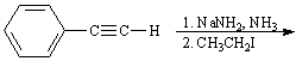
Free
(Essay)
4.8/5 (89)
(89) Correct Answer:Verified
Verified
Instructions: Predict the products of each reaction below. Indicate regiochemistry and stereochemistry when relevant.
Predict and indicate: 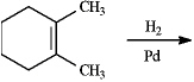
Free
(Essay)
4.9/5 (82)
(82) Correct Answer:Verified
Verified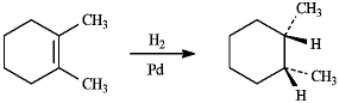
Instructions: Predict the products of each reaction below. Indicate regiochemistry and stereochemistry when relevant.
Predict and indicate. 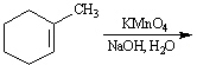
(Essay)
4.9/5 (88)
(88) To answer the questions below, consider the following information:
In an abandoned laboratory has been found a flammable liquid, A, in a bottle bearing only the label "Compound A: C7H12. Government agents have offered you a considerable sum to determine the structure of this compound. After verifying the molecular formula by elemental analysis, you find that Compound A reacts with 1 mol equiv of hydrogen and, after treatment with acidic KMnO4, gives the dicarboxylic acid C (see below). Another bottle from the same laboratory is labeled "Compound B (isomer of A)." Compound B also reacts with 1 mol equiv of hydrogen, but yields cyclohexanone after treatment with acidic KMnO4. 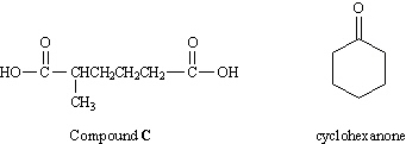 What was the other product formed in the KMnO4 oxidation of B?
 (Short Answer)
4.8/5 (92)
(92) Instructions: Predict the products of each reaction below. Indicate regiochemistry and stereochemistry when relevant.
Predict and indicate. 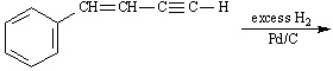
(Essay)
4.8/5 (77)
(77) 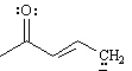
Instructions: Predict the structure of the alkene you would use to prepare the folloiwng compounds. There may be more than one answer in some cases.
Predict. 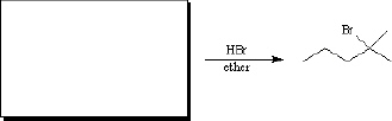
(Essay)
4.8/5 (71)
(71) MATCH each definition to the term it describes. Place the letter of the term in the blank to the left of the definition.
-Refer to Instructions. _____Predicts that in electrophilic additions to alkenes the more stable carbocation intermediate is formed.
(Multiple Choice)
4.7/5 (78)
(78) Instructions: The reaction of 2-methylpropene with HBr in ether gives one of the two products below. Answer the following question(s) about this reaction. 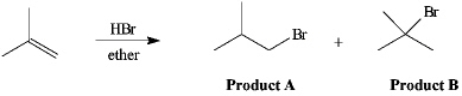 Refer to instructions. The reaction mixture would contain a majority of which isomeric product?
 (Short Answer)
4.8/5 (79)
(79) The product(s) of the reaction when carried out in an organic solvent 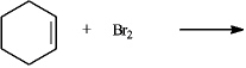 would be:
 (Multiple Choice)
4.9/5 (86)
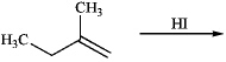
(86) 
Povidone is produced commercially as a series of products having mean molecular weights ranging from about 10,000 to 700,000. Complexed with iodine, povidone yields an iodophor, marketed under the tradename Betadine, which is used as a topical anti-infective. 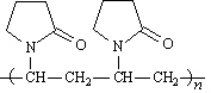 Identify the monomer unit(s) in povidone.
 (Essay)
4.7/5 (83)
(83) Instructions: Predict the products of each reaction below. Indicate regiochemistry and stereochemistry when relevant.
Predict and indicate. 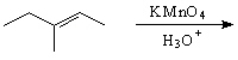
(Essay)
4.8/5 (80)
(80) On the structures provided, draw arrows showing the electron flow in the reaction mechanism for the electrophilic addition of hydrogen bromide to hex-1-yne. 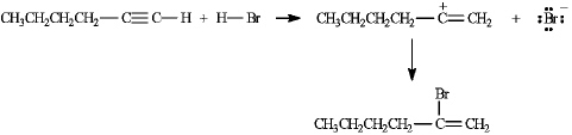
(Essay)
4.9/5 (76)
(76) Predict the major organic product(s) in the reaction below. If more than one major organic product is expected, draw each one. Explain the significance of "35 C" and "ether" shown in the reaction. 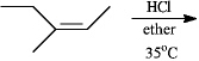
(Essay)
4.7/5 (86)
(86) MATCH each definition to the term it describes. Place the letter of the term in the blank to the left of the definition.
-Refer to Instructions. _____Assigns priorities to substituent groups on a carbon.
(Multiple Choice)
4.8/5 (70)
(70) Instructions: The reaction of 2-methylpropene with HBr in ether gives one of the two products below. Answer the following question(s) about this reaction. 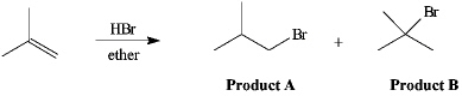 Refer to instructions. Which product is the Markovnikov product?
 (Short Answer)
4.9/5 (88)
(88) 
Filters
- Essay(0)
- Multiple Choice(0)
- Short Answer(0)
- True False(0)
- Matching(0)