



 Chat with AI
Exam 8: Alcohols, Phenols, Ethers, and Their Sulfur Analogs

Exam 1: Structure and Bonding:acids and Bases40 Questions
Exam 2: Alkanes: The Nature of Organic Compounds47 Questions
Exam 3: Alkenes and Alkynes: the Nature of Organic Reactions37 Questions
Exam 4: Reactions of Alkenes and Alkynes44 Questions
Exam 5: Aromatic Compounds51 Questions
Exam 6: Sterechemistry at Tetrahedral Centers35 Questions
Exam 7: Organohalides: Nucleophilic Substitutions and Eliminations49 Questions
Exam 8: Alcohols, Phenols, Ethers, and Their Sulfur Analogs39 Questions
Exam 9: Aldehydes and Ketones: Nucleophilic Addition Reactions32 Questions
Exam 10: Carboxylic Acids and Derivatives: Nucleophilic Acyl Substitution Reactions66 Questions
Exam 11: Carbonyl Alpha-Substitution Reactions and Condensation Reactions37 Questions
Exam 12: Amines31 Questions
Exam 13: Structure Determination64 Questions
Exam 14: Biomolecules: Carbohydrates41 Questions
Exam 15: Biomolecules: Amino Acids, Peptides, and Proteins43 Questions
Exam 16: Biomolecules: Lipids and Nucleic Acids37 Questions
Exam 17: The Organic Chemistry of Metabolic Pathways35 Questions
Select questions type


Instructions: Provide correct IUPAC names for each of the structures below.
Name: 

Free
(Short Answer)
4.9/5  (89)
(89) Correct Answer: Verified
(E)-2-ethyl-but-2-en-1-ol
Instructions: Provide correct IUPAC names for each of the structures below.
Name: 
Free
(Short Answer)
4.9/5 (68)
(68) Correct Answer:Verified
Verifiedtrans-cycloheptane-1,3-diol
Instructions: To answer the following question(s), consider the reaction below.  Refer to instructions. Provide the IUPAC name for the product alcohol.
Free
(Short Answer)
4.7/5 (65)
(65) Correct Answer:Verified
Verifiedtrans-2-methylcyclohexanol
Choose the best reagent for carrying out the following reactions from the list below. Place the letter of the reagent(s) in the box over the reaction arrow. Only one letter per box.  A. B.
C. warm D.
in ether then F heat
A. B.
C. warm D.
in ether then F heat (Essay)
4.9/5 (81)
(81) Instructions: Refer to the data below to answer the following question(s).
of Some Phenols
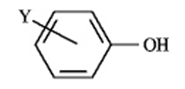 m- 8.28 p- 7.17 m- 9.65 p- 10.21 Refer to instructions.
a) The weakest acid in the table is
b) Which of the acids in the table has the weakest conjugate base?
m- 8.28 p- 7.17 m- 9.65 p- 10.21 Refer to instructions.
a) The weakest acid in the table is
b) Which of the acids in the table has the weakest conjugate base? (Essay)
4.9/5 (77)
(77) Instructions: Consider the reaction below to answer the following question.  Refer to instructions. Mechanistically, the Williamson ether synthesis outlined above is:
 (Multiple Choice)
4.8/5 (82)
(82) Instructions: Provide correct IUPAC names for each of the structures below.
Name: 
(Essay)
4.9/5 (70)
(70) Instructions: To answer the following question(s), consider the reaction below.  Refer to instructions. On the templates provided below, draw both conformations of the alcohol product. Circle the least stable conformation.

Refer to instructions. On the templates provided below, draw both conformations of the alcohol product. Circle the least stable conformation. (Essay)
4.7/5 (75)
(75) Instructions: Draw structures corresponding to each of the following IUPAC names.
Draw:
cyclopropyl ethyl sulfide
(Essay)
4.9/5 (87)
(87) Instructions: Draw structures corresponding to each of the following IUPAC names.
Draw:
Dicyclohexyl sulfide
(Essay)
5.0/5 (79)
(79) Instructions:
Choose the best reagent(s) for carrying out the following conversions from the list provided below. Place the letter of the best choice in the blank. Reagents may be used more than once.
1. , ethanol
2.
1. , ether
2.
periodinane Refer to instructions. _____ 
(Short Answer)
5.0/5 (75)
(75) Instructions: To answer the following question(s), consider the reaction below.  Refer to instructions. The alcohol product is classified as a:
 (Multiple Choice)
4.8/5 (75)
(75) Instructions:
Choose the best reagent(s) for carrying out the following conversions from the list provided below. Place the letter of the best choice in the blank. Reagents may be used more than once.
1. , ethanol
2.
1. , ether
2.
periodinane Refer to instructions. _____ 
(Short Answer)
4.7/5 (74)
(74) Choose the best reagent(s) for carrying out the following conversions from the choices


Correct Answer:Verified
VerifiedPremises:
Responses:
(Matching)
5.0/5 (90)
(90) Instructions:
Give the major organic product(s) of the following reactions or sequences of reactions. Show all relevant stereochemistry.
Write the product(s): 
(Essay)
4.8/5 (86)
(86) Answer the following questions.
a) Which of the following would produce an aldehyde when reacted with periodinane?
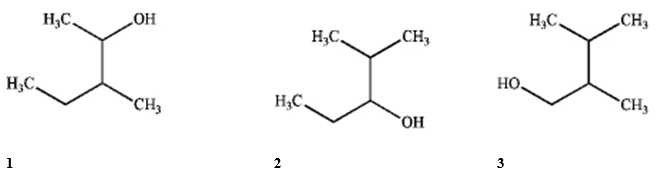 a. only 1
b. only 3
c. only 1 and 3
d. only 2 and 3
b) If were used in place of periodinane, how would the product of the reaction differ?
a. a ketone would be produced
b. a carboxylic acid would be produced.
c. a mixture of aldehyde and ketone would be produced
d. the reaction product would be the same in both cases
a. only 1
b. only 3
c. only 1 and 3
d. only 2 and 3
b) If were used in place of periodinane, how would the product of the reaction differ?
a. a ketone would be produced
b. a carboxylic acid would be produced.
c. a mixture of aldehyde and ketone would be produced
d. the reaction product would be the same in both cases (Essay)
4.7/5 (80)
(80) 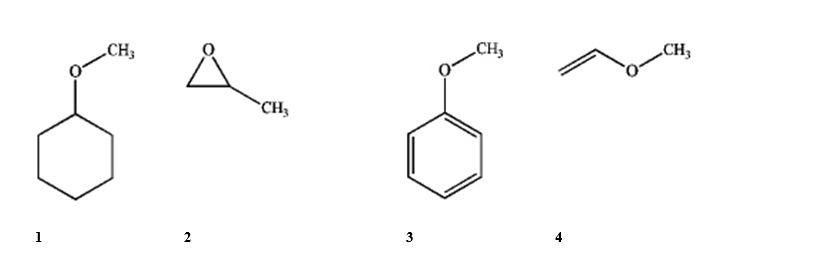
A useful and general method for the synthesis of alcohols is the addition of Grignard reagents to carbonyl compounds. Show what Grignard reagent and what carbonyl compound you would start with to prepare each alcohol below. List all possibilities. 
(Essay)
4.9/5 (69)
(69) Instructions: Draw structures corresponding to each of the following IUPAC names.
Draw:
2-phenylpropan-2-ol
(Essay)
5.0/5 (86)
(86) Instructions:
Give the major organic product(s) of the following reactions or sequences of reactions. Show all relevant stereochemistry.
Write the product(s): 
(Essay)
4.7/5 (75)
(75) 
Filters
- Essay(0)
- Multiple Choice(0)
- Short Answer(0)
- True False(0)
- Matching(0)