



 Chat with AI
Exam 7: Organohalides: Nucleophilic Substitutions and Eliminations

Exam 1: Structure and Bonding:acids and Bases40 Questions
Exam 2: Alkanes: The Nature of Organic Compounds47 Questions
Exam 3: Alkenes and Alkynes: the Nature of Organic Reactions37 Questions
Exam 4: Reactions of Alkenes and Alkynes44 Questions
Exam 5: Aromatic Compounds51 Questions
Exam 6: Sterechemistry at Tetrahedral Centers35 Questions
Exam 7: Organohalides: Nucleophilic Substitutions and Eliminations49 Questions
Exam 8: Alcohols, Phenols, Ethers, and Their Sulfur Analogs39 Questions
Exam 9: Aldehydes and Ketones: Nucleophilic Addition Reactions32 Questions
Exam 10: Carboxylic Acids and Derivatives: Nucleophilic Acyl Substitution Reactions66 Questions
Exam 11: Carbonyl Alpha-Substitution Reactions and Condensation Reactions37 Questions
Exam 12: Amines31 Questions
Exam 13: Structure Determination64 Questions
Exam 14: Biomolecules: Carbohydrates41 Questions
Exam 15: Biomolecules: Amino Acids, Peptides, and Proteins43 Questions
Exam 16: Biomolecules: Lipids and Nucleic Acids37 Questions
Exam 17: The Organic Chemistry of Metabolic Pathways35 Questions
Select questions type


Consider the reactions below to answer the following questions. a.
or
b. The mechanism for these reactions is:
a.
b.
c.
d
(Short Answer)
4.7/5  (83)
(83) Which mechanism is favored by the reaction of a secondary alkyl bromide with potassium t-butoxide?
(Multiple Choice)
4.8/5 (72)
(72) Instructions:
Draw the structure of the major organic products(s) for each of the following reactions. Indicate the stereochemistry for each reaction when appropriate. 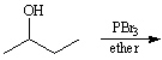
(Essay)
4.8/5 (74)
(74) Consider the following reaction: 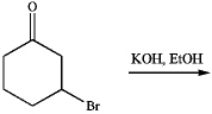 a) Draw the prochuct of the reaction. How would you cate gorize this process mechanistically?
b) Which af the following spectral methods caud be used to follow the pargess of the reartigr??
a. NMR spectroscopy
b. Mass spectrometry
c. Infrared spectroscopy
d. UV spectroscopy
e. all of the se
f. a, b, and c onlv
a) Draw the prochuct of the reaction. How would you cate gorize this process mechanistically?
b) Which af the following spectral methods caud be used to follow the pargess of the reartigr??
a. NMR spectroscopy
b. Mass spectrometry
c. Infrared spectroscopy
d. UV spectroscopy
e. all of the se
f. a, b, and c onlv (Essay)
4.9/5 (87)
(87) Consider the reactions below to answer the following questions. a.
or
b. Halving the concentration of hydroxide in these reactions:
a. causes the reaction mechanism to change
b. halves the rate of reaction
c. has no effect on the rate of reaction
d. doubles the rate of reaction
(Short Answer)
4.7/5 (90)
(90) Instructions: For each question, draw a structure corresponding to the given name.
Draw:
3-iodoprop-1-ene
(Essay)
5.0/5 (78)
(78) Instructions: For each question, provide structures for the reactants, intermediates, or products, as indicated. Draw the structures in the boxes provided.
Draw: 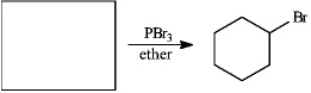
(Essay)
4.7/5 (78)
(78) Instructions: Consider the reaction below to answer the following question(s). 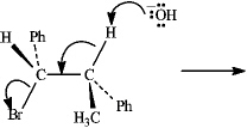 Refer to instructions. Draw a Newman projection of the reactive conformation of the starting material.
 (Essay)
4.8/5 (70)
(70) Instructions: Consider the reaction below to answer the following question(s). 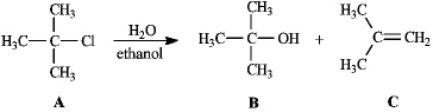 Refer to instructions. Compound B is the:
 (Multiple Choice)
4.9/5 (70)
(70) Instructions: Consider the pair of reactions below to answer the following question(s). 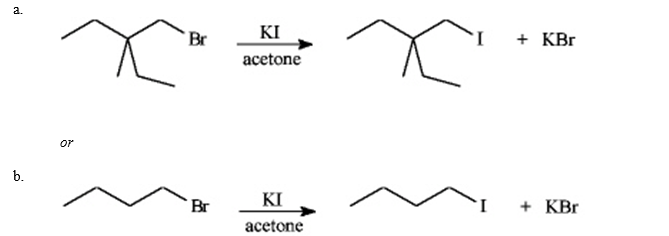 Refer to instructions. The mechanism for these reactions is:
 (Multiple Choice)
4.9/5 (85)
(85) 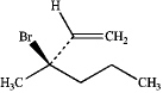
Propose a synthesis of the following compound from the given starting material and any inorganic reagents necessary. 
(Essay)
4.9/5 (74)
(74) Consider the reaction below to answer the following questions. 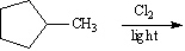 Draw all the monochlorination products of methylcyclopentane (ignore stereoisomers).
 (Essay)
4.8/5 (95)
(95) Instructions:
For each substrate below, choose which reaction type is favored. Place the letter of the reaction type in the blank above the substrate.
a.
b.
c.
d Refer to Instructions.
_____
(Short Answer)
4.8/5 (87)
(87) Instructions: Consider the reaction below to answer the following question.  Refer to instructions. The mechanism for this reaction is:
 (Multiple Choice)
4.9/5 (79)
(79) Instructions: Consider the reaction below to answer the following question(s). 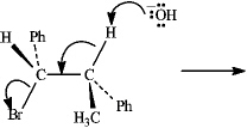 Refer to instructions. Write the product that results from the indicated electron flow in the reaction, showing any resulting stereochemistry
 (Essay)
4.8/5 (81)
(81) Instructions: Circle the correct response in each set below.
Refer to instructions. The least reactive compound in an SN2 reaction. Explain your choice. 
(Essay)
4.9/5 (81)
(81) Instructions: Provide a IUPAC name for each of the following alkyl halides.
Name: 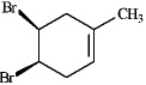
(Essay)
4.8/5 (69)
(69) Which of the following statements about an SN2 reaction is true?
(Multiple Choice)
4.8/5 (87)
(87) Instructions: For each question, provide structures for the reactants, intermediates, or products, as indicated. Draw the structures in the boxes provided.
Draw: 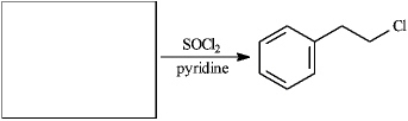
(Essay)
4.8/5 (78)
(78) 
Filters
- Essay(0)
- Multiple Choice(0)
- Short Answer(0)
- True False(0)
- Matching(0)