



 Chat with AI
Exam 2: Thinking Like an Economist

Exam 1: Ten Principles of Economics438 Questions
Exam 2: Thinking Like an Economist620 Questions
Exam 3: Interdependence and the Gains From Trade527 Questions
Exam 4: The Market Forces of Supply and Demand700 Questions
Exam 5: Elasticity and Its Application598 Questions
Exam 6: Supply, Demand, and Government Policies648 Questions
Exam 7: Consumers, Producers, and the Efficiency of Markets547 Questions
Exam 8: Application: the Costs of Taxation514 Questions
Exam 9: Application: International Trade496 Questions
Exam 10: Measuring a Nations Income522 Questions
Exam 11: Measuring the Cost of Living545 Questions
Exam 12: Production and Growth507 Questions
Exam 13: Saving, Investment, and the Financial System567 Questions
Exam 14: The Basic Tools of Finance513 Questions
Exam 15: Unemployment699 Questions
Exam 16: The Monetary System517 Questions
Exam 17: Money Growth and Inflation487 Questions
Exam 18: Open-Economy Macroeconomics: Basic Concepts522 Questions
Exam 19: A Macroeconomic Theory of the Open Economy484 Questions
Exam 20: Aggregate Demand and Aggregate Supply563 Questions
Exam 21: The Influence of Monetary and Fiscal Policy on Aggregate Demand511 Questions
Exam 22: The Short-Run Trade-Off Between Inflation and Unemployment516 Questions
Exam 23: Six Debates Over Macroeconomic Policy372 Questions
Select questions type


Figure 2-5  -Refer to Figure 2-5. Efficient production is represented by which points)?
 (Multiple Choice)
4.9/5  (77)
(77) Using the outline below, draw a circular-flow diagram representing the interactions between households and firms in a simple economy. Explain briefly the various parts of the diagram. 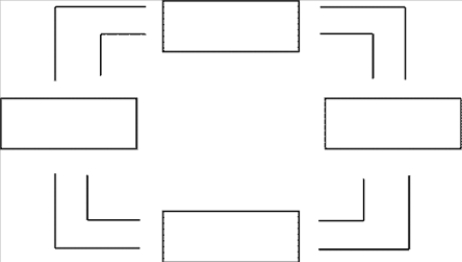
(Essay)
4.8/5 (96)
(96) Which of the following statements about the circular-flow diagram is correct?
(Multiple Choice)
4.9/5 (81)
(81) Which of the following is not an example of a graph of a single variable?
(Multiple Choice)
4.8/5 (73)
(73) The slope of an upward-sloping line is positive, and the slope of a downward-sloping line is negative.
(True/False)
4.8/5 (83)
(83) Almost all economists agree that tariffs and import quotas
(Multiple Choice)
4.8/5 (85)
(85) Figure 2-21 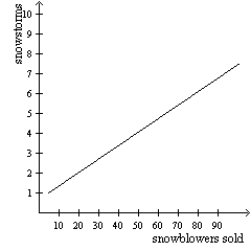 -Refer to Figure 2-21. Which of the following could be an omitted variable in the graph?
 (Multiple Choice)
4.9/5 (92)
(92) Figure 2-23  -Refer to Figure 2-23. The opportunity cost of moving from point B to point A is zero.
 (True/False)
4.9/5 (75)
(75) Points inside the production possibilities frontier represent inefficient levels of production.
(True/False)
4.9/5 (90)
(90) Figure 2-2  -Refer to Figure 2-2. If the outer loop of this circular-flow diagram represents flows of dollars, then the inner loop includes
 (Multiple Choice)
4.9/5 (67)
(67) The opportunity cost of something is what you give up to get it.
(True/False)
4.8/5 (71)
(71) Figure 2-12 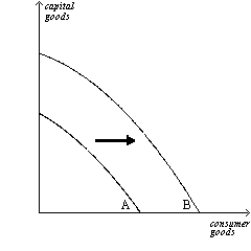 -Refer to Figure 2-12. The shift of the production possibilities frontier from A to B can best be described as
 (Multiple Choice)
4.8/5 (89)
(89) Table 2-1
The following table contains some production possibilities for an economy for a given month.
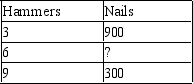 -Refer to Table 2-1. If the production possibilities frontier is bowed outward, then "?" could be
 (Multiple Choice)
4.9/5 (70)
(70) "Society would be better off if the welfare system were abolished" is a normative statement, not a positive statement.
(True/False)
4.8/5 (83)
(83) Suppose an economy produces two goods, food and machines. This economy always operates on its production possibilities frontier. Last year, it produced 1000 units of food and 47 machines. This year it experienced a technological advance in its machine-making industry. As a result, this year the society wants to produce 1050 units of food and 47 machines. Which of the following statements is correct?
(Multiple Choice)
4.8/5 (94)
(94) Most economists agree that a large federal budget deficit has what type of effect on the economy?
(Essay)
4.9/5 (84)
(84) 
Filters
- Essay(0)
- Multiple Choice(0)
- Short Answer(0)
- True False(0)
- Matching(0)