



 Chat with AI
Exam 2: Thinking Like an Economist

Exam 1: Ten Principles of Economics438 Questions
Exam 2: Thinking Like an Economist620 Questions
Exam 3: Interdependence and the Gains From Trade527 Questions
Exam 4: The Market Forces of Supply and Demand700 Questions
Exam 5: Elasticity and Its Application598 Questions
Exam 6: Supply, Demand, and Government Policies648 Questions
Exam 7: Consumers, Producers, and the Efficiency of Markets547 Questions
Exam 8: Application: the Costs of Taxation514 Questions
Exam 9: Application: International Trade496 Questions
Exam 10: Measuring a Nations Income522 Questions
Exam 11: Measuring the Cost of Living545 Questions
Exam 12: Production and Growth507 Questions
Exam 13: Saving, Investment, and the Financial System567 Questions
Exam 14: The Basic Tools of Finance513 Questions
Exam 15: Unemployment699 Questions
Exam 16: The Monetary System517 Questions
Exam 17: Money Growth and Inflation487 Questions
Exam 18: Open-Economy Macroeconomics: Basic Concepts522 Questions
Exam 19: A Macroeconomic Theory of the Open Economy484 Questions
Exam 20: Aggregate Demand and Aggregate Supply563 Questions
Exam 21: The Influence of Monetary and Fiscal Policy on Aggregate Demand511 Questions
Exam 22: The Short-Run Trade-Off Between Inflation and Unemployment516 Questions
Exam 23: Six Debates Over Macroeconomic Policy372 Questions
Select questions type


When a production possibilities frontier is bowed outward, the opportunity cost of one good in terms of the other is constant.
(True/False)
4.7/5  (66)
(66) When constructing a production possibilities frontier, which of the following assumptions is not made?
(Multiple Choice)
4.9/5 (81)
(81) Home is a country that produces two goods, pears and cellular phones. Last year, Home produced 450 bushels of pears and 1050 cellular phones. This year it produced 450 bushels of pears and 2000 cellular phones. Given no other information, which of the following events could explain this change?
(Multiple Choice)
4.9/5 (73)
(73) Figure 2-9
Panel a) Panel b)

 -Refer to Figure 2-9, Panel a) and Panel b). Which of the following is not a result of the shift of the economy's production possibilities frontier from Panel a) to Panel b)?
 (Multiple Choice)
4.9/5 (77)
(77) John Maynard Keynes believed the ideas of economists to be
(Multiple Choice)
4.8/5 (71)
(71) In the markets for factors of production in the circular-flow diagram,
(Multiple Choice)
4.8/5 (80)
(80) Figure 2-1  -Refer to Figure 2-1. Raymond buys a refrigerator for his new home. To which of the arrows does this transaction directly contribute?
 (Multiple Choice)
4.8/5 (85)
(85) A production possibilities frontier has a bowed shape if the opportunity cost is constant at all levels of output.
(True/False)
4.8/5 (81)
(81) The duties of the Council of Economic Advisers are to advise the president of the United States and to determine U.S. monetary policy.
(True/False)
4.7/5 (70)
(70) Economic models can help us understand reality only when they include all details of the economy.
(True/False)
4.8/5 (76)
(76) When a variable that is named on an axis of a graph changes, the curve shifts.
(True/False)
4.9/5 (96)
(96) Table 2-6
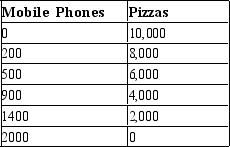 -Refer to Table 2-6. Consider the production possibilities table for an economy that produces only mobile phones and pizzas. What is the opportunity cost of increasing production of mobile phones from 200 to 500?
 (Essay)
4.7/5 (85)
(85) Figure 2-20
Relationship Between Years of Education and Annual Income 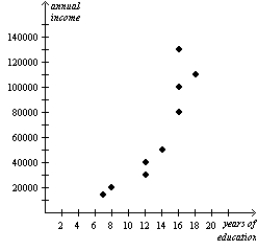 -Refer to Figure 2-20. The graph above is a
 (Multiple Choice)
4.8/5 (87)
(87) 
Filters
- Essay(0)
- Multiple Choice(0)
- Short Answer(0)
- True False(0)
- Matching(0)