



 Chat with AI
Exam 2: Thinking Like an Economist

Exam 1: Ten Principles of Economics438 Questions
Exam 2: Thinking Like an Economist620 Questions
Exam 3: Interdependence and the Gains From Trade527 Questions
Exam 4: The Market Forces of Supply and Demand700 Questions
Exam 5: Elasticity and Its Application598 Questions
Exam 6: Supply, Demand, and Government Policies648 Questions
Exam 7: Consumers, Producers, and the Efficiency of Markets547 Questions
Exam 8: Application: the Costs of Taxation514 Questions
Exam 9: Application: International Trade496 Questions
Exam 10: Measuring a Nations Income522 Questions
Exam 11: Measuring the Cost of Living545 Questions
Exam 12: Production and Growth507 Questions
Exam 13: Saving, Investment, and the Financial System567 Questions
Exam 14: The Basic Tools of Finance513 Questions
Exam 15: Unemployment699 Questions
Exam 16: The Monetary System517 Questions
Exam 17: Money Growth and Inflation487 Questions
Exam 18: Open-Economy Macroeconomics: Basic Concepts522 Questions
Exam 19: A Macroeconomic Theory of the Open Economy484 Questions
Exam 20: Aggregate Demand and Aggregate Supply563 Questions
Exam 21: The Influence of Monetary and Fiscal Policy on Aggregate Demand511 Questions
Exam 22: The Short-Run Trade-Off Between Inflation and Unemployment516 Questions
Exam 23: Six Debates Over Macroeconomic Policy372 Questions
Select questions type


Which of the following is an example of a positive, as opposed to normative, statement?
(Multiple Choice)
4.9/5  (72)
(72) Which of the following areas of study typifies macroeconomics as opposed to microeconomics?
(Multiple Choice)
4.7/5 (76)
(76) Since economists cannot use natural experiments offered by history, they must use carefully constructed laboratory experiments instead.
(True/False)
4.7/5 (85)
(85) Which of the following is not an assumption of the productions possibilities frontier?
(Multiple Choice)
4.9/5 (85)
(85) One difference between a hypothetical benevolent king implementing the best policy and the president implementing the best policy in the real world is the president has to be concerned about
(Multiple Choice)
4.7/5 (85)
(85) In the circular-flow diagram, which of the following items does not flow from firms to households?
(Multiple Choice)
4.7/5 (89)
(89) Figure 2-11 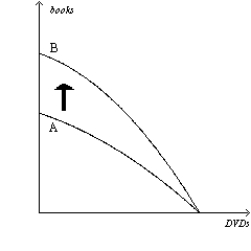 -Refer to Figure 2-11. The shift of the production possibilities frontier from A to B illustrates
 (Multiple Choice)
4.9/5 (81)
(81) In the markets for goods and services in the circular-flow diagram,
(Multiple Choice)
4.8/5 (82)
(82) When two variables move in opposite directions, the curve relating them is upward sloping, and we say the variables are positively related.
(True/False)
4.8/5 (72)
(72) In the circular-flow diagram, firms produce goods and services using the factors of production.
(True/False)
4.8/5 (97)
(97) Figure 2-9
Panel a) Panel b)

 -Refer to Figure 2-9, Panel a). The opportunity cost of moving from point K to point L is
 (Multiple Choice)
4.9/5 (59)
(59) In the circular-flow diagram, firms consume all the goods and services that they produce.
(True/False)
4.7/5 (90)
(90) As a substitute for laboratory experiments, economists use evidence available through history's
(Essay)
4.8/5 (67)
(67) Because almost all economists oppose policies that restrict trade among nations, policymakers do not restrict imports of certain goods.
(True/False)
4.9/5 (66)
(66) Which of the following statements about economic models is correct?
(Multiple Choice)
4.8/5 (80)
(80) 
Filters
- Essay(0)
- Multiple Choice(0)
- Short Answer(0)
- True False(0)
- Matching(0)