



 Chat with AI
Exam 2: Thinking Like an Economist

Exam 1: Ten Principles of Economics438 Questions
Exam 2: Thinking Like an Economist620 Questions
Exam 3: Interdependence and the Gains From Trade527 Questions
Exam 4: The Market Forces of Supply and Demand700 Questions
Exam 5: Elasticity and Its Application598 Questions
Exam 6: Supply, Demand, and Government Policies648 Questions
Exam 7: Consumers, Producers, and the Efficiency of Markets547 Questions
Exam 8: Application: the Costs of Taxation514 Questions
Exam 9: Application: International Trade496 Questions
Exam 10: Measuring a Nations Income522 Questions
Exam 11: Measuring the Cost of Living545 Questions
Exam 12: Production and Growth507 Questions
Exam 13: Saving, Investment, and the Financial System567 Questions
Exam 14: The Basic Tools of Finance513 Questions
Exam 15: Unemployment699 Questions
Exam 16: The Monetary System517 Questions
Exam 17: Money Growth and Inflation487 Questions
Exam 18: Open-Economy Macroeconomics: Basic Concepts522 Questions
Exam 19: A Macroeconomic Theory of the Open Economy484 Questions
Exam 20: Aggregate Demand and Aggregate Supply563 Questions
Exam 21: The Influence of Monetary and Fiscal Policy on Aggregate Demand511 Questions
Exam 22: The Short-Run Trade-Off Between Inflation and Unemployment516 Questions
Exam 23: Six Debates Over Macroeconomic Policy372 Questions
Select questions type


Identify each of the following topics as being part of microeconomics or macroeconomics:
a. the impact of a change in consumer income on the purchase of luxury automobiles
b. the effect of a change in the price of Coke on the purchase of Pepsi
c. the impact of a war in the Middle East on the rate of inflation in the United States
d. factors influencing the rate of economic growth
e. factors influencing the demand for tractors
f. the impact of tax policy on national saving
g. the effect of pollution taxes on the U.S. copper industry
h. the degree of competition in the cable television industry
i. the effect of a balanced-budget amendment on economic stability
j. the impact of deregulation on the savings and loan industry
(Essay)
4.7/5  (76)
(76) The prairie dog has always been considered a problem for American cattle ranchers. They dig holes that cattle and horses can step in, and they eat grass necessary for cattle. Recently, ranchers have discovered that there is a demand for prairie dogs as pets. In some areas, prairie dogs can sell for as high as $150 each. Cattlemen are now fencing off prairie dog towns on their land so these towns will not be disturbed by their cattle.
Draw a rancher's production possibilities frontier showing increasing opportunity cost of cattle production in terms of prairie dog production. Using a separate graph for each situation, show what would happen to the initial production possibilities frontier in each of the following situations:
a. The outcome is efficient, with ranchers choosing to produce equal numbers of cattle and prairie dogs.
b. As a protest against the government introducing the gray wolf back into the wild in their state, ranchers decide to withhold 25 percent of the available grassland for grazing.
c. The price of prairie dogs increases to $200 each, so ranchers decide to allot additional land for prairie dogs.
d. The government grants new leases to ranchers, giving them 10,000 new acres of grassland each for grazing.
e. A drought destroys most of the available grass for grazing of cattle, but not for prairie dogs since they also eat plant roots.
(Essay)
4.8/5 (77)
(77) The effects of foreign competition on the U.S. textile industry would be studied by a microeconomist rather than a macroeconomist.
(True/False)
4.9/5 (73)
(73) Figure 2-14  Consider the production possibilities curve for a country that can produce sweaters, apples in bushels), or a combination of the two.
-Refer to Figure 2-14. Which points) on the graph show unemployment of resources?
Consider the production possibilities curve for a country that can produce sweaters, apples in bushels), or a combination of the two.
-Refer to Figure 2-14. Which points) on the graph show unemployment of resources? (Essay)
4.9/5 (64)
(64) A demand curve displaying the relationship between the price of cars and the quantity demanded of cars should have a slope that is
(Multiple Choice)
5.0/5 (74)
(74) Figure 2-7  -Refer to Figure 2-7. Inefficient production is represented by which points)?
 (Multiple Choice)
4.8/5 (84)
(84) Figure 2-12 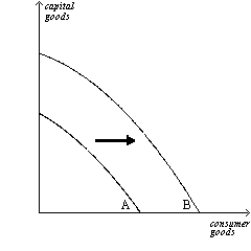 -Refer to Figure 2-12. Which of the following would most likely have caused the production possibilities frontier to shift outward from A to B?
 (Multiple Choice)
4.8/5 (72)
(72) Figure 2-18
Relationship between Price and Restaurant Meals  -Refer to Figure 2-18. A movement from point A to point Z is called
 (Multiple Choice)
5.0/5 (88)
(88) Points on the production possibilities frontier represent efficient levels of production.
(True/False)
4.9/5 (78)
(78) Which of the following statements is correct about the extent of disagreement among economists?
(Multiple Choice)
4.8/5 (88)
(88) The goal of an economist who formulates new theories is to
(Multiple Choice)
4.8/5 (79)
(79) Figure 2-7
-Refer to Figure 2-7. Efficient production is represented by which points)?
-Refer to Figure 2-7. Efficient production is represented by which points)? (Multiple Choice)
4.9/5 (88)
(88) The argument that purchases of minivans cause large families is an example of
(Multiple Choice)
4.8/5 (69)
(69) Since 1946, the president of the United States has received guidance from the Council of Economic Advisers.
(True/False)
5.0/5 (96)
(96) When two variables have a negative correlation and the x-variable decreases,
(Multiple Choice)
4.8/5 (84)
(84) 
Filters
- Essay(0)
- Multiple Choice(0)
- Short Answer(0)
- True False(0)
- Matching(0)