



 Chat with AI
Exam 2: Thinking Like an Economist

Exam 1: Ten Principles of Economics438 Questions
Exam 2: Thinking Like an Economist620 Questions
Exam 3: Interdependence and the Gains From Trade527 Questions
Exam 4: The Market Forces of Supply and Demand700 Questions
Exam 5: Elasticity and Its Application598 Questions
Exam 6: Supply, Demand, and Government Policies648 Questions
Exam 7: Consumers, Producers, and the Efficiency of Markets547 Questions
Exam 8: Application: the Costs of Taxation514 Questions
Exam 9: Application: International Trade496 Questions
Exam 10: Measuring a Nations Income522 Questions
Exam 11: Measuring the Cost of Living545 Questions
Exam 12: Production and Growth507 Questions
Exam 13: Saving, Investment, and the Financial System567 Questions
Exam 14: The Basic Tools of Finance513 Questions
Exam 15: Unemployment699 Questions
Exam 16: The Monetary System517 Questions
Exam 17: Money Growth and Inflation487 Questions
Exam 18: Open-Economy Macroeconomics: Basic Concepts522 Questions
Exam 19: A Macroeconomic Theory of the Open Economy484 Questions
Exam 20: Aggregate Demand and Aggregate Supply563 Questions
Exam 21: The Influence of Monetary and Fiscal Policy on Aggregate Demand511 Questions
Exam 22: The Short-Run Trade-Off Between Inflation and Unemployment516 Questions
Exam 23: Six Debates Over Macroeconomic Policy372 Questions
Select questions type


Figure 2-8  -Refer to Figure 2-8. Which point on the graph best represents the fact that, because resources are scarce, not every conceivable outcome is feasible?
 (Multiple Choice)
4.7/5  (81)
(81) Because it is difficult for economists to use experiments to generate data, they generally must
(Multiple Choice)
4.7/5 (72)
(72) Figure 2-6  -Refer to Figure 2-6. The opportunity cost of this economy moving from point I to point H is
 (Multiple Choice)
4.7/5 (75)
(75) Which of the following is an example of a positive, as opposed to normative, statement?
(Multiple Choice)
4.8/5 (87)
(87) President Truman once said he wanted to find a one-armed economist because when he asked his economists for advice, they always answered, "On the one hand, ... On the other hand, ..." Truman's observation that economists' advice is not always straightforward
(Multiple Choice)
4.9/5 (92)
(92) In the markets for goods and services in the circular-flow diagram,
(Multiple Choice)
4.8/5 (79)
(79) In the simple circular flow diagram, the flow of money from the markets for goods and services to the firms is called
(Multiple Choice)
4.8/5 (82)
(82) Figure 2-2  -Refer to Figure 2-2. If the flow of goods and services is part of what is represented by the inner loop of this circular-flow diagram, then
 (Multiple Choice)
4.9/5 (81)
(81) Figure 2-7  -Refer to Figure 2-7. This economy has the ability to produce at which points)?
 (Multiple Choice)
4.9/5 (75)
(75) Changes in one variable on a graph might be caused by the other variable on the graph or by a third omitted variable.
(True/False)
4.8/5 (76)
(76) In the ordered pair 10,30), 10 is the horizontal location of the point and 30 is the vertical location of the point.
(True/False)
4.8/5 (80)
(80) Figure 2-23  -Refer to Figure 2-23. The opportunity cost of moving from point B to point D is 15 doghouses.
 (True/False)
4.9/5 (81)
(81) Figure 2-17  -Refer to Figure 2-17. The movement from point A to point B is an)
 (Multiple Choice)
4.9/5 (89)
(89) Figure 2-13  -Refer to Figure 2-13. Which of the following statements is true about point G for this economy?
 (Multiple Choice)
4.8/5 (74)
(74) In the circular-flow diagram, which of the following items flows from firms to households through the markets for the factors of production?
(Multiple Choice)
4.9/5 (80)
(80) The production possibilities frontier provides an illustration of the principle that
(Multiple Choice)
4.8/5 (80)
(80) Figure 2-20
Relationship Between Years of Education and Annual Income 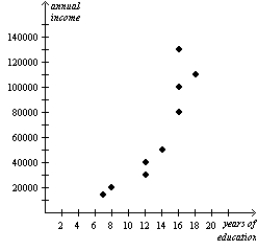 -Refer to Figure 2-20. Senator Smith observes the graph and concludes that people who earn higher incomes attend school for more years. Senator Jones observes the graph and concludes that people who attend school for more years earn higher incomes. Who is correct?
 (Multiple Choice)
5.0/5 (69)
(69) 
Filters
- Essay(0)
- Multiple Choice(0)
- Short Answer(0)
- True False(0)
- Matching(0)