



 Chat with AI
Exam 2: Thinking Like an Economist

Exam 1: Ten Principles of Economics438 Questions
Exam 2: Thinking Like an Economist620 Questions
Exam 3: Interdependence and the Gains From Trade527 Questions
Exam 4: The Market Forces of Supply and Demand700 Questions
Exam 5: Elasticity and Its Application598 Questions
Exam 6: Supply, Demand, and Government Policies648 Questions
Exam 7: Consumers, Producers, and the Efficiency of Markets547 Questions
Exam 8: Application: the Costs of Taxation514 Questions
Exam 9: Application: International Trade496 Questions
Exam 10: Measuring a Nations Income522 Questions
Exam 11: Measuring the Cost of Living545 Questions
Exam 12: Production and Growth507 Questions
Exam 13: Saving, Investment, and the Financial System567 Questions
Exam 14: The Basic Tools of Finance513 Questions
Exam 15: Unemployment699 Questions
Exam 16: The Monetary System517 Questions
Exam 17: Money Growth and Inflation487 Questions
Exam 18: Open-Economy Macroeconomics: Basic Concepts522 Questions
Exam 19: A Macroeconomic Theory of the Open Economy484 Questions
Exam 20: Aggregate Demand and Aggregate Supply563 Questions
Exam 21: The Influence of Monetary and Fiscal Policy on Aggregate Demand511 Questions
Exam 22: The Short-Run Trade-Off Between Inflation and Unemployment516 Questions
Exam 23: Six Debates Over Macroeconomic Policy372 Questions
Select questions type


Economists believe that production possibilities frontiers are often bowed because

Free
(Multiple Choice)
4.8/5  (79)
(79) Correct Answer: Verified
B
Figure 2-14  Consider the production possibilities curve for a country that can produce sweaters, apples in bushels), or a combination of the two.
-Refer to Figure 2-14. What is the opportunity cost of moving from point R to point Q?
Consider the production possibilities curve for a country that can produce sweaters, apples in bushels), or a combination of the two.
-Refer to Figure 2-14. What is the opportunity cost of moving from point R to point Q?Free
(Essay)
4.8/5 (75)
(75) Correct Answer:Verified
Verified80 bushels of apples
Figure 2-7  -Refer to Figure 2-7. What is the opportunity cost of moving from point L to point M?
Free
(Multiple Choice)
4.8/5 (67)
(67) Correct Answer:Verified
VerifiedD
Which markets are represented in the simple circular-flow diagram?
(Multiple Choice)
4.8/5 (95)
(95) Economists may disagree about the validity of alternative positive theories about how the world works.
(True/False)
4.9/5 (84)
(84) Deciding that A causes B when in fact B causes A is a mistake called omitted variable bias.
(True/False)
4.9/5 (86)
(86) Figure 2-2  -Refer to Figure 2-2. If households are sellers in the markets represented by Box D of this circular-flow diagram, then
 (Multiple Choice)
4.8/5 (77)
(77) "Prices rise when the quantity of money rises rapidly" is an example of a
(Multiple Choice)
4.8/5 (67)
(67) Table 2-4
Production Possibilities for Picnicland
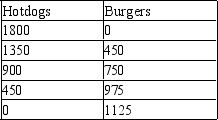 -Refer to Table 2-4. What is the opportunity cost to Picnicland of increasing the production of burgers from 450 to 750?
 (Multiple Choice)
4.9/5 (85)
(85) Economists who are primarily responsible for advising Congress on economic matters work in which agency?
(Multiple Choice)
4.8/5 (70)
(70) Economists believe that production possibilities frontiers rarely have a bowed shape.
(True/False)
4.8/5 (77)
(77) The production possibilities frontier shows the opportunity cost of one good as measured in terms of the other good.
(True/False)
4.7/5 (80)
(80) Figure 2-19
In the following graph the x-axis shows the number of times a commuter rail train stops at a station per hour and the y-axis shows the number of commuter rail passengers per hour.
Commuter Rail Passengers by Frequency of Service 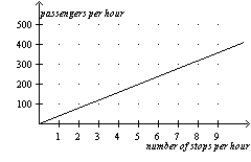 -Refer to Figure 2-19. Which of the following conclusions should not be drawn from observing this graph?
 (Multiple Choice)
4.9/5 (92)
(92) Figure 2-23  -Refer to Figure 2-23. Point B represents an inefficient outcome for this economy.
 (True/False)
4.8/5 (67)
(67) Figure 2-17  -Refer to Figure 2-17. The movement from point B to point C could have been caused by
 (Multiple Choice)
4.8/5 (78)
(78) A normative economic statement such as "The minimum wage should be abolished"
(Multiple Choice)
4.9/5 (84)
(84) 
Filters
- Essay(0)
- Multiple Choice(0)
- Short Answer(0)
- True False(0)
- Matching(0)