



 Chat with AI
Exam 2: Thinking Like an Economist

Exam 1: Ten Principles of Economics438 Questions
Exam 2: Thinking Like an Economist620 Questions
Exam 3: Interdependence and the Gains From Trade527 Questions
Exam 4: The Market Forces of Supply and Demand700 Questions
Exam 5: Elasticity and Its Application598 Questions
Exam 6: Supply, Demand, and Government Policies648 Questions
Exam 7: Consumers, Producers, and the Efficiency of Markets547 Questions
Exam 8: Application: the Costs of Taxation514 Questions
Exam 9: Application: International Trade496 Questions
Exam 10: Measuring a Nations Income522 Questions
Exam 11: Measuring the Cost of Living545 Questions
Exam 12: Production and Growth507 Questions
Exam 13: Saving, Investment, and the Financial System567 Questions
Exam 14: The Basic Tools of Finance513 Questions
Exam 15: Unemployment699 Questions
Exam 16: The Monetary System517 Questions
Exam 17: Money Growth and Inflation487 Questions
Exam 18: Open-Economy Macroeconomics: Basic Concepts522 Questions
Exam 19: A Macroeconomic Theory of the Open Economy484 Questions
Exam 20: Aggregate Demand and Aggregate Supply563 Questions
Exam 21: The Influence of Monetary and Fiscal Policy on Aggregate Demand511 Questions
Exam 22: The Short-Run Trade-Off Between Inflation and Unemployment516 Questions
Exam 23: Six Debates Over Macroeconomic Policy372 Questions
Select questions type


Economic growth causes a production possibilities frontier to shift outward.
(True/False)
4.9/5  (83)
(83) John Maynard Keynes referred to economics as an easy subject,
(Multiple Choice)
4.9/5 (86)
(86) Figure 2-3  -Refer to Figure 2-3. What do the ovals represent in the figure?
 (Essay)
4.8/5 (93)
(93) Is the following a positive or normative statement? The United States government should mandate that every citizen purchases health insurance.
(Essay)
4.8/5 (83)
(83) Table 2-6
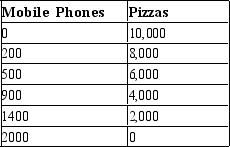 -Refer to Table 2-6. Consider the production possibilities table for an economy that produces only mobile phones and pizzas. Describe the shape of the production possibilities frontier.
 (Essay)
4.9/5 (74)
(74) In the circular-flow diagram, one loop represents the flow of goods and services, and the other loop represents the flow of factors of production.
(True/False)
4.9/5 (80)
(80) It is difficult for economists to make observations and develop theories, but it is easy for economists to run experiments to generate data to test their theories.
(True/False)
4.9/5 (84)
(84) Figure 2-15 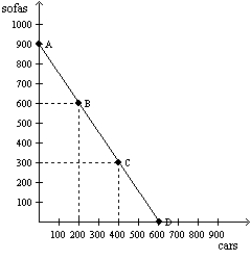 -Refer to Figure 2-15. Consider the production possibilities frontier for an economy that produces only sofas and cars. The opportunity cost of one sofa is
 (Essay)
4.9/5 (88)
(88) "Other things equal, an increase in supply causes a decrease in price" is a normative statement, not a positive statement.
(True/False)
4.7/5 (76)
(76) The circular flow model is not used anymore because it fails to perfectly replicate real world situations.
(True/False)
4.8/5 (75)
(75) A macroeconomist, rather than a microeconomist, would study the effects on a market from two firms merging.
(True/False)
4.9/5 (65)
(65) Figure 2-5  -Refer to Figure 2-5. It is possible for this economy to produce
 (Multiple Choice)
4.7/5 (90)
(90) Table 2-5
 -Refer to Table 2-5. Table 2-5 shows one set of production possibilities. What is the opportunity cost of increasing the production of corn from 400 bushels to 800 bushels?
 (Multiple Choice)
4.9/5 (84)
(84) When a production possibilities frontier is bowed outward, the opportunity cost of the first good in terms of the second good increases as more of the second good is produced.
(True/False)
4.9/5 (91)
(91) Figure 2-23  -Refer to Figure 2-23. Given the technology available for manufacturing doghouses and dishwashers, this economy does not have enough of the factors of production to support the level of output represented by point C.
 (True/False)
4.9/5 (92)
(92) The slope of a line is the ratio of the vertical distance covered to the horizontal distance covered along the line.
(True/False)
4.9/5 (85)
(85) 
Filters
- Essay(0)
- Multiple Choice(0)
- Short Answer(0)
- True False(0)
- Matching(0)