



 Chat with AI
Exam 2: Thinking Like an Economist

Exam 1: Ten Principles of Economics438 Questions
Exam 2: Thinking Like an Economist620 Questions
Exam 3: Interdependence and the Gains From Trade527 Questions
Exam 4: The Market Forces of Supply and Demand700 Questions
Exam 5: Elasticity and Its Application598 Questions
Exam 6: Supply, Demand, and Government Policies648 Questions
Exam 7: Consumers, Producers, and the Efficiency of Markets547 Questions
Exam 8: Application: the Costs of Taxation514 Questions
Exam 9: Application: International Trade496 Questions
Exam 10: Measuring a Nations Income522 Questions
Exam 11: Measuring the Cost of Living545 Questions
Exam 12: Production and Growth507 Questions
Exam 13: Saving, Investment, and the Financial System567 Questions
Exam 14: The Basic Tools of Finance513 Questions
Exam 15: Unemployment699 Questions
Exam 16: The Monetary System517 Questions
Exam 17: Money Growth and Inflation487 Questions
Exam 18: Open-Economy Macroeconomics: Basic Concepts522 Questions
Exam 19: A Macroeconomic Theory of the Open Economy484 Questions
Exam 20: Aggregate Demand and Aggregate Supply563 Questions
Exam 21: The Influence of Monetary and Fiscal Policy on Aggregate Demand511 Questions
Exam 22: The Short-Run Trade-Off Between Inflation and Unemployment516 Questions
Exam 23: Six Debates Over Macroeconomic Policy372 Questions
Select questions type


A model that shows how dollars flow through markets among households and firms is called the
(Multiple Choice)
4.9/5  (77)
(77) Yi and Avik are both economists. Yi thinks that taxing consumption, rather than income, would result in higher household saving because income that is saved would not be taxed. Avik does not think that household saving would respond much to a change in the tax laws. In this example, Yi and Avik
(Multiple Choice)
4.8/5 (85)
(85) Figure 2-23  -Refer to Figure 2-23. Points A, B, and D represent efficient outcomes for this economy.
 (True/False)
4.8/5 (97)
(97) A survey which sought the opinion of professional economists on fourteen propositions about economic policy found that
(Multiple Choice)
4.9/5 (74)
(74) Figure 2-3  -Refer to Figure 2-3. What do the inner arrows represent in the figure?
 (Essay)
4.9/5 (77)
(77) Which of the following is an example of a normative - as opposed to a positive - statement?
(Multiple Choice)
4.8/5 (82)
(82) Figure 2-23
-Refer to Figure 2-23. Points A, B, and D represent feasible outcomes for this economy.
-Refer to Figure 2-23. Points A, B, and D represent feasible outcomes for this economy. (True/False)
4.9/5 (91)
(91) Economic models omit many details to allow us to see what is truly important.
(True/False)
4.9/5 (85)
(85) Figure 2-15 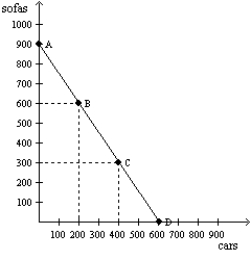 -Refer to Figure 2-15. Consider the production possibilities frontier for an economy that produces only sofas and cars. When society moves from point A to point B,
 (Multiple Choice)
4.9/5 (102)
(102) A pie chart is a way to display information regarding two variables.
(True/False)
4.7/5 (77)
(77) Figure 2-9
Panel a) Panel b)

 -Refer to Figure 2-9, Panel a) and Panel b). A shift of the economy's production possibilities frontier from Panel a) to Panel b) could be caused by
 (Multiple Choice)
4.8/5 (79)
(79) Which of the following statements is an example of a positive, as opposed to normative, statement?
(Multiple Choice)
4.9/5 (87)
(87) Which of the following would likely be studied by a microeconomist rather than a macroeconomist?
(Multiple Choice)
4.9/5 (79)
(79) Which of the following statements applies to economics, as well as to other sciences such as physics?
(Multiple Choice)
4.7/5 (85)
(85) Figure 2-15 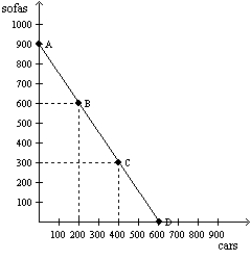 -Refer to Figure 2-15. Consider the production possibilities frontier for an economy that produces only sofas and cars. As the economy moves from point A to point D, is the opportunity cost of cars increasing, constant, or decreasing?
 (Essay)
4.9/5 (66)
(66) In economics, graphs serve two purposes: they offer a way to visually express ideas, and they provide a way of finding and interpreting patterns when analyzing economic data.
(True/False)
4.8/5 (82)
(82) 
Filters
- Essay(0)
- Multiple Choice(0)
- Short Answer(0)
- True False(0)
- Matching(0)