



 Chat with AI
Exam 2: Thinking Like an Economist

Exam 1: Ten Principles of Economics438 Questions
Exam 2: Thinking Like an Economist620 Questions
Exam 3: Interdependence and the Gains From Trade527 Questions
Exam 4: The Market Forces of Supply and Demand700 Questions
Exam 5: Elasticity and Its Application598 Questions
Exam 6: Supply, Demand, and Government Policies648 Questions
Exam 7: Consumers, Producers, and the Efficiency of Markets547 Questions
Exam 8: Application: the Costs of Taxation514 Questions
Exam 9: Application: International Trade496 Questions
Exam 10: Measuring a Nations Income522 Questions
Exam 11: Measuring the Cost of Living545 Questions
Exam 12: Production and Growth507 Questions
Exam 13: Saving, Investment, and the Financial System567 Questions
Exam 14: The Basic Tools of Finance513 Questions
Exam 15: Unemployment699 Questions
Exam 16: The Monetary System517 Questions
Exam 17: Money Growth and Inflation487 Questions
Exam 18: Open-Economy Macroeconomics: Basic Concepts522 Questions
Exam 19: A Macroeconomic Theory of the Open Economy484 Questions
Exam 20: Aggregate Demand and Aggregate Supply563 Questions
Exam 21: The Influence of Monetary and Fiscal Policy on Aggregate Demand511 Questions
Exam 22: The Short-Run Trade-Off Between Inflation and Unemployment516 Questions
Exam 23: Six Debates Over Macroeconomic Policy372 Questions
Select questions type


The two basic reasons why economists often appear to give conflicting advice to policymakers are differences in
(Multiple Choice)
4.9/5  (83)
(83) Figure 2-13  -Refer to Figure 2-13. Which points are not currently attainable but could become achievable for this economy if there is an improvement in technology?
 (Multiple Choice)
4.8/5 (77)
(77) Figure 2-8  -Refer to Figure 2-8. To reach point L, the economy would have to
 (Multiple Choice)
4.9/5 (85)
(85) When a relevant variable that is not named on either axis changes,
(Multiple Choice)
4.8/5 (74)
(74) Figure 2-5  -Refer to Figure 2-5. It is not possible for this economy to produce at point
 (Multiple Choice)
4.9/5 (85)
(85) The bowed shape of the production possibilities frontier can be explained by the fact that
(Multiple Choice)
4.9/5 (81)
(81) Figure 2-10
Panel a) Panel b)

 -Refer to Figure 2-10, Panel a). Production at point Y is
 (Multiple Choice)
4.7/5 (84)
(84) Normative statements describe how the world is, while positive statements prescribe how the world should be.
(True/False)
4.7/5 (81)
(81) Table 2-2
The following table contains some production possibilities for an economy for a given year:
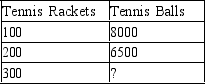 -Refer to Table 2-2. If the production possibilities frontier is bowed outward, then "?" could be
 (Multiple Choice)
4.9/5 (70)
(70) Figure 2-22  -Refer to Figure 2-22. What are the coordinates of point C?
 (Essay)
4.9/5 (88)
(88) Figure 2-14  Consider the production possibilities curve for a country that can produce sweaters, apples in bushels), or a combination of the two.
-Refer to Figure 2-14. Which points) on the graph isare) efficient production possibilities?
Consider the production possibilities curve for a country that can produce sweaters, apples in bushels), or a combination of the two.
-Refer to Figure 2-14. Which points) on the graph isare) efficient production possibilities? (Essay)
5.0/5 (80)
(80) An assumption an economist might make while studying international trade is
(Multiple Choice)
4.8/5 (90)
(90) In the circular flow diagram, when Daphne purchases a new mobile phone, she participates in the markets for
(Essay)
4.8/5 (82)
(82) According to the circular flow diagram, if Denny is the owner of a landscaping business and he just received $50 for mowing Mrs. Pendleton's lawn,
(Multiple Choice)
4.7/5 (63)
(63) Figure 2-5
-Refer to Figure 2-5. The opportunity cost of obtaining 40 additional dryers by moving from point D to point C is
-Refer to Figure 2-5. The opportunity cost of obtaining 40 additional dryers by moving from point D to point C is (Multiple Choice)
4.8/5 (75)
(75) Positive statements can be evaluated using data alone, but normative statements cannot.
(True/False)
4.8/5 (68)
(68) Economists at the U.S. Department of the Treasury help design U.S. coins and paper money.
(True/False)
4.9/5 (72)
(72) 
Filters
- Essay(0)
- Multiple Choice(0)
- Short Answer(0)
- True False(0)
- Matching(0)