



 Chat with AI
Exam 7: Consumers, Producers, and the Efficiency of Markets

Exam 1: Ten Principles of Economics438 Questions
Exam 2: Thinking Like an Economist620 Questions
Exam 3: Interdependence and the Gains From Trade527 Questions
Exam 4: The Market Forces of Supply and Demand700 Questions
Exam 5: Elasticity and Its Application598 Questions
Exam 6: Supply, Demand, and Government Policies648 Questions
Exam 7: Consumers, Producers, and the Efficiency of Markets550 Questions
Exam 8: Application: The Costs of Taxation514 Questions
Exam 9: Application: International Trade496 Questions
Exam 10: Externalities522 Questions
Exam 11: Public Goods and Common Resources434 Questions
Exam 12: The Costs of Production420 Questions
Exam 13: Firms in Competitive Markets543 Questions
Exam 14: Monopoly637 Questions
Exam 15: Measuring a Nations Income522 Questions
Exam 16: Measuring the Cost of Living545 Questions
Exam 17: Production and Growth507 Questions
Exam 18: Saving, Investment, and the Financial System567 Questions
Exam 19: The Basic Tools of Finance513 Questions
Exam 20: Unemployment699 Questions
Exam 21: The Monetary System518 Questions
Exam 22: Money Growth and Inflation487 Questions
Exam 23: Aggregate Demand and Aggregate Supply563 Questions
Exam 24: The Influence of Monetary and Fiscal Policy on Aggregate Demand512 Questions
Select questions type


For any given quantity, the price on a demand curve represents the marginal buyer's willingness to pay.
(True/False)
4.8/5  (71)
(71) Table 7-2
This table refers to five possible buyers' willingness to pay for a case of Vanilla Coke.
 -Refer to Table 7-2. If the market price is $5.50, the consumer surplus in the market will be
 (Multiple Choice)
4.8/5 (71)
(71) Total surplus in a market will increase when the government
(Multiple Choice)
4.9/5 (89)
(89) Table 7-10
The only four consumers in a market have the following willingness to pay for a good:
Buyer Willingness to Pay
 -Refer to Table 7-10. If the market price for the good is $20, who will purchase the good?
 (Multiple Choice)
5.0/5 (82)
(82) Scenario 7-1
Suppose market demand is given by the equation  -Refer to Scenario 7-1. If the market equilibrium price falls from $10 to $5, what is the change in total consumer surplus in the market?
 (Short Answer)
4.9/5 (77)
(77) Table 7-5
For each of three potential buyers of oranges, the table displays the willingness to pay for the first three oranges of the day. Assume Allison, Bob, and Charisse are the only three buyers of oranges, and only three oranges can be supplied per day.
 -Refer to Table 7-5. Who experiences the largest gain in consumer surplus when the price of an orange decreases from $1.05 to $0.75?
 (Multiple Choice)
4.7/5 (79)
(79) In order to calculate consumer surplus in a market, we need to know willingness to pay and price.
(True/False)
4.9/5 (81)
(81) Scenario 7-2
Suppose market demand and market supply are given by the equations:  -Refer to Scenario 7-2. How much is total surplus at the equilibrium price in this market?
 (Short Answer)
4.9/5 (72)
(72) Denise values a stainless steel dishwasher for her new house at $500. The actual price of the dishwasher is $650. Denise
(Multiple Choice)
4.8/5 (73)
(73) Figure 7-31  -Refer to Figure 7-31. If the market equilibrium price rises from $25 to $35, how much is the increase in producer surplus to the producers supplying units at the initial $25 price?
 (Short Answer)
4.8/5 (85)
(85) Ticket scalping can increase total surplus in the market for tickets to sporting events.
(True/False)
4.9/5 (83)
(83) Table 7-15
 -Refer to Table 7-15. You and your best friend want to hire a professional photographer to take pictures of your two families. The table shows the costs of the four potential sellers in the local photography market. You and your friend take bids from the sellers. Who offers the two winning bids, and what do they offer to charge for the photography sessions?
 (Multiple Choice)
4.8/5 (89)
(89) Figure 7-8 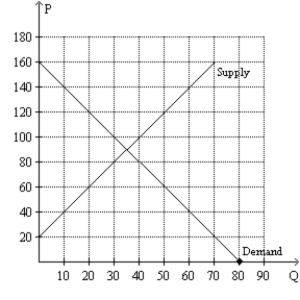 -Refer to Figure 7-8. If the government imposes a price floor of $100 in this market, then consumer surplus will decrease by
 (Multiple Choice)
4.7/5 (70)
(70) Table 7-2
This table refers to five possible buyers' willingness to pay for a case of Vanilla Coke.
-Refer to Table 7-2. Which of the following is not true?
-Refer to Table 7-2. Which of the following is not true? (Multiple Choice)
4.8/5 (76)
(76) All else equal, an increase in supply will cause an increase in consumer surplus.
(True/False)
4.9/5 (76)
(76) Figure 7-6 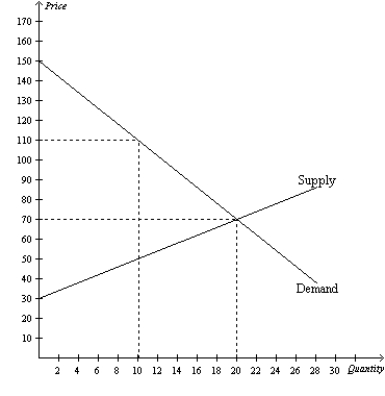 -Refer to Figure 7-6. At the equilibrium price, consumer surplus is
 (Multiple Choice)
4.8/5 (81)
(81) Table 7-4
The numbers in Table 7-1 reveal the maximum willingness to pay for a ticket to a Chicago Cubs vs. St. Louis Cardinal's baseball game at Wrigley Field.
 -Refer to Table 7-4. If tickets sell for $40 each, then what is the total consumer surplus in the market?
 (Multiple Choice)
4.8/5 (89)
(89) Figure 7-13 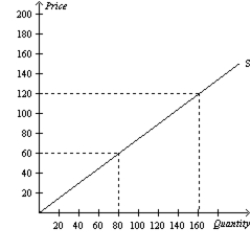 -Refer to Figure 7-13. If the equilibrium price rises from $60 to $120, what is the additional producer surplus to initial producers in the market?
 (Multiple Choice)
4.8/5 (86)
(86) 
Filters
- Essay(0)
- Multiple Choice(0)
- Short Answer(0)
- True False(0)
- Matching(0)