



 Chat with AI
Exam 7: Consumers, Producers, and the Efficiency of Markets

Exam 1: Ten Principles of Economics438 Questions
Exam 2: Thinking Like an Economist620 Questions
Exam 3: Interdependence and the Gains From Trade527 Questions
Exam 4: The Market Forces of Supply and Demand700 Questions
Exam 5: Elasticity and Its Application598 Questions
Exam 6: Supply, Demand, and Government Policies648 Questions
Exam 7: Consumers, Producers, and the Efficiency of Markets550 Questions
Exam 8: Application: The Costs of Taxation514 Questions
Exam 9: Application: International Trade496 Questions
Exam 10: Externalities522 Questions
Exam 11: Public Goods and Common Resources434 Questions
Exam 12: The Costs of Production420 Questions
Exam 13: Firms in Competitive Markets543 Questions
Exam 14: Monopoly637 Questions
Exam 15: Measuring a Nations Income522 Questions
Exam 16: Measuring the Cost of Living545 Questions
Exam 17: Production and Growth507 Questions
Exam 18: Saving, Investment, and the Financial System567 Questions
Exam 19: The Basic Tools of Finance513 Questions
Exam 20: Unemployment699 Questions
Exam 21: The Monetary System518 Questions
Exam 22: Money Growth and Inflation487 Questions
Exam 23: Aggregate Demand and Aggregate Supply563 Questions
Exam 24: The Influence of Monetary and Fiscal Policy on Aggregate Demand512 Questions
Select questions type


We can say that the allocation of resources is efficient if
(Multiple Choice)
4.8/5  (71)
(71) Consumer surplus can be measured as the area between the demand curve and the supply curve.
(True/False)
4.8/5 (81)
(81) Table 7-17
 -Refer to Table 7-17. Both the demand curve and the supply curve are straight lines. At equilibrium, consumer surplus is
 (Multiple Choice)
4.8/5 (78)
(78) Table 7-1
 -Refer to Table 7-1. If the price of the product is $90, then who would be willing to purchase the product?
 (Multiple Choice)
4.8/5 (77)
(77) All else equal, an increase in demand will always increase consumer surplus.
(True/False)
4.9/5 (86)
(86) Figure 7-24  -Refer to Figure 7-24. If 6 units of the good are produced and sold, then
 (Multiple Choice)
4.9/5 (72)
(72) Figure 7-22  -Refer to Figure 7-22. Assume demand increases, which causes the equilibrium price to increase from $50 to $70. The increase in producer surplus due to new producers entering the market would be
 (Multiple Choice)
4.9/5 (73)
(73) Corn chips and potato chips are substitutes. Good weather that sharply increases the corn harvest would
(Multiple Choice)
4.9/5 (81)
(81) Figure 7-9 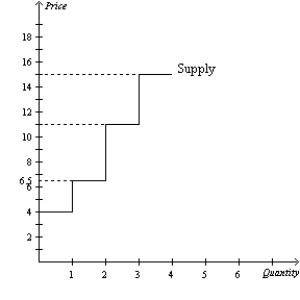 -Refer to Figure 7-9. If producer surplus is $19, then the price of the good is
 (Multiple Choice)
4.9/5 (73)
(73) Figure 7-16  -Refer to Figure 7-16. If the price of the good is $500, then producer surplus amounts to
 (Multiple Choice)
4.9/5 (75)
(75) Figure 7-5 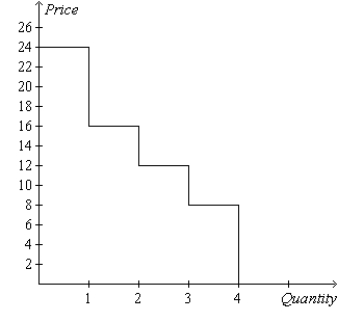 -Refer to Figure 7-5. If the price of the good is $12, then consumer surplus is
 (Multiple Choice)
4.9/5 (78)
(78) Joel has a 1966 Mustang, which he sells to Susie, an avid car collector. Susie is pleased since she paid $8,000 for the car but would have been willing to pay $11,000 for the car. Susie's consumer surplus is $2,000.
(True/False)
4.9/5 (65)
(65) Table 7-17
-Refer to Table 7-17. Both the demand curve and the supply curve are straight lines. If the price is $4 but only 6 units are bought and sold, total surplus will be
-Refer to Table 7-17. Both the demand curve and the supply curve are straight lines. If the price is $4 but only 6 units are bought and sold, total surplus will be (Multiple Choice)
5.0/5 (80)
(80) Figure 7-22
-Refer to Figure 7-22. Assume demand increases, which causes the equilibrium price to increase from $50 to $70. The increase in producer surplus would be
-Refer to Figure 7-22. Assume demand increases, which causes the equilibrium price to increase from $50 to $70. The increase in producer surplus would be (Multiple Choice)
4.8/5 (74)
(74) Even though participants in the economy are motivated by self-interest, the "invisible hand" of the marketplace guides this self-interest into promoting general economic well-being.
(True/False)
4.8/5 (81)
(81) Which tools allow economists to determine if the allocation of resources determined by free markets is desirable?
(Multiple Choice)
4.9/5 (72)
(72) Laissez-faire is a French expression which literally means
(Multiple Choice)
4.7/5 (67)
(67) Table 7-3
The only four consumers in a market have the following willingness to pay for a good:
 -Refer to Table 7-3. If there is only one unit of the good and if the buyers bid against each other for the right to purchase it, then the consumer surplus will be
 (Multiple Choice)
4.8/5 (83)
(83) Table 7-13
The numbers reveal the opportunity costs of providing 10 piano lessons of equal quality.
 -Refer to Table 7-13. The equilibrium market price for 10 piano lessons is $300. What is the total producer surplus in the market?
 (Multiple Choice)
4.8/5 (64)
(64) 
Filters
- Essay(0)
- Multiple Choice(0)
- Short Answer(0)
- True False(0)
- Matching(0)