



 Chat with AI
Exam 7: Consumers, Producers, and the Efficiency of Markets

Exam 1: Ten Principles of Economics438 Questions
Exam 2: Thinking Like an Economist620 Questions
Exam 3: Interdependence and the Gains From Trade527 Questions
Exam 4: The Market Forces of Supply and Demand700 Questions
Exam 5: Elasticity and Its Application598 Questions
Exam 6: Supply, Demand, and Government Policies648 Questions
Exam 7: Consumers, Producers, and the Efficiency of Markets550 Questions
Exam 8: Application: The Costs of Taxation514 Questions
Exam 9: Application: International Trade496 Questions
Exam 10: Externalities522 Questions
Exam 11: Public Goods and Common Resources434 Questions
Exam 12: The Costs of Production420 Questions
Exam 13: Firms in Competitive Markets543 Questions
Exam 14: Monopoly637 Questions
Exam 15: Measuring a Nations Income522 Questions
Exam 16: Measuring the Cost of Living545 Questions
Exam 17: Production and Growth507 Questions
Exam 18: Saving, Investment, and the Financial System567 Questions
Exam 19: The Basic Tools of Finance513 Questions
Exam 20: Unemployment699 Questions
Exam 21: The Monetary System518 Questions
Exam 22: Money Growth and Inflation487 Questions
Exam 23: Aggregate Demand and Aggregate Supply563 Questions
Exam 24: The Influence of Monetary and Fiscal Policy on Aggregate Demand512 Questions
Select questions type


If a market is allowed to move freely to its equilibrium price and quantity, then an increase in supply will
(Multiple Choice)
4.9/5  (74)
(74) Table 7-5
For each of three potential buyers of oranges, the table displays the willingness to pay for the first three oranges of the day. Assume Allison, Bob, and Charisse are the only three buyers of oranges, and only three oranges can be supplied per day.
 -Refer to Table 7-5. Who experiences the largest loss of consumer surplus when the price of an orange increases from $0.70 to $1.40?
 (Multiple Choice)
4.8/5 (67)
(67) Figure 7-21  -Refer to Figure 7-21. When the price is P1, area A represents
 (Multiple Choice)
4.9/5 (72)
(72) Table 7-9
During the last two days, Chad purchased a latte from two different stores. The table below shows Chad's willingness to pay on each day and his consumer surplus from each purchase.
 -Refer to Table 7-9. The price that Chad paid for a latte on the first day is
 (Multiple Choice)
4.7/5 (82)
(82) Table 7-17
 -Refer to Table 7-17. Both the demand curve and the supply curve are straight lines. At equilibrium, total surplus is
 (Multiple Choice)
4.8/5 (80)
(80) If the United States legally allowed for a market in transplant organs, it is estimated that one kidney would sell for at least $100,000.
(True/False)
4.8/5 (71)
(71) Unless markets are perfectly competitive, they may fail to maximize the total benefits to buyers and sellers.
(True/False)
4.8/5 (90)
(90) 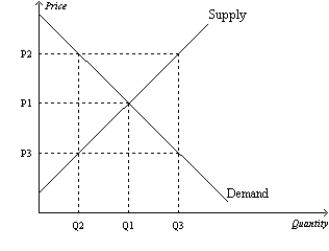 -Refer to Figure 7-28. At the quantity Q3,
Table 7-17
-Refer to Table 7-17. At a price of $2.00, total surplus is
-Refer to Table 7-17. At a price of $2.00, total surplus is (Multiple Choice)
4.8/5 (71)
(71) Tom tunes pianos in his spare time for extra income. Buyers of his service are willing to pay $155 per tuning. One particular week, Tom is willing to tune the first piano for $120, the second piano for $125, the third piano for $140, and the fourth piano for $160. Assume Tom is rational in deciding how many pianos to tune. His producer surplus is
(Multiple Choice)
4.8/5 (67)
(67) Which of the following will cause an increase in producer surplus?
(Multiple Choice)
4.9/5 (81)
(81) Figure 7-22  -Refer to Figure 7-22. At the equilibrium price, producer surplus is
 (Multiple Choice)
4.9/5 (83)
(83) Kristi and Rebecca sell lemonade on the corner for $0.50 per cup. It costs them $0.10 to make each cup. On a certain day, their producer surplus is $20. How many cups did Kristi and Rebecca sell?
(Multiple Choice)
4.7/5 (87)
(87) Figure 7-33  -Refer to Figure 7-33. Suppose demand shifts such that consumers wish to purchase 12 fewer units at every price.
How much is total producer surplus in this market at the new equilibrium price?
-Refer to Figure 7-33. Suppose demand shifts such that consumers wish to purchase 12 fewer units at every price.
How much is total producer surplus in this market at the new equilibrium price? (Essay)
4.9/5 (80)
(80) Brock is willing to pay $400 for a new suit, but he is able to buy the suit for $250. His consumer surplus is
(Multiple Choice)
4.9/5 (89)
(89) Figure 7-3  -Refer to Figure 7-3. When the price is P2, consumer surplus is
 (Multiple Choice)
4.8/5 (78)
(78) Table 7-7
 -Refer to Table 7-7. You have an extra ticket to the Midwest Regional Sweet 16 game in the men's NCAA basketball tournament. The table shows the willingness to pay of the four potential buyers in the market for a ticket to the game. You hold an auction to sell the ticket. Michael bids $410 for the ticket, and you sell him the ticket. What is his consumer surplus?
 (Multiple Choice)
4.8/5 (91)
(91) If the government allowed a free market for transplant organs such as kidneys to exist, the
(Multiple Choice)
4.9/5 (87)
(87) 
Filters
- Essay(0)
- Multiple Choice(0)
- Short Answer(0)
- True False(0)
- Matching(0)