



 Chat with AI
Exam 7: Consumers, Producers, and the Efficiency of Markets

Exam 1: Ten Principles of Economics438 Questions
Exam 2: Thinking Like an Economist620 Questions
Exam 3: Interdependence and the Gains From Trade527 Questions
Exam 4: The Market Forces of Supply and Demand700 Questions
Exam 5: Elasticity and Its Application598 Questions
Exam 6: Supply, Demand, and Government Policies648 Questions
Exam 7: Consumers, Producers, and the Efficiency of Markets550 Questions
Exam 8: Application: The Costs of Taxation514 Questions
Exam 9: Application: International Trade496 Questions
Exam 10: Externalities522 Questions
Exam 11: Public Goods and Common Resources434 Questions
Exam 12: The Costs of Production420 Questions
Exam 13: Firms in Competitive Markets543 Questions
Exam 14: Monopoly637 Questions
Exam 15: Measuring a Nations Income522 Questions
Exam 16: Measuring the Cost of Living545 Questions
Exam 17: Production and Growth507 Questions
Exam 18: Saving, Investment, and the Financial System567 Questions
Exam 19: The Basic Tools of Finance513 Questions
Exam 20: Unemployment699 Questions
Exam 21: The Monetary System518 Questions
Exam 22: Money Growth and Inflation487 Questions
Exam 23: Aggregate Demand and Aggregate Supply563 Questions
Exam 24: The Influence of Monetary and Fiscal Policy on Aggregate Demand512 Questions
Select questions type


Figure 7-34  -Refer to Figure 7-34. Suppose the government imposes a price floor at $10 per unit in this market. With the price floor, how much is total producer surplus assuming those producers with the lowest cost are the ones who supply the market?
 (Short Answer)
4.9/5  (86)
(86) Kelly is willing to pay $5.20 for a gallon of gasoline. The price of gasoline at her local gas station is $3.80. If she purchases ten gallons of gasoline, then Kelly's consumer surplus is
(Multiple Choice)
4.8/5 (69)
(69) Economists argue that restrictions against ticket scalping actually drive up the cost of many tickets.
(True/False)
4.7/5 (81)
(81) David tunes pianos in his spare time for extra income. Buyers of his service are willing to pay $135 per tuning. One particular week, David is willing to tune the first piano for $115, the second piano for $125, the third piano for $140, and the fourth piano for $175. Assume David is rational in deciding how many pianos to tune. His producer surplus is
(Multiple Choice)
4.9/5 (82)
(82) Table 7-16
The following table represents the costs of five possible sellers.
Seller Cost $)
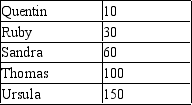 -Refer to Table 7-16. Suppose each of the five sellers can supply at most one unit of the good. At which of the following prices would the market quantity supplied be exactly three units?
 (Multiple Choice)
4.8/5 (67)
(67) Figure 7-19  -Refer to Figure 7-19. At the equilibrium price, consumer surplus is
 (Multiple Choice)
4.8/5 (81)
(81) You are offered a free ticket to see the Chicago Cubs play the Chicago White Sox at Wrigley Field. Assume the ticket has no resale value. Willie Nelson is performing on the same night, and his concert is your next-best alternative activity. Tickets to see Willie Nelson cost $40. On any given day, you would be willing to pay up to $50 to see and hear Willie Nelson perform. Assume there are no other costs of seeing either event. Based on this information, at a minimum, how much would you have to value seeing the Cubs play the White Sox to accept the ticket and go to the game?
(Multiple Choice)
4.8/5 (70)
(70) If the United States changed its laws to allow for the legal sale of a kidney, which of the following is likely to occur?
(Multiple Choice)
4.9/5 (78)
(78) Figure 7-30  -Refer to Figure 7-30. If the market equilibrium price is $120, how much is total consumer surplus?
 (Short Answer)
4.8/5 (76)
(76) Scenario 7-2
Suppose market demand and market supply are given by the equations:  -Refer to Scenario 7-2. How much is total producer surplus at the equilibrium price in this market?
 (Short Answer)
4.8/5 (86)
(86) Abraham drinks Mountain Dew. He can buy as many cans of Mountain Dew as he wishes at a price of $0.55 per can. On a particular day, he is willing to pay $0.95 for the first can, $0.80 for the second can, $0.60 for the third can, and $0.40 for the fourth can. Assume Abraham is rational in deciding how many cans to buy. His consumer surplus is
(Multiple Choice)
4.8/5 (69)
(69) Table 7-1
 -Refer to Table 7-1. If the price of the product is $130, then who would be willing to purchase the product?
 (Multiple Choice)
4.8/5 (81)
(81) Free markets allocate a) the supply of goods to the buyers who value them most highly and b) the demand for goods to the sellers who can produce them at least cost.
(True/False)
4.9/5 (80)
(80) Figure 7-23  -Refer to Figure 7-23. If the price were P3, consumer surplus would be represented by the area
 (Multiple Choice)
4.8/5 (74)
(74) Bill created a new software program he is willing to sell for $300. He sells his first copy and enjoys a producer surplus of $250. What is the price paid for the software?
(Multiple Choice)
4.9/5 (74)
(74) Suppose the demand for peaches decreases. What will happen to producer surplus in the market for peaches?
(Multiple Choice)
4.9/5 (82)
(82) Figure 7-21  -Refer to Figure 7-21. When the price is P1, area B represents
 (Multiple Choice)
4.9/5 (83)
(83) 
Filters
- Essay(0)
- Multiple Choice(0)
- Short Answer(0)
- True False(0)
- Matching(0)