



 Chat with AI
Exam 7: Consumers, Producers, and the Efficiency of Markets

Exam 1: Ten Principles of Economics438 Questions
Exam 2: Thinking Like an Economist620 Questions
Exam 3: Interdependence and the Gains From Trade527 Questions
Exam 4: The Market Forces of Supply and Demand700 Questions
Exam 5: Elasticity and Its Application598 Questions
Exam 6: Supply, Demand, and Government Policies648 Questions
Exam 7: Consumers, Producers, and the Efficiency of Markets550 Questions
Exam 8: Application: The Costs of Taxation514 Questions
Exam 9: Application: International Trade496 Questions
Exam 10: Externalities522 Questions
Exam 11: Public Goods and Common Resources434 Questions
Exam 12: The Costs of Production420 Questions
Exam 13: Firms in Competitive Markets543 Questions
Exam 14: Monopoly637 Questions
Exam 15: Measuring a Nations Income522 Questions
Exam 16: Measuring the Cost of Living545 Questions
Exam 17: Production and Growth507 Questions
Exam 18: Saving, Investment, and the Financial System567 Questions
Exam 19: The Basic Tools of Finance513 Questions
Exam 20: Unemployment699 Questions
Exam 21: The Monetary System518 Questions
Exam 22: Money Growth and Inflation487 Questions
Exam 23: Aggregate Demand and Aggregate Supply563 Questions
Exam 24: The Influence of Monetary and Fiscal Policy on Aggregate Demand512 Questions
Select questions type


Suppose Larry, Moe, and Curly are bidding in an auction for a mint-condition video of Charlie Chaplin's first movie. Each has in mind a maximum amount that he will bid. This maximum is called
(Multiple Choice)
4.7/5  (80)
(80) If producing a soccer ball costs Jake $5, and he sells it for $40, his producer surplus is $35.
(True/False)
4.9/5 (82)
(82) Table 7-12
The only four producers in a market have the following costs:
 -Refer to Table 7-12. If the sellers bid against each other for the right to sell the good to a consumer, then the good will sell for
 (Multiple Choice)
4.8/5 (88)
(88) Which of the following will cause no change in producer surplus?
(Multiple Choice)
5.0/5 (74)
(74) Figure 7-31  -Refer to Figure 7-31. If the market equilibrium price is $35, how much is total producer surplus in this market?
 (Short Answer)
5.0/5 (82)
(82) Jeff decides that he would pay as much as $3,000 for a new laptop computer. He buys the computer and realizes consumer surplus of $700. How much did Jeff pay for his computer?
(Multiple Choice)
4.8/5 (72)
(72) Figure 7-25  -Refer to Figure 7-25. Suppose the government imposes a price floor of $28 in this market. If the sellers with the lowest cost are the ones who sell the good and the government does not purchase any excess units produced, then total surplus will be
 (Multiple Choice)
4.9/5 (85)
(85) When markets fail, public policy can potentially remedy the problem and increase economic efficiency.
(True/False)
4.7/5 (77)
(77) Table 7-4
The numbers in Table 7-1 reveal the maximum willingness to pay for a ticket to a Chicago Cubs vs. St. Louis Cardinal's baseball game at Wrigley Field.
 -Refer to Table 7-4. If you have a ticket that you sell to the group in an auction, what will be the selling price?
 (Multiple Choice)
4.7/5 (80)
(80) Table 7-16
The following table represents the costs of five possible sellers.
Seller Cost $)
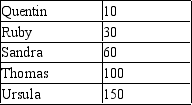 -Refer to Table 7-16. If each producer has one unit available for sale, and if the market equilibrium price is $80 per unit, how much is the total producer surplus in this market?
 (Multiple Choice)
4.9/5 (90)
(90) Figure 7-26  -Refer to Figure 7-26. At the equilibrium price, total surplus is
 (Multiple Choice)
4.8/5 (69)
(69) Figure 7-30  -Refer to Figure 7-30. If the market equilibrium price falls from $120 to $80, how much is the change in total consumer surplus in the market?
 (Short Answer)
4.8/5 (90)
(90) Kristi sells purses. Her cost is $35 per purse. On a certain day, she sells 12 purses, and her producer surplus for that day amounts to $180. Kristi sold each purse for
(Multiple Choice)
4.8/5 (85)
(85) Suppose that Firms A and B each produce high-resolution computer monitors, but Firm A can do so at a lower cost. Cassie and David each want to purchase a high-resolution computer monitor, but David is willing to pay more than Cassie. Which of the following market outcomes is efficient?
(Multiple Choice)
4.7/5 (78)
(78) If Rosa is willing to pay $450 for hockey tickets and has consumer surplus of $175, the price of the tickets is $625.
(True/False)
4.7/5 (83)
(83) Figure 7-31
-Refer to Figure 7-31. If the market equilibrium price rises from $25 to $35, how much is the producer surplus for the producers entering the market after the price increase?
-Refer to Figure 7-31. If the market equilibrium price rises from $25 to $35, how much is the producer surplus for the producers entering the market after the price increase? (Essay)
4.9/5 (84)
(84) 
Filters
- Essay(0)
- Multiple Choice(0)
- Short Answer(0)
- True False(0)
- Matching(0)