



 Chat with AI
Exam 7: Consumers, Producers, and the Efficiency of Markets

Exam 1: Ten Principles of Economics438 Questions
Exam 2: Thinking Like an Economist620 Questions
Exam 3: Interdependence and the Gains From Trade527 Questions
Exam 4: The Market Forces of Supply and Demand700 Questions
Exam 5: Elasticity and Its Application598 Questions
Exam 6: Supply, Demand, and Government Policies648 Questions
Exam 7: Consumers, Producers, and the Efficiency of Markets550 Questions
Exam 8: Application: The Costs of Taxation514 Questions
Exam 9: Application: International Trade496 Questions
Exam 10: Externalities522 Questions
Exam 11: Public Goods and Common Resources434 Questions
Exam 12: The Costs of Production420 Questions
Exam 13: Firms in Competitive Markets543 Questions
Exam 14: Monopoly637 Questions
Exam 15: Measuring a Nations Income522 Questions
Exam 16: Measuring the Cost of Living545 Questions
Exam 17: Production and Growth507 Questions
Exam 18: Saving, Investment, and the Financial System567 Questions
Exam 19: The Basic Tools of Finance513 Questions
Exam 20: Unemployment699 Questions
Exam 21: The Monetary System518 Questions
Exam 22: Money Growth and Inflation487 Questions
Exam 23: Aggregate Demand and Aggregate Supply563 Questions
Exam 24: The Influence of Monetary and Fiscal Policy on Aggregate Demand512 Questions
Select questions type


The lower the price, the lower the consumer surplus, all else equal.
(True/False)
4.8/5  (89)
(89) When a buyer's willingness to pay for a good is equal to the price of the good, the
(Multiple Choice)
4.8/5 (85)
(85) Table 7-5
For each of three potential buyers of oranges, the table displays the willingness to pay for the first three oranges of the day. Assume Allison, Bob, and Charisse are the only three buyers of oranges, and only three oranges can be supplied per day.
 -Refer to Table 7-5. If the market price of an orange is $0.70, then the market quantity of oranges demanded per day is
 (Multiple Choice)
4.8/5 (80)
(80) Figure 7-23  -Refer to Figure 7-23. At equilibrium, total surplus is represented by the area
 (Multiple Choice)
4.8/5 (94)
(94) Figure 7-4  -Refer to Figure 7-4. When the price falls from P1 to P2, which area represents the increase in consumer surplus to existing buyers?
 (Multiple Choice)
5.0/5 (85)
(85) Producer surplus is the cost of production minus the amount a seller is paid.
(True/False)
4.8/5 (84)
(84) The maximum price that a buyer will pay for a good is called
(Multiple Choice)
4.8/5 (77)
(77) Figure 7-6 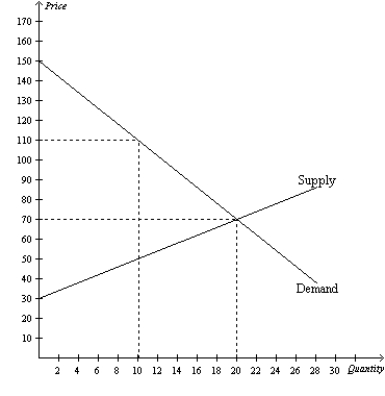 -Refer to Figure 7-6. If the government imposes a price floor of $110 in this market, then consumer surplus will decrease by
 (Multiple Choice)
4.8/5 (92)
(92) Figure 7-18  -Refer to Figure 7-18. If total surplus is $240 and consumer surplus is
 (Multiple Choice)
4.8/5 (76)
(76) Figure 7-10  -Refer to Figure 7-10. When the price rises from P1 to P2, which area represents the increase in producer surplus to existing producers?
 (Multiple Choice)
4.8/5 (75)
(75) Figure 7-24  -Refer to Figure 7-24. At equilibrium, producer surplus is measured by the area
 (Multiple Choice)
4.9/5 (76)
(76) Which of the following will cause a decrease in producer surplus?
(Multiple Choice)
4.9/5 (87)
(87) If the United States changed its laws to allow for the legal sale of a kidney, which of the following is least likely to occur?
(Multiple Choice)
5.0/5 (69)
(69) Figure 7-24
-Refer to Figure 7-24. If 10 units of the good are produced and sold, then
-Refer to Figure 7-24. If 10 units of the good are produced and sold, then (Multiple Choice)
5.0/5 (75)
(75) 
Filters
- Essay(0)
- Multiple Choice(0)
- Short Answer(0)
- True False(0)
- Matching(0)