



 Chat with AI
Exam 20: An Emerging World Power, 1890-1918

Exam 1: Colliding Worlds, 1491-160084 Questions
Exam 2: American Experiments, 1521-170086 Questions
Exam 3: The British Atlantic World, 1607-175080 Questions
Exam 4: Growth, Diversity, and Conflict, 1720-176380 Questions
Exam 5: The Problem of Empire, 1754-177687 Questions
Exam 6: Making War and Republican Governments, 1776-178981 Questions
Exam 7: Hammering Out a Federal Republic, 1787-182088 Questions
Exam 8: Economic Transformations, 1800-184886 Questions
Exam 9: A Democratic Revolution, 1800-184884 Questions
Exam 10: Religion, Reform, and Culture, 1820-184888 Questions
Exam 11: Imperial Ambitions, 1820-184878 Questions
Exam 12: Sectional Conflict and Crisis, 1844-186081 Questions
Exam 13: Bloody Ground: the Civil War, 1861-186582 Questions
Exam 14: Reconstruction, 1865-187786 Questions
Exam 15: Conquering a Continent, 1860-189083 Questions
Exam 16: Industrial America: Corporations and Conflicts, 1877-191085 Questions
Exam 17: Making Modern American Culture, 1880-191785 Questions
Exam 18: Civilizations Inferno: the Rise and Reform of Industrial Cities, 1880-191784 Questions
Exam 19: Whose Government Politics, Populists, and Progressives, 1880-191784 Questions
Exam 20: An Emerging World Power, 1890-191883 Questions
Exam 21: Unsettled Prosperity: From War to Depression, 1919-193289 Questions
Exam 22: Managing the Great Depression, Forging the New Deal, 1929-193893 Questions
Exam 23: The World at War, 1937-194588 Questions
Exam 24: Cold War America, 1945-196385 Questions
Exam 25: Triumph of the Middle Class, 1945-196383 Questions
Exam 26: Walking Into Freedom Land: the Civil Rights Movement, 1941-197389 Questions
Exam 27: Uncivil Wars:liberal Crisis and Conservative Rebirth, 1961-197290 Questions
Exam 28: The Search for Order in an Era of Limits, 1973-198086 Questions
Exam 29: Conservative America in the Ascent, 1980-199185 Questions
Exam 30: Confronting Global and National Dilemmas, 1989 to the Present88 Questions
Select questions type


In his appearance before Congress to ask for a declaration of war in 1917,Woodrow Wilson
(Multiple Choice)
4.9/5  (68)
(68) How did Roosevelt,Taft,and Wilson differ as architects of American imperialism?
(Essay)
5.0/5 (81)
(81) For this question,refer to the following table.Note that the figures below for military casualties are rough estimates.Civilian casualties are even more uncertain. 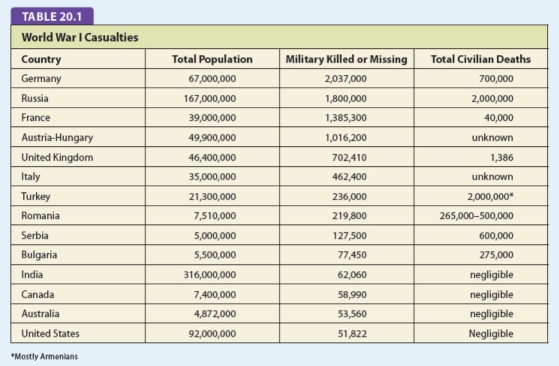 The data above is best understood in the context of
 (Multiple Choice)
4.8/5 (86)
(86) Which of the following policies did U.S.naval officer Alfred Mahan support in his 1890 book The Influence of Sea Power upon History?
(Multiple Choice)
4.7/5 (74)
(74) What was Woodrow Wilson's primary reason for wanting to keep the United States neutral at the outbreak of World War I?
(Multiple Choice)
4.7/5 (73)
(73) Which of the following factors partially contributed to the rising tensions in Europe in the early 1900s that eventually resulted in World War I?
(Multiple Choice)
4.8/5 (95)
(95) Which of the following was true of race relations during World War I?
(Multiple Choice)
4.8/5 (80)
(80) What economic and intellectual factors promoted U.S.imperialism in the late nineteenth century?
(Essay)
4.9/5 (72)
(72) "Chronic wrong doing ...may ...require intervention by ...the United States [in adherence to] the Monroe Doctrine ... ,however reluctantly,in flagrant cases of such wrong doing or impotence,to the exercise of an international police power." The philosophy exemplified in this quote reveals that it was taken from
(Multiple Choice)
4.8/5 (85)
(85) How did the United States curb dissent against World War I on the home front?
(Multiple Choice)
4.8/5 (92)
(92) Herbert Hoover emerged from World War I as one of the nation's most admired men because of his leadership of the
(Multiple Choice)
4.9/5 (68)
(68) In the late 1800s and early 1900s,which nation's growing power in East Asia most surprised Europe and the United States?
(Multiple Choice)
4.8/5 (74)
(74) 
Filters
- Essay(0)
- Multiple Choice(0)
- Short Answer(0)
- True False(0)
- Matching(0)