



 Chat with AI
Exam 25: Triumph of the Middle Class, 1945-1963

Exam 1: Colliding Worlds, 1491-160084 Questions
Exam 2: American Experiments, 1521-170086 Questions
Exam 3: The British Atlantic World, 1607-175080 Questions
Exam 4: Growth, Diversity, and Conflict, 1720-176380 Questions
Exam 5: The Problem of Empire, 1754-177687 Questions
Exam 6: Making War and Republican Governments, 1776-178981 Questions
Exam 7: Hammering Out a Federal Republic, 1787-182088 Questions
Exam 8: Economic Transformations, 1800-184886 Questions
Exam 9: A Democratic Revolution, 1800-184884 Questions
Exam 10: Religion, Reform, and Culture, 1820-184888 Questions
Exam 11: Imperial Ambitions, 1820-184878 Questions
Exam 12: Sectional Conflict and Crisis, 1844-186081 Questions
Exam 13: Bloody Ground: the Civil War, 1861-186582 Questions
Exam 14: Reconstruction, 1865-187786 Questions
Exam 15: Conquering a Continent, 1860-189083 Questions
Exam 16: Industrial America: Corporations and Conflicts, 1877-191085 Questions
Exam 17: Making Modern American Culture, 1880-191785 Questions
Exam 18: Civilizations Inferno: the Rise and Reform of Industrial Cities, 1880-191784 Questions
Exam 19: Whose Government Politics, Populists, and Progressives, 1880-191784 Questions
Exam 20: An Emerging World Power, 1890-191883 Questions
Exam 21: Unsettled Prosperity: From War to Depression, 1919-193289 Questions
Exam 22: Managing the Great Depression, Forging the New Deal, 1929-193893 Questions
Exam 23: The World at War, 1937-194588 Questions
Exam 24: Cold War America, 1945-196385 Questions
Exam 25: Triumph of the Middle Class, 1945-196383 Questions
Exam 26: Walking Into Freedom Land: the Civil Rights Movement, 1941-197389 Questions
Exam 27: Uncivil Wars:liberal Crisis and Conservative Rebirth, 1961-197290 Questions
Exam 28: The Search for Order in an Era of Limits, 1973-198086 Questions
Exam 29: Conservative America in the Ascent, 1980-199185 Questions
Exam 30: Confronting Global and National Dilemmas, 1989 to the Present88 Questions
Select questions type


For this question,refer to the following passage. And is this not the whole drift of our society? We are not interchangeable in the sense of being people without differences,but in the externals of existence we are united by a culture increasingly national.And this is part of the momentum of mobility.The more people move about,the more similar American environments become,and the more similar they become,the easier it is to move about.
More and more,the young couples who move do so only physically.With each transfer the décor,the architecture,the faces,and the names may change;the people,the conversation,and the values do not-and sometimes the décor and architecture don't either....
Suburban residents like to maintain that their suburbia not only looks classless but is classless.That is,they are apt to add on second thought,there are no extremes,and if the place isn't exactly without class,it is at least a one-class society...."We are all," they say,"in the same boat."
William H.Whyte,Jr. ,The Organization Man,1956
The excerpt above was most likely a reaction to
(Multiple Choice)
5.0/5  (93)
(93) How did automobile ownership affect American culture after World War II?
(Essay)
4.8/5 (87)
(87) The ideal family,as presented in the media of the 1950s,with a stay-at-home mom and a father as the breadwinner,was
(Multiple Choice)
4.8/5 (80)
(80) Answer the following questions :
-National Interstate and Defense Highways Act
(Multiple Choice)
4.9/5 (86)
(86) What were some material symbols of the new affluence in American society after World War II?
(Essay)
4.8/5 (76)
(76) For the following question,refer to the following photograph of a family at Zion National Park,Utah,in the 1950s. 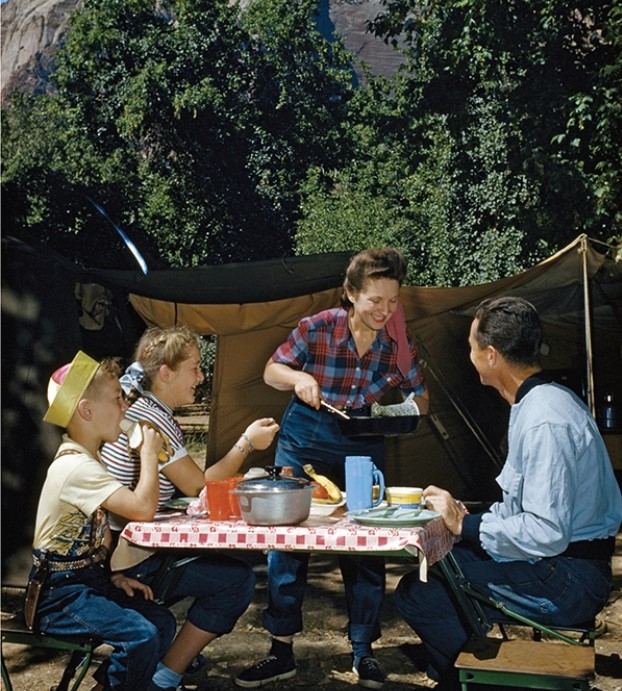 Which of the following groups would be most likely to reject the ideas depicted in the photograph above?
 (Multiple Choice)
4.9/5 (88)
(88) Why did the suburb achieve paramount significance for Americans in the 1950s? How was suburban life related to middle-class consumption and domesticity?
(Essay)
4.9/5 (70)
(70) Which of the following characterizes many of the newly built suburban communities in the 1950s?
(Multiple Choice)
4.9/5 (70)
(70) When Life magazine publisher Henry Luce referred to the dawning of the "American century," he was referring to
(Multiple Choice)
4.7/5 (79)
(79) Which of the following factors precipitated the urban crisis of the 1950s and 1960s?
(Multiple Choice)
4.9/5 (80)
(80) During the 1950s,military spending amounted to what percentage of U.S.gross national product?
(Multiple Choice)
4.9/5 (81)
(81) What was the relationship between consumer culture and the emphasis on family life in the postwar era?
(Essay)
4.7/5 (73)
(73) How did middle-class wives and mothers seek to justify their work outside the home in the 1950s?
(Multiple Choice)
4.8/5 (90)
(90) How did the American economy benefit from World War II and the Cold War?
(Essay)
4.9/5 (71)
(71) Which of the following was an impetus for the post-World War II baby boom?
(Multiple Choice)
5.0/5 (81)
(81) 
Filters
- Essay(0)
- Multiple Choice(0)
- Short Answer(0)
- True False(0)
- Matching(0)