



 Chat with AI
Exam 2: The Market System and the Circular Flow

Exam 1: Limits, Alternatives, and Choices212 Questions
Exam 2: The Market System and the Circular Flow141 Questions
Exam 3: Demand, Supply, and Market Equilibrium202 Questions
Exam 4: Market Failures: Public Goods and Externalities155 Questions
Exam 5: Governments Role and Government Failure148 Questions
Exam 6: An Introduction to Macroeconomics123 Questions
Exam 7: Measuring Domestic Output and National Income157 Questions
Exam 8: Economic Growth114 Questions
Exam 9: Business Cycles, Unemployment, and Inflation143 Questions
Exam 10: Basic Macroeconomic Relationships142 Questions
Exam 11: The Aggregate Expenditures Model143 Questions
Exam 12: Aggregate Demand and Aggregate Supply152 Questions
Exam 13: Fiscal Policy, Deficits, and Debt164 Questions
Exam 14: Money, Banking, and Financial Institutions130 Questions
Exam 15: Money Creation127 Questions
Exam 16: Interest Rates and Monetary Policy174 Questions
Exam 17: Financial Economics136 Questions
Exam 18: Extending the Analysis of Aggregate Supply135 Questions
Exam 19: Current Issues in Macro Theory and Policy134 Questions
Exam 20: International Trade151 Questions
Exam 21: The Balance of Payments, Exchange Rates, and Trade Deficits152 Questions
Exam 22: The Economics of Developing Countries135 Questions
Select questions type


Which of the following would be primarily determined in the resource markets?
(Multiple Choice)
4.9/5  (66)
(66) The following table illustrates alternative production techniques for producing 18 widgets that can be sold for $1 each for a total revenue of $18. 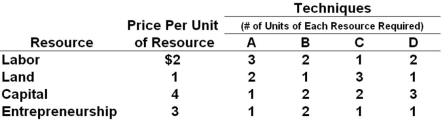 Refer to the above table. At the $3 price for labor the most efficient technique will result in an:
 (Multiple Choice)
4.8/5 (81)
(81) Government bailouts of failing businesses, like banks during the recent economic crisis, will tend to reduce the motivation among entrepreneurs to make prudent decisions is dealing with business risk.
(True/False)
5.0/5 (66)
(66) The market system is said to be characterized by "consumer sovereignty." This is because:
(Multiple Choice)
5.0/5 (93)
(93) If economic profits in a particular industry increase, then we would expect:
(Multiple Choice)
4.8/5 (63)
(63) In a market system, entrepreneurs start up businesses in order to earn a high salary.
(True/False)
4.7/5 (69)
(69) An increase in the demand for a product and a reduction in its costs of production would:
(Multiple Choice)
4.8/5 (69)
(69) In a market system, the task of assessing and managing the business risk of a firm is taken on by the firm's:
(Multiple Choice)
4.9/5 (76)
(76) Laissez-faire capitalism limits the government's economic functions to the following, except:
(Multiple Choice)
4.8/5 (81)
(81) Which is true of an economy which operates entirely through central planning?
(Multiple Choice)
4.8/5 (83)
(83) If a nation restricts trade with other nations, then the most likely effect is:
(Multiple Choice)
4.8/5 (77)
(77) The following table illustrates alternative production techniques for producing 18 widgets that can be sold for $1 each for a total revenue of $18. 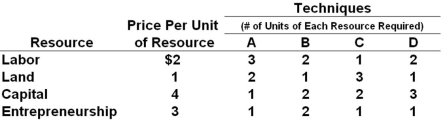 Based on the data given in the table above, the most economically efficient production technique is:
 (Multiple Choice)
4.9/5 (93)
(93) Suppose a firm can produce 70 units of a product, Zenia, by combining labor, land, capital, and entrepreneurial ability, as in the four alternative techniques shown in the table below. Assume further that the firm can hire labor at $3 per unit, land at $3 per unit, capital at $6 per unit, and entrepreneurship at $9 per unit. 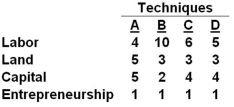 Refer to the above table, and suppose that the firm uses production technique D If each of the 70 units of Zenia that are produced sells for $1 apiece, then how much will be the profits of the firm from 70 units?
 (Multiple Choice)
4.9/5 (91)
(91) The idea that the desires of resource suppliers and firms to further their own self-interest will automatically further the public interest is known as:
(Multiple Choice)
4.9/5 (72)
(72) In the circular flow diagram, firms get their ability to pay for the costs of production from the:
(Multiple Choice)
4.8/5 (73)
(73) The fundamental economic question regarding the distribution of output in the economy is equivalent to the question of who will produce the output.
(True/False)
4.9/5 (79)
(79) The development of the digital video and camera which replaced film cameras is an example of:
(Multiple Choice)
4.8/5 (72)
(72) 
Filters
- Essay(0)
- Multiple Choice(0)
- Short Answer(0)
- True False(0)
- Matching(0)