



 Chat with AI
Exam 11: The Aggregate Expenditures Model

Exam 1: Limits, Alternatives, and Choices212 Questions
Exam 2: The Market System and the Circular Flow141 Questions
Exam 3: Demand, Supply, and Market Equilibrium202 Questions
Exam 4: Market Failures: Public Goods and Externalities155 Questions
Exam 5: Governments Role and Government Failure148 Questions
Exam 6: An Introduction to Macroeconomics123 Questions
Exam 7: Measuring Domestic Output and National Income157 Questions
Exam 8: Economic Growth114 Questions
Exam 9: Business Cycles, Unemployment, and Inflation143 Questions
Exam 10: Basic Macroeconomic Relationships142 Questions
Exam 11: The Aggregate Expenditures Model143 Questions
Exam 12: Aggregate Demand and Aggregate Supply152 Questions
Exam 13: Fiscal Policy, Deficits, and Debt164 Questions
Exam 14: Money, Banking, and Financial Institutions130 Questions
Exam 15: Money Creation127 Questions
Exam 16: Interest Rates and Monetary Policy174 Questions
Exam 17: Financial Economics136 Questions
Exam 18: Extending the Analysis of Aggregate Supply135 Questions
Exam 19: Current Issues in Macro Theory and Policy134 Questions
Exam 20: International Trade151 Questions
Exam 21: The Balance of Payments, Exchange Rates, and Trade Deficits152 Questions
Exam 22: The Economics of Developing Countries135 Questions
Select questions type


A rightward shift of the investment demand curve translates into an upward shift of the investment schedule in the aggregate expenditures model.
(True/False)
4.8/5  (85)
(85) What is the likely result from a depreciation of a nation's currency when its economy is already operating at its full-employment level of output?
(Multiple Choice)
4.9/5 (74)
(74)  Refer to the graph above for a private closed economy. At the $150-billion level of GDP:
 (Multiple Choice)
4.9/5 (89)
(89) One major point that Keynes raised pertains to income and spending. He argued that:
(Multiple Choice)
4.8/5 (74)
(74) If the MPC is 0.80, all taxes are lump-sum taxes, and the equilibrium GDP is $25 billion below the full-employment GDP, then the size of the recessionary expenditure gap is:
(Multiple Choice)
4.8/5 (73)
(73) If a lump-sum tax of $40 billion is levied at each level of income and the MPC is 0.75, then the saving schedule will shift:
(Multiple Choice)
4.8/5 (83)
(83) All figures below are in billions of dollars.  Refer to the table above. When there is no investment in this private closed economy, the equilibrium level of GDP will be:
 (Multiple Choice)
4.8/5 (61)
(61) In a recessionary expenditure gap, the equilibrium level of real GDP is:
(Multiple Choice)
4.9/5 (82)
(82) If actual investment exceeds planned investment in a private closed economy, then:
(Multiple Choice)
4.7/5 (89)
(89) In the Great Recession of 2007-2009, the Federal government enacted a "stimulus package" that was intended to bring inflation down.
(True/False)
4.8/5 (94)
(94) The table shows a private closed economy. All figures are in billions of dollars.  Refer to the table above. If the real rate of interest is 2%, then the equilibrium level of GDP will be:
 (Multiple Choice)
4.8/5 (82)
(82) If a government raises its expenditures by $50 billion and at the same time levies a lump-sum tax of $50 billion, the net effect on the economy will be to:
(Multiple Choice)
4.9/5 (73)
(73) Saving is $15 billion at the $125 billion equilibrium level of output in a closed, private economy. Actual investment must be:
(Multiple Choice)
4.9/5 (84)
(84) A recessionary expenditure gap is the amount by which aggregate expenditures must increase in order to reach the full-employment level of GDP.
(True/False)
4.8/5 (93)
(93) In a private closed economy, the equilibrium condition for the economy is:
(Multiple Choice)
4.9/5 (81)
(81) To close an inflationary expenditure gap of $20 billion in an economy with a marginal propensity to consume of 0.8, it would be necessary to:
(Multiple Choice)
4.8/5 (96)
(96) All figures in the table below are in billions.  Refer to the above data. The equilibrium level of GDP in this private open economy is:
 (Multiple Choice)
4.8/5 (97)
(97) A decrease in taxes will have a larger effect on equilibrium GDP if the marginal propensity to consume is smaller.
(True/False)
4.9/5 (77)
(77) The following data show levels of planned variables for an economy. Ig = Investment; Sa = Saving after taxes; G = Government spending; T = Taxation; X = Exports; M = Imports. What is the equilibrium level of domestic output? 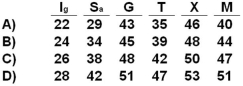
(Multiple Choice)
5.0/5 (83)
(83) In the aggregate expenditures model, the consumption schedule is shown to be:
(Multiple Choice)
4.7/5 (86)
(86) 
Filters
- Essay(0)
- Multiple Choice(0)
- Short Answer(0)
- True False(0)
- Matching(0)